










IndiaMART InterMESH Limited accepts 10%-15% enquiry loss
Key highlights
- IndiaMART reported Q2 FY27 consolidated revenue of Rs 429 crore, up 10% year on year.
- Customer collections rose 9% year on year to Rs 443 crore in Q2 FY27.
- Consolidated EBITDA reached Rs 159 crore in Q2 FY27, representing a 37% margin.
- BUSY reported Q2 billing of Rs 46 crore, up 20% year on year, and revenue from operations of Rs 37 crore, up 27%.
powered by IRIS
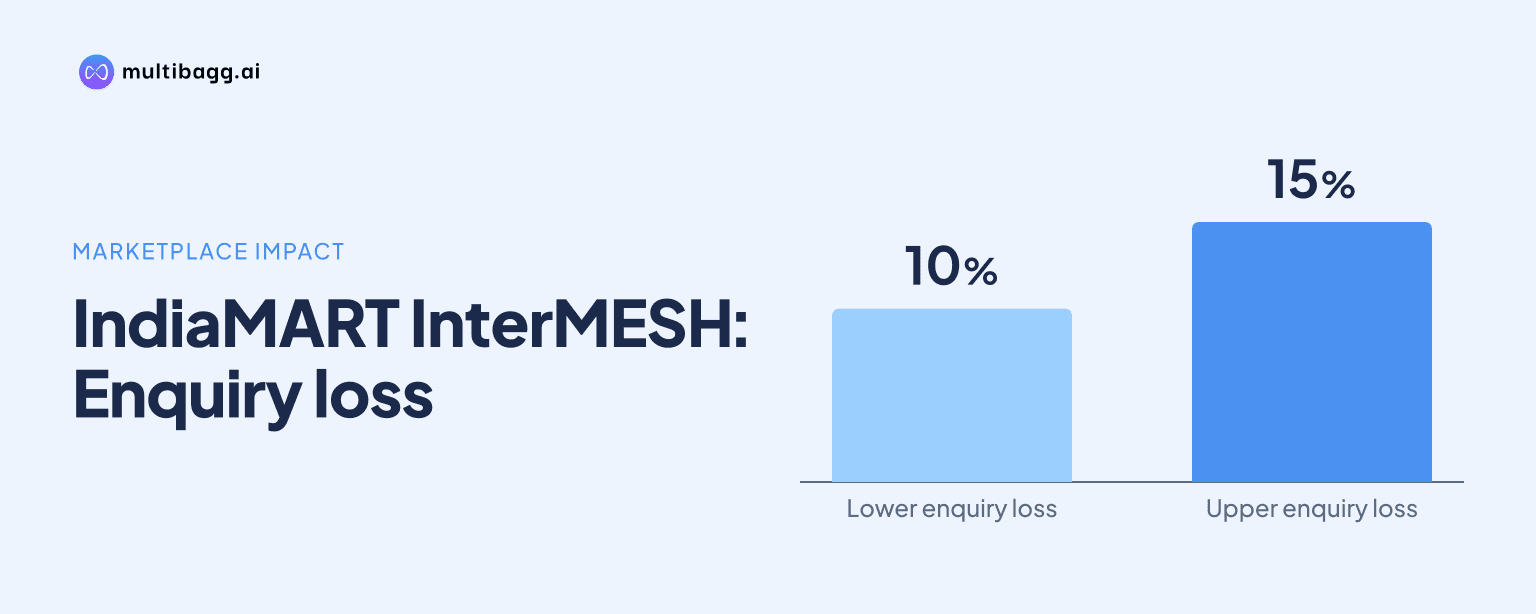
IndiaMART InterMESH Limited said it has accepted a 10%-15% decline from its best-ever business-enquiry levels after restricting access to selected proprietary information. Management said the policy reflects a decision to protect strategic data from search engines and large language models, even as Q2 FY27 consolidated revenue from operations rose 10% year on year to Rs 429 crore.
Know Indiamart Intermesh inside out
Results, valuation, peers and who's buying, in one view.
Why is IndiaMART allowing business enquiries to decline?
IndiaMART is accepting some enquiry loss because management considers parts of its marketplace information strategic and proprietary. It said active buyers and daily unique business enquiries had declined a little over the past two quarters after it put more information behind login, restricted unlimited scraping without login and stopped displaying selected information to search engines and large language models, or LLMs.
Management linked the decision to developments during the January-February-March period, when LLM-based agent activity increased. It said Google AI Overviews had expanded from about 10%-20% to 50% or more of searches, contributing to lost Google landing traffic. IndiaMART said it was prepared to give up 10%-20% of current business enquiries rather than distribute strategic data freely while data protections remain unsettled.
The reported business remained larger year on year despite this traffic pressure. IndiaMART recorded 27 million unique business enquiries in Q2 FY27, consolidated revenue of Rs 429 crore and customer collections of Rs 443 crore. Management said the reduction in enquiry activity was partly deliberate, rather than solely the result of a change in buyer demand or search-engine algorithms.
How much enquiry traffic has IndiaMART lost from its peak?
IndiaMART said the decline was about 10%-15% from its best-ever enquiry highs, although it saw some growth in Q2 from Q1. The company did not disclose the Q1 absolute enquiry total, but its Q2 FY27 result included 27 million unique business enquiries. Management attributed the movement both to its restrictions on data access and to the wider shift towards AI-led search results.
The traffic trend contrasts with the company’s reported financial growth in Q2 FY27. Consolidated revenue from operations increased 10% year on year to Rs 429 crore, customer collections increased 9% to Rs 443 crore, and deferred revenue rose 16% to Rs 2,029 crore. The comparison indicates that revenue and collections rose while management described lower active-buyer and daily-enquiry activity over the preceding two quarters.
IndiaMART’s paying supplier base was 217,000 at the end of Q2 FY27, down by 615 suppliers during the quarter. Management attributed the net decline primarily to elevated churn in the Silver subscription tier. Platinum and Gold customers accounted for about 50% of the customer base and about 75% of revenue, according to management.
Where is IndiaMART spending to replace lost enquiries?
IndiaMART is focusing advertising, time and spending on the top quartile of its roughly 100,000 categories, where management said the largest amount of business takes place. It plans to use search advertising in those categories to generate more enquiries and buyer leads, while also expanding to other media.
This approach prioritises categories with the highest business activity rather than retaining unrestricted search visibility for all platform data. Management did not provide an enquiry-recovery target or timetable. It said the outcome could not be known on a month-on-month or quarter-on-quarter basis because the technology shift is moving faster than users’ adoption of AI tools.
Management said the environment could remain volatile for a couple of quarters to a couple of years. It described technology changes as occurring over months and quarters, while the eventual effect on users, buyers and sellers may take years to emerge. IndiaMART’s stated response is to protect selected data while directing spending towards categories that matter most to its business.
Got a follow-up? Ask IRIS
What data could IndiaMART share with AI companies?
IndiaMART said it could provide redacted, non-personally identifiable information, or non-PII data, for model training if there is an opportunity to earn revenue. Management distinguished this from identifiable information, which it said should not be made available freely for training by anyone and everyone.
Management also separated model training from retrieval-augmented generation, or RAG, and from AI agents. For RAG, it said IndiaMART would need to determine which counterparties are useful for which purposes. For agents, management said it was still assessing which agents to permit and at what frequency, meaning no broad data-sharing arrangement or final access policy has been announced.
The company said there is a wider fight for data, but management did not forecast whether the enquiry loss would increase or reverse. It said nobody could reliably predict the steady-state outcome over the next couple of quarters or years. Its position is that data treatment should differ depending on whether it is used for training, RAG or agent-led activity.
How is IndiaMART using AI across its business?
IndiaMART said it has more than 20 AI deployments or initiatives across pre-sales, data preparation, sales meeting fixation, service-ticket resolution, catalogue production, category mapping, category audits and user verification. Its voice AI agent has served about 80,000 to 100,000 buyers daily for more than a year, with buyer leads and requests for quotation, or RFQs, posted live on the platform.
Management said these deployments can create cost, intelligence and time benefits, but did not quantify their contribution to revenue, margins, buyer retention or supplier additions. It said the company generally uses external models, including Gemini, Claude, ChatGPT, Gemma, Alibaba Qwen and Grok, rather than developing models internally, although some capabilities may be built when required.
IndiaMART has also started backend integration work involving BUSY, Livekeeping and IndiaMART. Management said it had initially left BUSY unchanged for the first three years after its acquisition, then began making changes at BUSY during the last two years. BUSY reported Q2 billing of Rs 46 crore, up 20% year on year, and revenue from operations of Rs 37 crore, up 27%.
Management said it would not press for gross supplier additions until it had a better handle on Silver-tier churn. This policy follows the 615-supplier quarterly reduction in the Q2 FY27 paid base of 217,000. The company said growth over the past two years had been flatter in total customer numbers, with more growth coming from average revenue per user, or ARPU, and upselling.
Conclusion
IndiaMART has made the near-term trade-off explicit: it is accepting a 10%-15% reduction from peak enquiry levels to retain control over data it regards as proprietary. Q2 FY27 nevertheless showed 10% revenue growth to Rs 429 crore, 9% collection growth to Rs 443 crore and consolidated earnings before interest, tax, depreciation and amortisation, or EBITDA, of Rs 159 crore at a 37% margin.
Next, investors can watch whether spending in the top quartile of about 100,000 categories offsets lost search traffic and whether management creates paid arrangements for redacted training data or RAG access. Management also identified improved Silver-tier churn as the condition for accelerating gross supplier additions after the Q2 FY27 supplier base fell by 615 to 217,000.