










IndiaMART prioritises Silver retention over supplier growth
Key highlights
- IndiaMART’s 12-month Silver supplier retention is 10% below its level four or five years ago.
- The Silver supplier base has remained flat for about two years, limiting Gold and Platinum supplier growth.
- Gold and Platinum suppliers represent about 50% of customers but approximately 75% of revenue.
- IndiaMART’s paid demand-generation spending was approaching Rs 10 crore per quarter, with paid activity contributing about 10% of traffic.
powered by IRIS
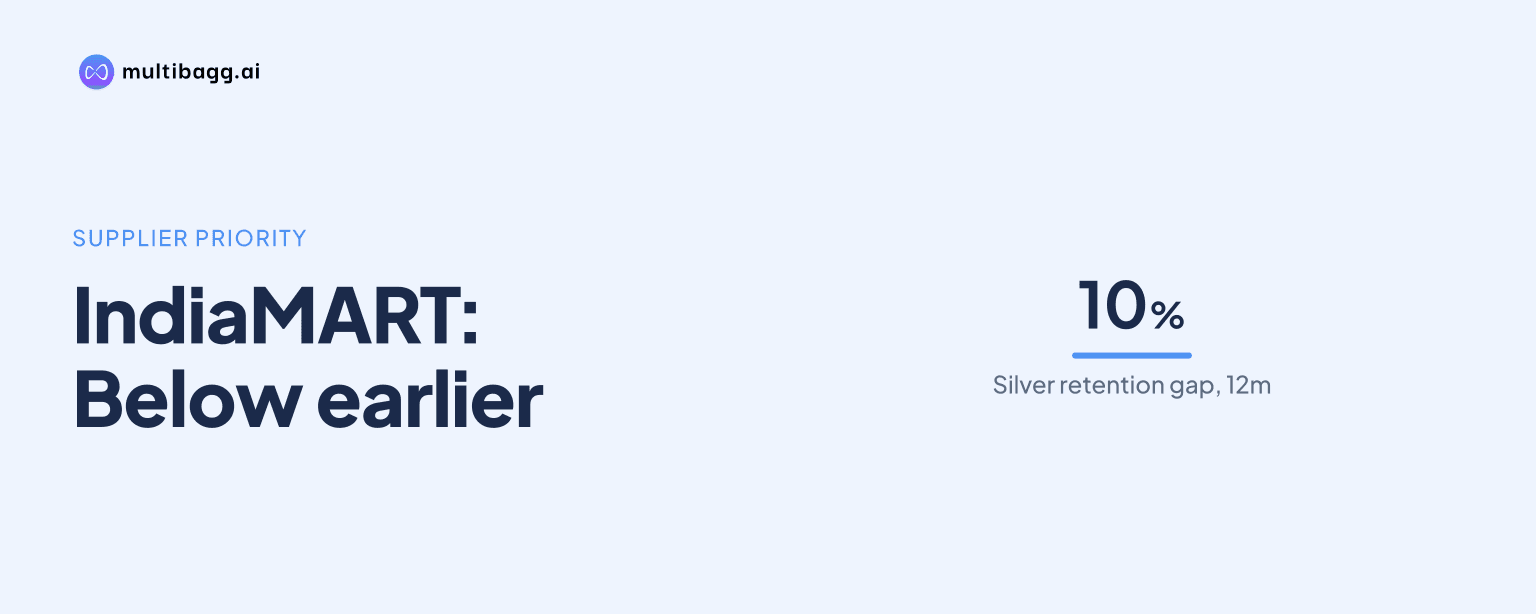
IndiaMART InterMESH Limited is prioritising more selective Silver supplier acquisition and retention after 12-month Silver retention was 10% lower than four or five years earlier. Management said this shortfall has kept the Silver base flat for about two years and also left Gold and Platinum supplier numbers stagnant.
Know Indiamart Intermesh inside out
Results, valuation, peers and who's buying, in one view.
Why is IndiaMART prioritising Silver retention over supplier growth?
IndiaMART is focusing on retention because management identified weaker Silver supplier retention as the reason the overall subscriber base has not improved for roughly two years. The company said stagnant Silver numbers have in turn kept Gold and Platinum supplier numbers flat, limiting the pool that feeds its higher-tier plans.
Management said it does not want to pursue every similar prospective Silver supplier. Instead, IndiaMART is seeking to identify suppliers more likely to remain on the platform and progress to Gold or Platinum, using turnover, industry and geography as targeting factors. This is a change in acquisition emphasis rather than a disclosed halt to supplier acquisition or a numerical acquisition target.
The company quantified the issue as a 10% decline in Silver suppliers’ 12-month retention compared with four or five years ago. Management said that without this difference, IndiaMART would have been looking at 10% volume growth and 10% value growth; this was management’s assessment of the retention impact, not forward guidance.
What has IndiaMART done to reduce Silver churn?
IndiaMART says it first improved service levels over the past three years because many employees were new, then concentrated during 2024 and 2025 on the quality of buy leads and requests for quotation, or RFQs. The work covered high-intent enquiries, quantities, specifications, relevance and customer feedback.
Management said suppliers responded positively to better leads and RFQs, but Gold and Platinum suppliers captured most of the benefit because they are the larger users of those services. Silver suppliers received some benefit, but their 12-month retention still remained 10% below the level of four or five years earlier.
The company also cited TrustSEAL verification, trust communications and a trust-assurance programme. Under that programme, buyers are protected for purchases up to Rs 5 lakh when they buy from TrustSEAL suppliers through verified bank accounts. IndiaMART said the measures are intended to improve trust and repeat business, although the greatest benefit has so far accrued to Gold and Platinum suppliers.
Can Gold and Platinum growth offset weaker Silver retention?
IndiaMART said average revenue per user, or ARPU, has naturally grown by 5% to 10%, supporting revenue growth of about 8% to 10%. Management said it does not want to rely only on price and mix, however, and would rather improve the quality of Silver acquisition to replenish Gold and Platinum onboarding.
Gold and Platinum suppliers account for approximately 50% of IndiaMART’s customer base and about 75% of revenue, according to management. The comparison shows why better lead quality can support revenue despite a flat total supplier base, but it also shows the dependence of future higher-tier growth on a healthier Silver pipeline.
The tier comparison is important because Gold and Platinum suppliers use buy leads, RFQs and enquiries more intensively than Silver suppliers. As a result, management said the improvements made in 2024 and 2025 disproportionately helped higher-tier customers while the Silver retention issue remained unresolved.
Got a follow-up? Ask IRIS
Is IndiaMART using paid demand generation to support retention?
IndiaMART is using paid demand generation selectively to attract more targeted business buyers rather than maximise paid traffic as a share of all enquiries. Management said advertising spending had been running at Rs 8 crore to Rs 9 crore a quarter during the prior year and was approaching a Rs 10 crore quarterly budget, mainly directed at the top quartile of categories.
Management estimated that about 10% of traffic now comes from paid activity, or roughly 1 million enquiries each month and about 3 million in a quarter. It compared this with 26 million to 27 million unique business enquiries, while noting that paid activity can create 20% to 40% cannibalisation depending on the area.
Paid campaigns are being targeted by category, geography and customer characteristics, typically with a Tier 1 and Tier 2 city mix and some Tier 3 presence. Management gave an example of spending Rs 10,000 a month on a small segment and said IndiaMART may double investment once it has a better handle on the model; that is conditional management commentary, not a committed budget increase.
When does IndiaMART expect Silver churn to improve?
IndiaMART has given no timeline or forecast for a recovery in Silver retention. Management said it had stopped providing guidance on the issue over the past two or three years because it lacked certainty on when the various initiatives would result in a better outcome.
The company is also experimenting with buyer verification and buyer monetisation, rather than operating a scaled paid buyer programme. IndiaMART said it has started seeking mobile, Permanent Account Number, or PAN, goods and services tax, or GST, and Udyam details from buyers, while testing a verified business-buyer proposition that could involve charges of Rs 1,000 to Rs 10,000 annually.
Management said any buyer monetisation experiment would need to scale automatically before it provides a substantive update. IndiaMART added more than 30 employees in the latest quarter from the preceding quarter, mostly on the business side, which management characterised as business as usual rather than a separate Silver-retention hiring programme.
Conclusion
IndiaMART’s stated problem is not a lack of initiatives but the uneven outcome from them: service, lead-quality, paid-demand and trust measures have improved the marketplace experience, while the larger benefit has gone to Gold and Platinum suppliers. With Silver retention 10% below its level four or five years earlier, the entry-level supplier pool has remained flat for about two years and constrained higher-tier subscriber growth.
The next measure to watch is whether more selective Silver acquisition by turnover, industry and geography changes retention and supplier counts. Management has not set a recovery date, while paid-demand spending was approaching Rs 10 crore a quarter and any increase beyond that remains contingent on better results from targeted campaigns.