










IndiaMART may double paid marketing spend as targeting improves
Key highlights
- Paid marketing contributes approximately 10% of IndiaMART’s traffic, or about 1 million buyer enquiries per month.
- IndiaMART’s paid campaigns may cannibalise 20% to 40% of traffic that would otherwise arrive through other channels.
- Advertising expenditure was running at Rs 8 crore to Rs 9 crore per quarter and approaching a Rs 10 crore quarterly budget.
- Gold and Platinum suppliers represent approximately 50% of IndiaMART’s customers and about 75% of revenue, while Silver retention is 10% below its level four or five years ago.
powered by IRIS
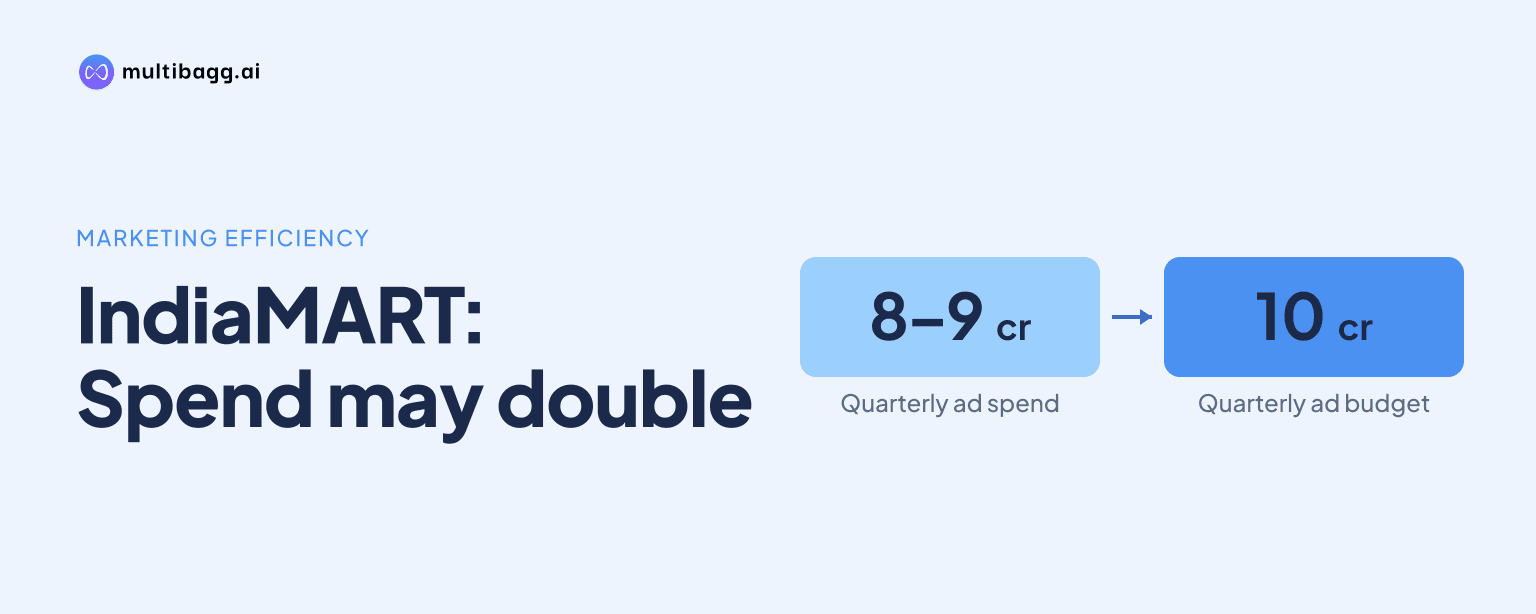
IndiaMART InterMESH Limited says paid marketing supplies approximately 10% of its traffic, or about 1 million targeted buyer enquiries a month. IndiaMART may double investment in the programme after its data-science team improves local targeting by category, geography and demography, while advertising expenditure approaches a Rs 10 crore quarterly budget.
Know Indiamart Intermesh inside out
Results, valuation, peers and who's buying, in one view.
How much IndiaMART traffic comes from paid marketing?
IndiaMART says paid marketing contributes approximately 10% of traffic, with about 1 million buyer enquiries a month, or about 3 million in a quarter. Management discussed this alongside a base of 26 million to 27 million unique business enquiries, describing the paid flow as more targeted than its broader organic traffic.
The paid-traffic figure is a gross measure rather than a confirmed net addition to buyer acquisition. Management said paid advertising can result in 20% to 40% cannibalisation, depending on the area, meaning some users acquired through campaigns may otherwise have arrived through non-paid channels.
IndiaMART distinguished the breadth of its organic activity from the narrower paid programme. Organic traffic covers about 100,000 categories, Tier 1, Tier 2 and Tier 3 cities, and both Goods and Services Tax, or GST, registered and non-GST buyers; paid activity is concentrated in the top quartile of categories.
How is IndiaMART targeting paid buyer campaigns?
IndiaMART is targeting campaigns through small combinations of category, geography and demography rather than seeking broad national reach. Management said a segment defined by all three variables may receive Rs 10,000 a month, allowing the company to assess the outcome of highly localised matching before allocating more spending.
The company said it reviews where money is spent, the traffic received, conversion, industry and enquiry quantities. Its model requires local fulfilment between buyer and supplier, which management contrasted with Amazon's ability to fulfil demand nationally or regionally across many categories.
IndiaMART said it does not aim for paid advertising to account for 20% of its approximately 10 million monthly unique buyers. Management instead said it would prefer a lower proportion of paid traffic if that traffic is more useful than normal organic traffic, particularly within higher-priority categories and Tier 1 and Tier 2 markets.
Will IndiaMART double its paid marketing spend?
IndiaMART said it may double the investment in paid marketing once it has a better handle on the targeted-campaign model. This was a conditional management statement, not formal spending guidance, and management did not give a timetable for reaching that point.
Management said advertising expense had been running at Rs 8 crore to Rs 9 crore a quarter during the last year and was nearly reaching a Rs 10 crore quarterly budget. Most of that spending was directed to the top quartile of categories, rather than spread across all 100,000 categories on the platform.
A potential increase would follow further testing of category-geography-demography combinations. Management said the campaigns are becoming more sophisticated, and the Rs 10,000 monthly segment-level approach is intended to establish the relevance and conversion of traffic before it considers a larger investment.
Got a follow-up? Ask IRIS
How does paid acquisition connect with supplier retention?
IndiaMART is pursuing targeted buyer acquisition alongside measures intended to improve outcomes for suppliers, including its Silver tier. Management said it first improved service levels, then worked during 2024 and 2025 on buy-lead and request-for-quotation, or RFQ, quality through buyer intent, quantity, specifications, enquiry relevance and feedback.
Management said most of the benefits from better buy leads, RFQs and enquiries accrued to Gold and Platinum suppliers because they are the heaviest users of those services. IndiaMART also reduced the number of unique business buyers to whom an enquiry is delivered, aiming to lower supplier competition and the number of parties a buyer needs to contact.
Trust measures form another part of the programme. IndiaMART said buyers are protected for purchases of up to Rs 5 lakh when a transaction uses verified bank accounts and TrustSEAL suppliers, although the call did not quantify the number of transactions or suppliers covered by this assurance.
What is the position of Gold, Platinum and Silver suppliers?
IndiaMART said Gold and Platinum suppliers account for approximately 50% of its customer base and about 75% of revenue. Platinum customer numbers rose by about 1,000 to 2,000 in the last year, compared with about 3,000 in the preceding year, while management did not disclose a combined Gold-and-Platinum customer count.
Management is trying to identify Silver customers more likely to remain and move to Gold or Platinum by using turnover, industry and geography as targeting factors. However, IndiaMART said overall Silver numbers have not improved over roughly two years, and Gold and Platinum numbers have therefore remained stagnant.
Silver suppliers' 12-month retention is 10% lower than it was four or five years ago, according to management. IndiaMART said this difference is what separates the present outcome from a potential 10% volume-growth and 10% value-growth scenario, but it has stopped giving guidance on when Silver churn could improve.
Conclusion
IndiaMART's paid-marketing programme remains a targeted addition to broad organic acquisition, rather than a plan to maximise the paid share of traffic. The company is accepting possible 20% to 40% cannibalisation in return for enquiries that management considers more relevant by category, location and buyer profile, while its supplier initiatives have so far delivered more benefit to Gold and Platinum tiers.
The next disclosed milestone is management gaining a better handle on its local campaign model, which could support doubling investment from a budget nearing Rs 10 crore a quarter. Silver retention remains the unresolved issue: IndiaMART reported a 10% decline versus four or five years ago and gave no timing guidance for improvement.