










IndiaMART deploys voice AI for up to 100,000 buyers daily
Key highlights
- IndiaMART’s voice AI agent serves about 80,000 to 100,000 buyers daily and has operated at that scale for more than 1 year.
- IndiaMART has deployed more than 20 AI applications across areas including pre-sales, catalogue design, category mapping and service-ticket resolution.
- IndiaMART has begun backend data and technology integration across IndiaMART, BUSY and Livekeeping, but has not set a commercial rollout timetable.
- Management expects AI’s effects on revenue, costs and buyer behaviour to remain volatile over the next 2 to 4 years, while retaining a long-term EBITDA margin target of 33%.
powered by IRIS
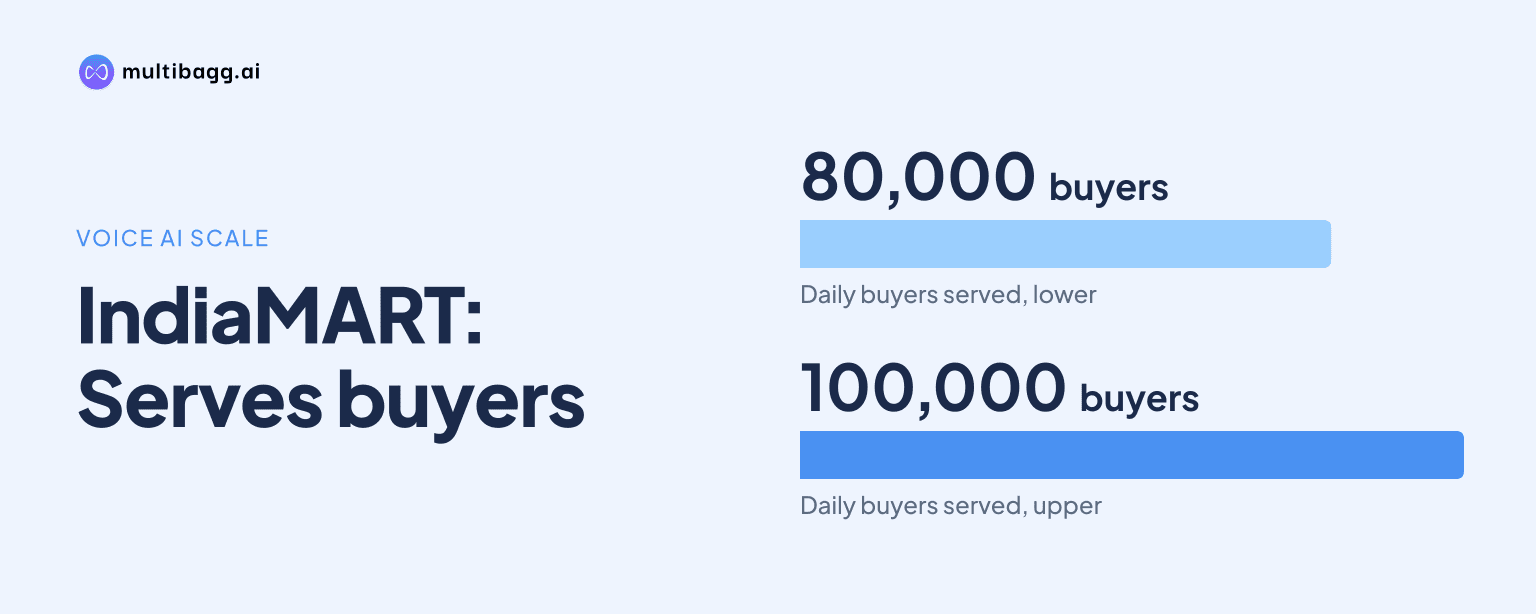
IndiaMART says its voice artificial intelligence, or AI, agent has served about 80,000 to 100,000 buyers each day for more than a year, with buyer leads and requests for quotation posted live on its platform. IndiaMART has also begun backend data and technology integration across IndiaMART, BUSY and Livekeeping, although management gave no timetable or quantified outcome.
Know Indiamart Intermesh inside out
Results, valuation, peers and who's buying, in one view.
How many buyers does IndiaMART’s voice AI serve each day?
IndiaMART says its voice AI agent serves about 80,000 to 100,000 buyers daily. Dinesh Chandra Agarwal said the deployment had operated at that scale for the past year, while related buy leads and RFQs, or requests for quotation, had been posted live on the IndiaMART platform for more than a year.
This is management’s clearest quantified measure of customer-facing AI use. Agarwal described the system as a large-scale deployment rather than an experiment, but IndiaMART did not disclose lead conversion, buyer satisfaction, resolution rates or the share of its total buyer traffic served by the voice agent.
IndiaMART placed the voice system among more than 20 AI applications. The disclosed uses include pre-sales, data preparation, sales meeting fixation, service-ticket resolution, catalogue design, category mapping, category audits, user verification and category intelligence, with management citing cost, intelligence and time benefits rather than one measured financial result.
Where has IndiaMART deployed AI beyond voice operations?
IndiaMART says AI is deployed across its processes, not only in buyer conversations. Agarwal said IndiaMART has used AI since 2018, with deployment expanding across “every process” and “every place” over the past two to three years, and characterized the work as continuous deployment and improvement.
BUSY 21 and the BUSY Magic platform provide one software example. Agarwal said their user experience, or UX, was designed using AI-based technologies about nine months before the call, while IndiaMART used videos instead of slides at its board meeting on the day of the call after discovering that approach about one month earlier.
IndiaMART uses multiple external models rather than relying on one proprietary foundation model. Management named Gemini, Claude, ChatGPT, Gemma, Alibaba Qwen and Grok, saying its general preference is not to develop models in-house because that is not its core operating area, though some internal development may be necessary.
How is IndiaMART integrating BUSY and Livekeeping?
IndiaMART says it has begun backend work on data exchanges and technology integration across IndiaMART, BUSY and Livekeeping. Management said it first made changes within BUSY over the past two years and is now assessing what data and technology links can be established across the three platforms.
The process follows a staged approach after the BUSY acquisition. IndiaMART said it initially decided not to alter BUSY for its first three years because it was the company’s first large acquisition; after learning how BUSY worked during the following two years, it began making changes within the business.
Management did not identify the data fields to be exchanged, products to be connected or a commercial rollout date. Agarwal said there were many potential actions, but that the pace of technology change and number of market participants made the next two to three quarters, and the next two to three years, difficult to predict.
Got a follow-up? Ask IRIS
Why is IndiaMART limiting data access for AI systems?
IndiaMART says it has restricted access to strategic and proprietary information because large language models, or LLMs, can absorb data and present results in their own words. The company has added login requirements, sought to limit scraping and stopped displaying some information on search engines and to LLMs.
Management said it had accepted a 10% to 15% decline from its best-ever levels of daily business enquiries and active buyers. Agarwal linked part of that decline to IndiaMART’s data-protection choices and part to Google AI Overviews expanding from 10% or 20% to 50% or more of searches, as described on the call.
IndiaMART said it is focusing spending on the top quartile of its 100,000 categories, where management says the most business occurs. The company uses search advertising to seek more enquiries and buyer leads in those categories, while saying it may expand to other media.
Management distinguishes between data used for model training, retrieval-augmented generation, or RAG, and autonomous agents. Agarwal said redacted non-personally identifiable information could be provided for training where there is a revenue opportunity, but decisions on RAG partners, permitted agents and permitted access frequency remain unresolved.
What financial effect does IndiaMART expect from AI?
IndiaMART says AI’s net effect on revenue, costs and buyer behaviour could remain volatile over the next two to four years. Management said the technology creates opportunities that were previously unavailable, but also distributes similar capabilities to the public, and did not assign any revenue, churn or margin figure to AI.
In the short run, management expects the cost of experimentation and keeping pace with technology to add to expenses. IndiaMART said it expenses manpower, AI research and software costs immediately across IndiaMART, BUSY, Livekeeping and IIL Digital, rather than capitalising them, except for genuine capital items such as fixed assets where required.
IndiaMART’s long-term earnings before interest, tax, depreciation and amortisation, or EBITDA, margin guidance remains 33%. Management said quarterly margins are not directly comparable because costs are incurred upfront while revenue follows over an 18-month period, and savings from AI may be redirected to other opportunities.
Conclusion
IndiaMART has disclosed an operating AI deployment with measurable scale, serving 80,000 to 100,000 buyers daily through its voice agent for more than a year. Its broader strategy combines more than 20 AI applications with tighter control over proprietary data and the early-stage integration of its marketplace, BUSY and Livekeeping systems.
The next issue to watch is whether backend integration produces measurable changes in buyer-supplier fulfilment, retention or growth. Management said it will not press hard on gross customer additions until Silver-level churn improves, while it has not set an integration timetable and expects AI’s commercial effect to remain volatile over the next two to four years.