








Indian Car Ownership: GST Now Runs From 18% to 40%
Max Plan at ₹4,999/yr₹8,999

Find your next multibaggerBe a Pro Investor
Research stocks and track your picks on the go. Download the app.
Key highlights
- GST is stated at 18% for small cars and 40% for larger, luxury and SUV segments after 22 September 2025.
- Electric vehicles remain taxed at 5%, while the earlier compensation cess has been removed.
- Private-car road-tax examples range from 2.5% in a listed Daman and Diu band to 22% in a listed Kerala band.
- Cars with invoice values above Rs.10 lakh attract 1% TCS at purchase.
powered by IRIS
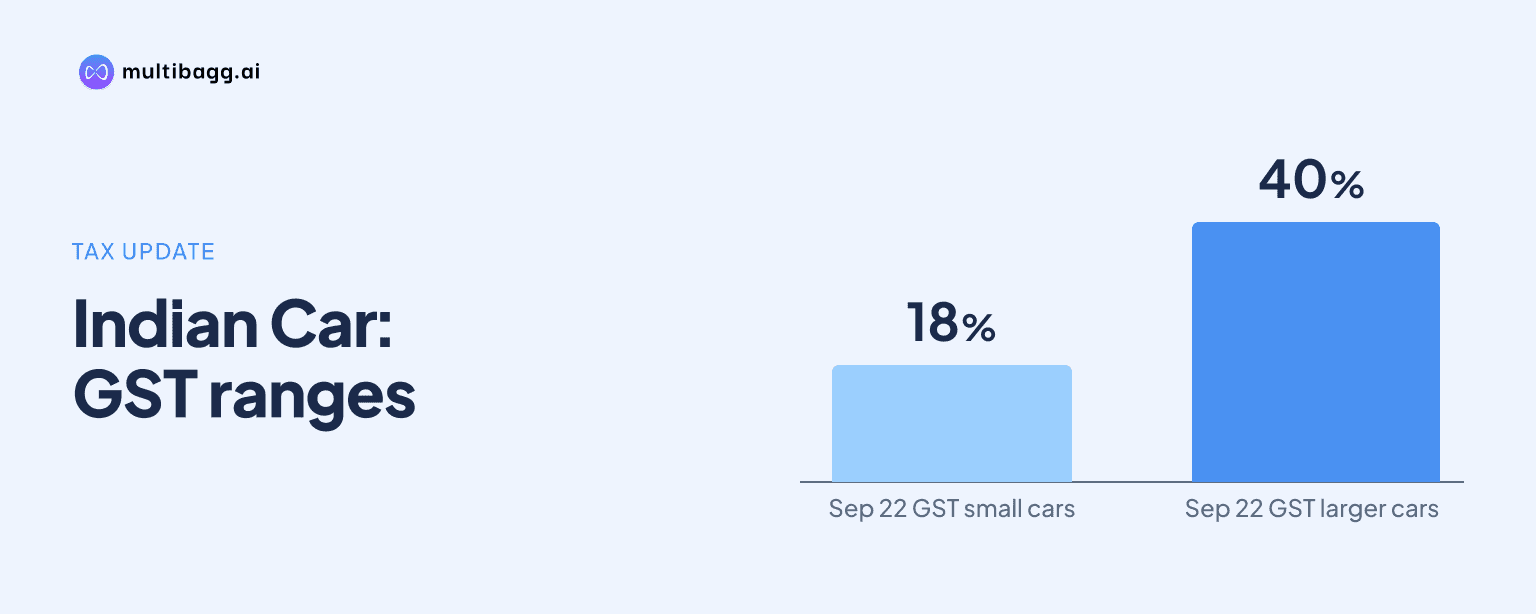
Indian car ownership now carries GST primarily at 18% for small cars and 40% for larger, luxury and SUV segments under the structure effective after 22 September 2025, while the final on-road bill also includes state road tax, registration and compulsory insurance. EVs remain taxed at 5%.
What GST applies to Indian car ownership now?
Indian car ownership is subject mainly to 18% GST for small cars and 40% for larger, luxury and SUV segments under the post-22 September 2025 framework. The supplied tax structure says the earlier 28% GST plus compensation cess arrangement has been replaced by these simplified slabs, with compensation cess removed completely. Electric vehicles remain at 5%.
This distinction matters because the ex-showroom price already reflects the applicable GST. Older discussions that cite 28% GST and an additional 1% to 22% cess describe the previous structure, rather than the framework said to apply after the September 2025 reforms. Imported cars brought in as completely built units can also attract customs duty of 60% to 100%, depending on engine size and whether the cost, insurance and freight value is below or above $40,000.
Why is the on-road price higher than the ex-showroom price?
Car ownership costs more than the ex-showroom price because the on-road price adds road tax, registration, insurance and other applicable charges. The discussion estimates an approximate 10% gap between ex-showroom and on-road price in one broad illustration, although the actual difference depends substantially on the registration state, vehicle type and insurance value.
Road tax is a state-level levy, commonly paid when a new vehicle is purchased, and is also called motor vehicle tax, VAHAN tax or Parivahan tax. The supplied material cites Section 39 of the Motor Vehicle Taxation Act 1988 as requiring vehicle owners to pay road tax. It also notes that the amount varies by engine capacity, fuel type, ex-showroom price and state of registration.
Registration and allied charges add to the bill as well. The standard private-vehicle registration fee is listed at Rs.600. A FASTag costs about Rs.500 to Rs.600, while hypothecation charges of Rs.1,500 apply to loan-funded purchases. HSRP figures in the supplied material range from about Rs.400 to Rs.1,500, so buyers should seek an itemised dealer quotation rather than assume a single national amount.
Got a follow-up? Ask IRIS
How much does state road tax change car ownership costs?
Car ownership costs can differ sharply across states because lifetime road-tax rates vary by price band, fuel and local rules. The supplied state data shows examples ranging from 2.5% for cars up to Rs.10 lakh in Daman and Diu to 22% for cars up to Rs.20 lakh in Kerala, alongside other state-specific surcharges and fees.
For example, Maharashtra lists private petrol-car road tax from 11% for cars up to Rs.10 lakh to 13% for cars above Rs.20 lakh, with diesel rates higher in the cited bands. Karnataka lists 13% for cars up to Rs.5 lakh and up to 18% for cars above Rs.20 lakh, with road-tax cess and infrastructure cess calculated cumulatively at 11% of calculated road tax. Tamil Nadu's listed private rates range from 12% to 20% by price band.
A buyer should therefore compare the same model's on-road quotation in the state where it will be registered. Some entries also identify charges such as temporary registration, municipal parking fees, green tax or an additional tax for a second vehicle, which can further change the payable amount.
What other mandatory costs should buyers budget for?
Car ownership requires upfront insurance alongside taxes and registration, with a new car required to include one year of own-damage cover and three years of third-party liability cover paid at purchase. The supplied material attributes this 1+3 structure to IRDAI requirements following the Supreme Court's 2018 order aimed at reducing uninsured vehicles.
For cars with an invoice value above Rs.10 lakh, dealers must collect tax collected at source, or TCS, at 1% under Section 206C of the Income Tax Act. The discussion describes this as recoverable when the buyer files an income-tax return, rather than a permanent extra cost. Optional spending can also be material: extended warranties are listed at Rs.8,000 to Rs.25,000, while accessories range from Rs.5,000 to Rs.50,000 or more.
The ownership calculation does not stop at delivery. Fuel, maintenance, repairs, insurance renewals, loan interest, tolls and depreciation form part of total cost of ownership. Depreciation is identified in the discussion as the largest single cost that many buyers fail to include in their initial budget.
Conclusion
Indian car ownership involves more than the advertised ex-showroom number. GST is now stated to range from 18% to 40% for most internal-combustion car categories, while state road tax, registration, insurance and financing-related charges determine how much more a buyer pays before taking delivery.
The next item to watch is the exact state-specific road-tax slab and the dealer's itemised on-road quotation for the chosen model. Buyers should also separate compulsory charges from optional accessories or warranty products, and account for insurance, fuel, maintenance, loan interest and depreciation over the period they expect to own the car.

