








Foodlink IPO Values FY26 Earnings at 34.2 Times P/E Ratio
Max Plan at ₹4,999/yr₹8,999

Find your next multibaggerBe a Pro Investor
Research stocks and track your picks on the go. Download the app.
Key highlights
- Foodlink's IPO price band is ₹181 to ₹191 per share, with a minimum application of ₹14,898 at the cap price.
- Foodlink reported FY26 revenue of ₹567 crore, up from ₹377 crore in FY24.
- Foodlink recorded a ₹16.15 crore loss in the six months ended September 2026.
- At ₹191 per share, Foodlink is valued at 34.2 times FY26 basic EPS of ₹5.58.
powered by IRIS
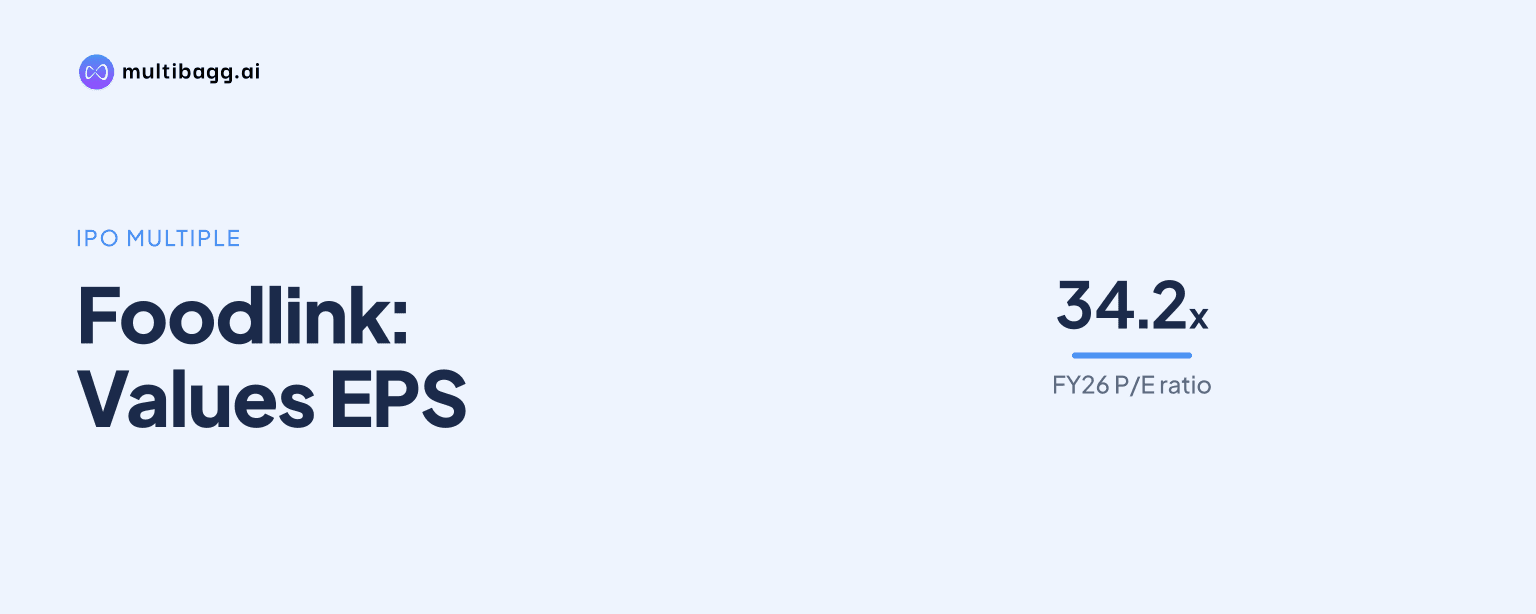
Foodlink F&B Holdings (India) Limited's IPO values FY26 basic earnings at 34.2 times at the upper price band of ₹191, while the company reported FY26 revenue of ₹567 crore and a ₹16.15 crore loss for April to September 2026. The issue pairs a growing luxury catering business with material recent profitability pressure.
What are Foodlink's IPO price, dates and structure?
Foodlink's mainboard IPO has a price band of ₹181 to ₹191 per share and is scheduled to open on November 26, 2026, and close on November 30, 2026. The company is expected to list on the BSE and NSE on December 3, 2026, with the BSE designated as the stock exchange.
The offer combines a fresh issue of up to ₹192 crore with an offer for sale of about ₹169 crore. At the cap price, the total offer is stated at ₹360.76 crore. The lot size is 78 shares, making the minimum application amount ₹14,898 at ₹191 a share. The face value is ₹2 per equity share.
How has Foodlink's business and revenue grown?
Foodlink is described as India's largest organised luxury and ultra-luxury caterer by revenue in FY25, according to the F&S Report. Its operations span luxury wedding catering, banquet venues and restaurant brands including China Bistro, India Bistro and Art of Dum. The company says it can serve more than 30,000 guests at a single event across its three food and beverage verticals.
Sales increased from ₹377 crore on March 31, 2024, to ₹567 crore on March 31, 2026, a 50% rise over two years. Social-media analysis also puts Foodlink's FY24-to-FY26 revenue growth at about 22.65% to 22.66% annually. Its adjusted EBITDA margin reportedly improved from about 8% in FY24 to about 14% in FY26, with another disclosure placing the margin rise at 8.12% to 13.82%.
Why does Foodlink's recent loss matter to IPO investors?
Foodlink reported a ₹16.15 crore loss for the six months from April to September 2026, making the sustainability of its earlier profit growth a central issue for investors. One analysis attributes pressure partly to UAE headwinds, where the UAE unit reportedly posted a ₹22.70 crore loss during the period.
The business is also seasonal, with activity concentrated in the October-to-March wedding and festive period. A slowdown or disruption during these peak months could materially affect annual cash flows. Foodlink has disclosed that a 1% material-cost increase that is not passed to customers would reduce operating profit by roughly 1%, highlighting sensitivity to input costs.
Profitability has not been uniform in prior periods either. The disclosures cited in the discussion include a standalone loss of ₹18.46 crore in FY2024. Investors assessing the interim loss therefore need to consider both the seasonal structure of the business and the execution of overseas and domestic operations rather than relying only on FY26 revenue growth.
Got a follow-up? Ask IRIS
Is Foodlink's IPO valuation supported by reported financial metrics?
Foodlink's upper-band valuation is 34.2 times FY26 basic EPS of ₹5.58, while another offer analysis calculates diluted FY26 EPS-based valuation at 33.03 times at the floor price and 34.85 times at the cap price. These measures indicate that the issue price places a relatively high multiple on the reported FY26 earnings.
Other cited metrics add context but do not remove the uncertainty around earnings. One analysis reports a post-issue price-to-book value of 4.34, EPS of negative ₹3.10 and net asset value of ₹16.06, while another places return on equity at 7.17%. The latter compares this with 33.80% for Travel Food and 14.80% for Jubilant FoodWorks, though investors should note these are comparisons across different businesses.
Foodlink's operating profit was stated to cover interest expense 3.2 times. At the same time, disclosures cited ₹25.35 crore of borrowings, past covenant breaches that could lead to acceleration or enforcement, and ₹4.51 crore of contingent liabilities. The combination means valuation analysis should be considered alongside balance-sheet and cash-flow risks.
What will Foodlink use the fresh-issue proceeds for?
Foodlink plans to use fresh-issue proceeds for capital expenditure on two proposed centralised kitchens and two proposed banquets, alongside repayment of borrowings. These plans are directly tied to the company's stated expansion strategy and balance-sheet objectives.
The planned projects also carry execution risk. Discussions around the offer flag potential delays, approvals issues and cost overruns, as well as unfinalised expansion sites. Foodlink also faces the risk of unprofitable outlets, so the eventual benefits of new kitchens and banquets depend on timely commissioning and profitable operations rather than the capital-spending plan alone.
Conclusion
Foodlink brings a leading reported position in organised luxury catering, FY24-to-FY26 revenue growth and an improvement in adjusted EBITDA margin to the IPO market. However, the ₹16.15 crore loss in the six months ended September 2026, UAE losses, seasonal demand concentration and a valuation of 34.2 times FY26 basic EPS make earnings consistency a key consideration.
Investors should watch the progress of Foodlink's two proposed centralised kitchens and two proposed banquets, the use of fresh proceeds for repayment of borrowings, and whether performance improves through the October-to-March peak season. The RHP, financial statements, project timelines and risk factors remain important sources for evaluating the offer before the November 30, 2026 close.

