








India Faces Proposed 25% US Tariff Without Trade Deal
Max Plan at ₹4,999/yr₹8,999

Find your next multibaggerBe a Pro Investor
Research stocks and track your picks on the go. Download the app.
Key highlights
- The US has proposed tariffs of up to 25% on Indian goods without a trade agreement.
- India’s proposed tariff rate would be capped at 17% if it signs a trade deal with the US.
- The proposed deal-linked rate is 8 percentage points below the maximum no-deal rate.
- The USTR process includes public comments until January 5 and a hearing on January 25.
powered by IRIS
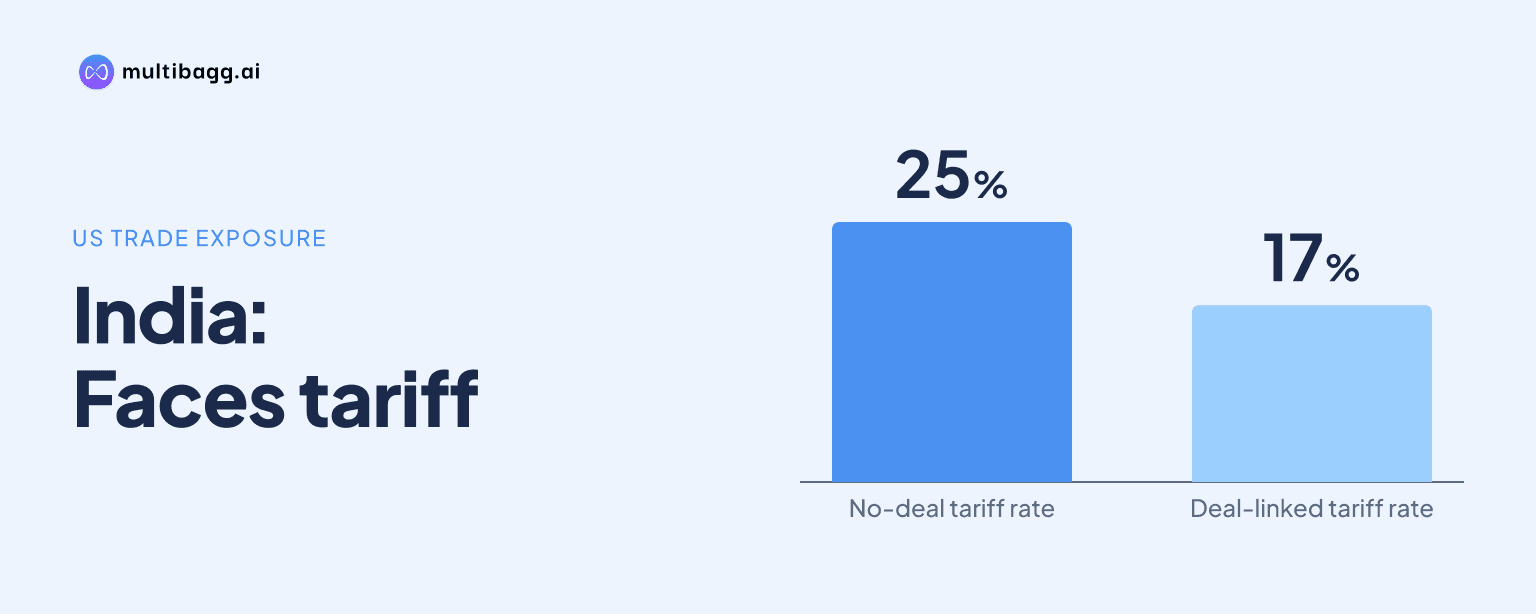
India could face a proposed US tariff of up to 25% on its goods under a Section 301 excess-capacity investigation, while the rate would be capped at 17% if India signs an Agreement on Reciprocal Trade with Washington. The proposal remains subject to the US review process and has not set a final effective date.
What tariff has the US proposed for India?
The United States has proposed tariffs of up to 25% on Indian goods after an investigation into what it describes as structural excess capacity and manufacturing production. The US Trade Representative said India’s relevant policies and practices are unreasonable and burden or restrict US commerce.
The proposal covers all goods of India, subject to exemptions for certain products and existing tariff provisions. The USTR language says the action would be applied net of existing Section 301 tariffs. Reporting cited in the discussion also says a senior US trade official indicated that only the higher rate would apply to exporters, rather than tariffs being added together.
The proposed action is not yet a final tariff decision. The USTR has invited public comments until January 5 and scheduled a hearing for January 25 before considering submissions and finalising its action. The final rate and the date on which any duties could take effect therefore remain open.
How could a US-India trade deal lower the tariff?
India could receive a 17% tariff cap if it finalises the interim trade deal still being negotiated with the United States. The proposed lower rate is linked to an Agreement on Reciprocal Trade that addresses the findings of the USTR investigation.
That creates a clear difference between the two outcomes in the US proposal. Without an agreement, Indian goods could be subject to a rate of up to 25%. With an agreement, the stated rate would be 17%, an 8-percentage-point reduction from the maximum no-deal rate.
The discussion around the proposal has treated the tariff framework as part of the broader trade negotiations. India has said it remains committed to an early bilateral agreement with Washington. However, neither the provided material nor the USTR proposal establishes that a deal has been completed.
Got a follow-up? Ask IRIS
Which Indian sectors are named in the excess-capacity review?
The US investigation identified potential excess capacity or export surpluses in seven Indian sectors: solar modules, petrochemicals, steel, textiles, health-related goods, construction materials and automobiles. These sectors are central to the US allegation concerning manufacturing capacity and production.
The proposal itself is broader than that sector list because it refers to tariffs on all goods of India, with certain exemptions. The available information does not specify which products would be exempt, which individual products would face the maximum rate, or how any final product-level treatment would be determined.
For exporters and investors, that distinction matters. The seven sectors indicate where the investigation identified concerns, while the proposed tariff framework describes a country-level action. Until the USTR completes its process, the practical exposure of particular Indian companies and product categories is unresolved.
Why has India rejected the US excess-capacity allegation?
India has rejected the US claim of structural excess manufacturing capacity and said trade concerns should be addressed through negotiations. The Commerce Ministry said the allegations were under examination while reiterating India’s commitment to fast-track a bilateral trade agreement.
The US action follows an eight-month Section 301 investigation covering 16 economic jurisdictions, including India. The wider review concerns structural excess capacity and production in manufacturing sectors, rather than India alone. Other economies cited in the material include China, the European Union, Singapore, Switzerland, Indonesia, Malaysia, Cambodia, Thailand, Korea, Vietnam, Taiwan, Bangladesh, Japan, Norway and Mexico.
India’s stated position means the dispute has two tracks: it contests the underlying allegation, while continuing to pursue a negotiated trade arrangement that could limit the proposed tariff rate to 17%. The outcome will depend on the US review and on whether the two countries can finalise an agreement.
Conclusion
The immediate issue for India is a proposed US tariff range with a defined negotiation incentive: up to 25% without a trade agreement and 17% with one. The proposal is significant because it applies to Indian goods broadly, while the US investigation specifically flags seven manufacturing-related sectors. It is not yet a final measure, and India has formally rejected the excess-capacity characterisation.
The next milestones disclosed in the process are the January 5 deadline for public comments and the January 25 USTR hearing. Investors and exporters will need to watch for final USTR terms, including exemptions and an effective date, as well as any announcement on the still-negotiated India-US trade deal.

