










Indian Initial Public Offerings: GMP Favors Mainboard IPOs
Key highlights
- GMP predicted listing direction correctly in 98 of 123 non-zero 2026 signals, or 79.67%.
- Mainboard GMP directional accuracy was 88.24%, versus 73.61% for SME IPOs.
- A 294-IPO review found 69% of listings within 10 percentage points of GMP.
- One 2026 summary reported 81 of 161 SME IPOs below their issue price and 24 down 50%.
powered by IRIS
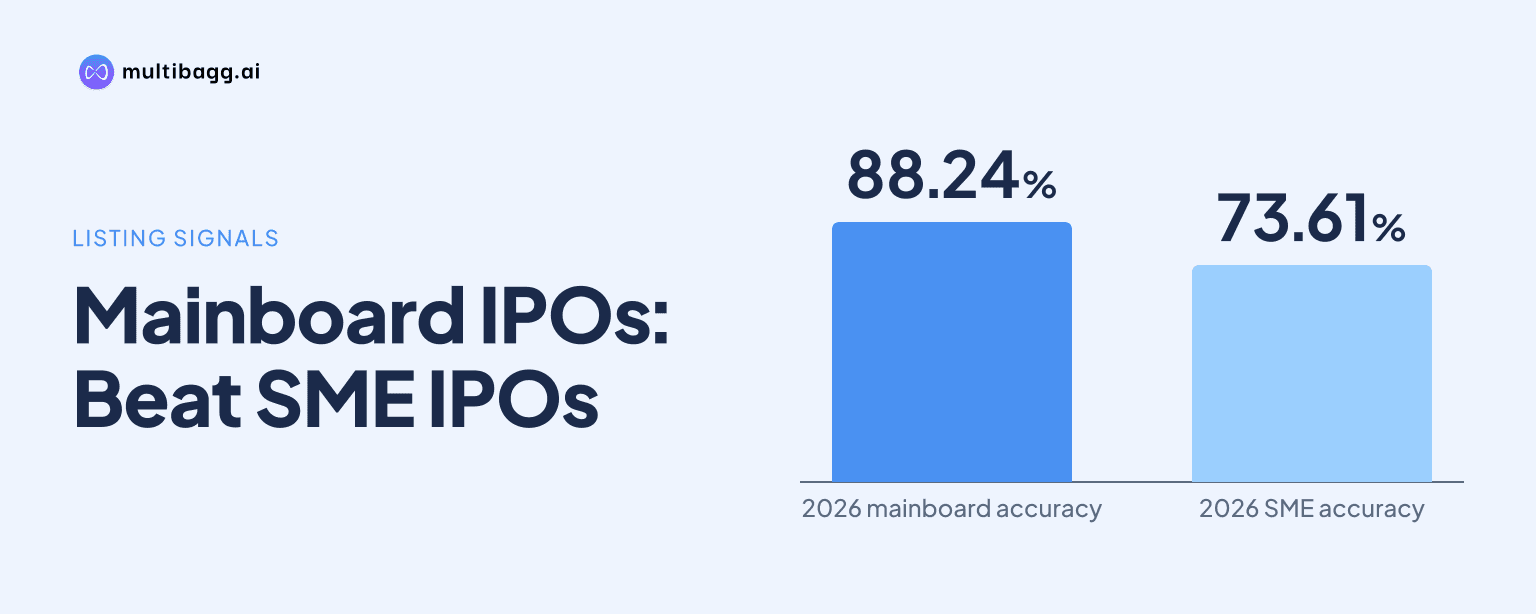
Indian initial public offerings show that GMP was more dependable for mainboard issues than SME issues in 2026: it predicted listing direction correctly in 88.24% of mainboard signals versus 73.61% of SME signals in a 123-IPO non-zero-GMP sample. The available tracking also shows that GMP is an informal sentiment measure, not a confirmed listing-price forecast.
How accurate was GMP for Indian IPO listings in 2026?
GMP was directionally useful in the shared 2026 datasets, but it was not consistently accurate enough to forecast the exact listing gain. In one comparison of 123 IPOs with a non-zero GMP signal, the direction was correct for 98 issues, or 79.67%. The same analysis found an average GMP of 12.46% against an average listing gain of 11.24% across 178 IPOs.
A separate review of 294 issues listed from 2 January to 28 October reported a correlation of 0.88 between GMP percentage and listing-gain percentage. Its median miss was zero, but the typical miss was still 8.6 percentage points. That study found 51% of IPOs within 5 percentage points of their GMP and 69% within 10 percentage points. These figures support using GMP as a broad signal, rather than as a precise target price.
Why was mainboard GMP more reliable than SME GMP?
Mainboard GMP was more reliable because the shared trackers recorded a higher rate of correct directional calls and smaller deviations from the eventual listing gain. In the 123-IPO sample, GMP direction was correct in 45 of 51 mainboard issues, or 88.24%, compared with 53 of 72 SME issues, or 73.61%.
Another review of 117 listings reached a similar conclusion. It found that 72.2% of mainboard IPOs listed within 10 percentage points of GMP, against 35.6% of SME IPOs. The median GMP-to-actual gap was 6.1 percentage points for mainboard issues and 16.5 percentage points for SME issues. Posts discussing the data attribute the wider SME variation to thinner grey markets that may be easier to distort.
Got a follow-up? Ask IRIS
How did SME IPOs perform after their issue price in 2026?
SME IPO performance after listing was uneven, with about half of the issues cited in the social-media data trading below their issue price. One shared summary said 161 SME IPOs had raised Rs 7,171.18 crore in 2026, with 81 trading below issue price and 24 losing 50% of their value. It put the median SME return at negative 0.2%.
That weak post-issue snapshot differs from some listing-day comparisons, which showed stronger average opening gains for SME issues. For example, the 123-signal dataset recorded an average SME listing gain of 22.19%, higher than the 13.63% average for mainboard issues. The distinction matters: a strong listing-day opening does not establish sustained performance after listing. The cited data also said only 32% of mainboard IPOs were below issue price, compared with about 50% of SME IPOs.
Can investors use GMP as a listing-price forecast?
Investors can use GMP to monitor informal demand and changing sentiment, but they should not treat it as a listing-price forecast. GMP is not regulated by the Securities and Exchange Board of India, the National Stock Exchange of India, or the Bombay Stock Exchange. It reflects unofficial market activity and can change before listing.
The error can be material even when the direction is right. In the 117-listing study, a positive GMP was followed by a listing above the issue price 69.8% of the time, while the median gap between GMP-implied and actual listing gains was 8 percentage points. The same review found that average GMP-implied gains were 22.4%, above the 19.3% average actual gain. Subscription levels, investor interest and broader market conditions can affect the final opening price.
Conclusion
The 2026 tracking shared across Reddit and social media points to one consistent result: GMP has value as a directional indicator, particularly for mainboard IPOs, but it has a meaningful error margin. SME issues can show higher premiums and stronger average opening gains in selected samples, yet their GMP signals are less dependable and their subsequent trading performance appears more uneven.
Investors should watch the final GMP trend, subscription data and the market backdrop before listing, while separating mainboard and SME comparisons. The unresolved issue is whether an IPO can hold its listing-day gain, especially in the SME segment, where the cited 2026 figures show 81 of 161 issues below their issue price and 24 down 50% from that level.