










Nippon India ETF Gold BeES Leads India's Gold ETF Flows
Key highlights
- Gold BeES attracted USD 1.17 billion in 2025 and ranked 15th globally by gold ETF flows.
- India received USD 4.37 billion of gold ETF inflows in 2025, behind only the United States and China.
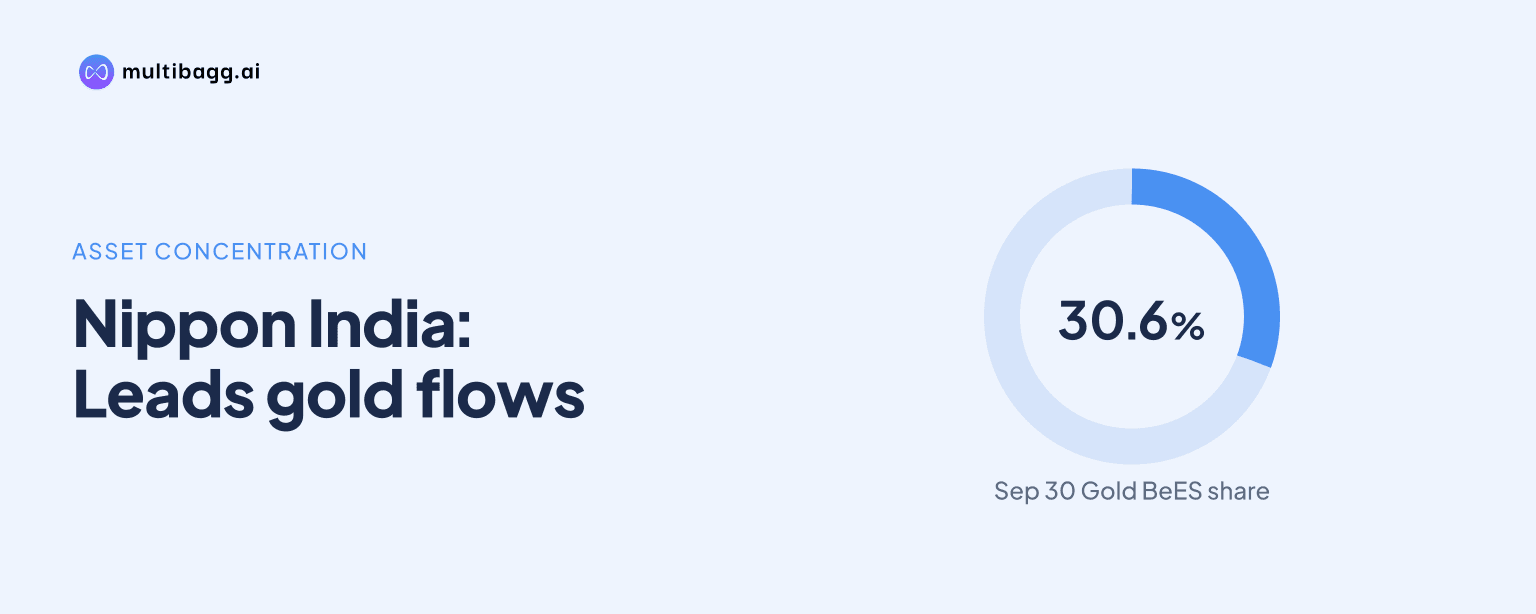
- Gold BeES held ₹56,982 crore, or 30.6%, of India’s ₹1.86 lakh crore gold ETF AUM as of September 30, 2026.
- The five largest gold ETFs controlled ₹1.49 lakh crore, equal to 80.2% of category assets.
powered by IRIS
Nippon India ETF Gold BeES attracted USD 1.17 billion in inflows during 2025, making it India’s largest gold ETF and placing it 15th worldwide by annual gold ETF flows. The result came as India drew USD 4.37 billion of gold ETF inflows, behind only the United States and China.
How large were Gold BeES's 2025 inflows?
Gold BeES received USD 1.17 billion of inflows in 2025 and was the only Indian gold ETF to feature in the global top 20 by flows. The World Gold Council’s December 2025 rankings placed the fund 15th among gold ETFs worldwide. It also led domestic gold ETF flows by a wide margin, according to the supplied data.
The global league table shows the relative scale of demand in the largest overseas products. SPDR Gold Shares was first with USD 23,361 million of inflows, followed by iShares Gold Trust with USD 11,150 million. Gold BeES's ranking nevertheless puts an Indian product in a global fund-flow list that was otherwise led by much larger US vehicles.
India as a market attracted USD 4.37 billion during 2025, making it one of the three largest destinations globally for gold ETF inflows. That national total provides the backdrop for Gold BeES's lead, while also showing that demand was spread across the domestic category rather than confined to one scheme.
Why are Indian gold ETF assets concentrated?
Indian gold ETF assets are concentrated because five schemes held 80.2% of the category’s ₹1.86 lakh crore AUM as of September 30, 2026. Gold BeES was the largest, with ₹56,982 crore, or 30.6% of total assets, according to ICRA Analytics.
The other four large schemes were ICICI Prudential Gold ETF, SBI Gold ETF, HDFC Gold ETF and Kotak Gold ETF. Together with Gold BeES, they managed ₹1.49 lakh crore. The concentration remains notable because ICRA Analytics found that returns across schemes were broadly close, indicating that performance alone did not explain where assets were held.
As of September 30, the five largest ETFs reported one-year CAGRs between 27.2% and 27.5%, while other schemes with a full year of history ranged from 26.1% to 28.1%. Investors should treat return figures from different snapshots carefully, as performance periods and market levels can differ.
Got a follow-up? Ask IRIS
Why do gold ETF returns differ if they track gold?
Gold ETF returns differ because schemes tracking the same domestic gold price incur different expenses and tracking differences. A gold ETF is an exchange-traded mutual fund scheme designed to provide returns linked to domestic gold prices, subject to scheme expenses and deviations from its benchmark.
Tracking error measures the consistency with which an ETF follows its benchmark. It is based on the standard deviation of the differences between fund returns and benchmark returns. The supplied data notes that physical gold backing is of 99.5% purity and that funds broadly track the same domestic gold benchmark, so costs and tracking execution become important points of comparison.
The available comparison also illustrates that longer-period returns need not be identical. UTI Gold ETF was cited with a 0.29% tracking error and an approximately 1.0% annual tracking difference over one, three and five years. Invesco Gold ETF was cited with a 0.45% tracking error and a five-year tracking difference of -1.12%.
Costs outside the published expense ratio can also affect an investor’s outcome. The context identifies making charges, tax differences and hidden costs as factors that may reduce realised gains. Trading activity and fund scale can also differ materially even where the underlying gold-price direction is similar.
What do the latest gold ETF flows and assets show?
The latest data show continuing inflows into Indian gold ETFs, even as a fall in domestic gold prices reduced assets in October. AMFI data cited in the context showed September net inflows of ₹44.5 billion, or USD 466.2 million, the highest level in seven months, with nearly 3 tonnes added to holdings.
Cumulative holdings reached 124 tonnes after the September additions. During the first half of October, estimated net inflows were ₹17.22 billion, equivalent to around 1.2 tonnes. However, category AUM fell 2.5% month on month to ₹1,863 billion, or USD 19.5 billion, largely because domestic gold prices declined 7% during that month.
Gold ETFs accounted for 2.25% of overall mutual fund AUM in the cited period, marginally lower than 2.27% in January 2026. The flow data therefore points to ongoing investor buying even when mark-to-market changes in gold prices reduce the rupee value of category assets.
Conclusion
Gold BeES's USD 1.17 billion of 2025 inflows and global rank of 15 underline its position at the centre of India’s expanding gold ETF market. Yet the wider category data show that investors are choosing among products with broadly similar gold-linked returns, while assets remain heavily concentrated in the largest five schemes.
Investors should watch whether fresh direct ETF demand continues after the reported suspension of new gold Fund of Funds subscriptions in mid-October. Direct gold ETF investments and existing systematic investment plans were unaffected, but Fund of Funds hold around one-third of Indian gold ETF assets, so the restriction could slow future inflows.