










Indian Rupee Gains 1.9% in Week as RBI Curbs Dollar Demand
Key highlights
- Indian rupee gained 1.9% in the week, its strongest weekly advance in seven months.
- The rupee was reported to close at 94.96 per US dollar, below 95 for the first time in 38 days.
- The RBI previously capped banks' net open foreign-exchange positions at $100 million.
- Foreign-exchange reserves were reported at $726.02 billion on October 9, down from $785.7 billion on September 4.
powered by IRIS
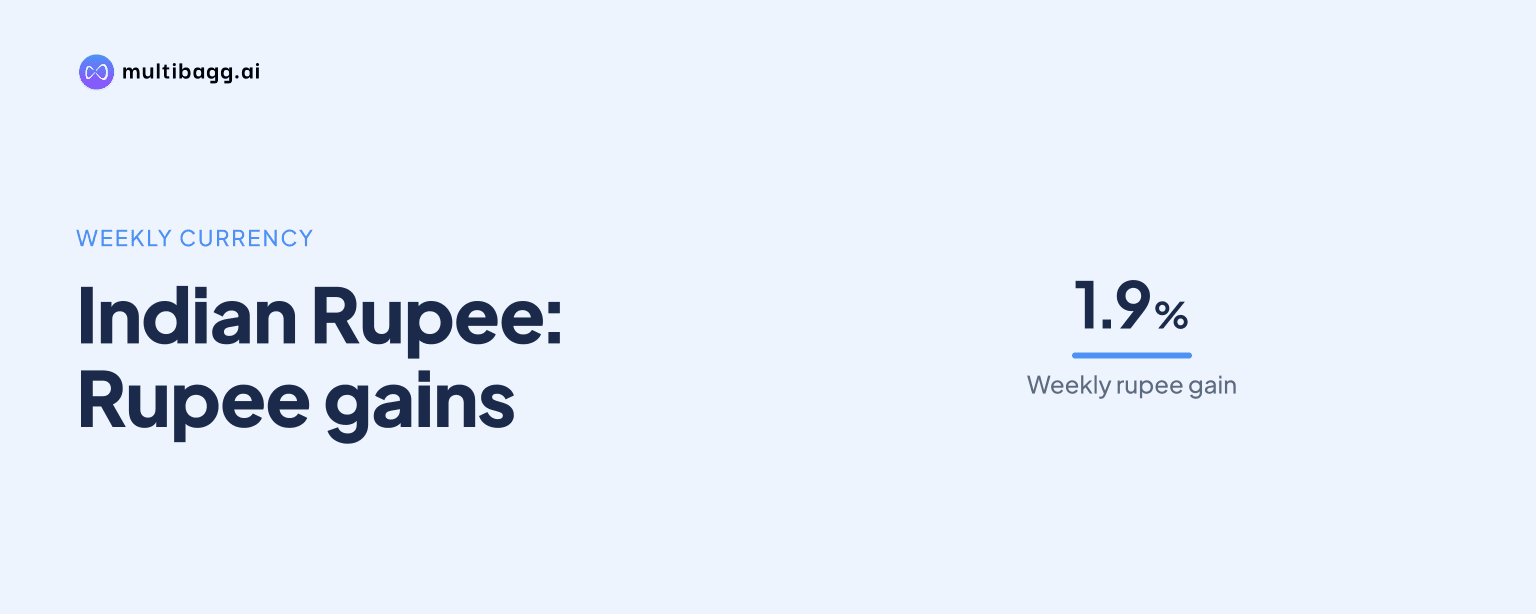
Indian rupee gained 1.9% over the week to close at 94.96 per US dollar, its strongest weekly advance in seven months, as Reserve Bank of India measures curbed immediate dollar demand and a weaker dollar index supported the move. The recovery took the currency below the 95-per-dollar mark after 38 days.
Why did the Indian rupee gain 1.9% this week?
The rupee gained 1.9% during the week as RBI actions reduced demand for dollars in the spot foreign-exchange market and restrained excessive currency positioning. The move was also supported by a weaker dollar index, despite corporate dollar-buying pressure and elevated crude oil prices.
The reported weekly close of 94.96 was the strongest weekly gain for the currency in seven months. Separate market updates also said the rupee rose 33 paise to close at 94.93, while another session saw it appreciate 42 paise to close at 95.36. These moves followed a 93-paise gain on one day, described as the steepest single-day advance in more than six months.
What RBI measures supported the rupee recovery?
RBI measures supported the rupee by easing near-term dollar demand, limiting speculative foreign-exchange exposure and redirecting some purchases away from the spot market. A special foreign-exchange window for state-owned oil refiners was cited as one tool that reduced their reliance on spot-market dollar buying.
The context also cites an FCNR(B) deposit scheme that mobilised additional foreign-currency inflows. In an earlier period of volatility, the RBI capped banks' net open positions at $100 million. Market commentary linked the central bank's actions to a sharp appreciation of 151 paise in one day and said the scale of the recent steps showed urgency in containing speculative activity.
How far has the rupee recovered from recent pressure?
The rupee has recovered from levels near 96.80 towards 95.00, though the reported exchange-rate levels differ across the cited market updates and dates. One report said the currency closed at 94.71 on October 17, compared with 96.73 a week earlier, while another cited an early-trade level of 94.92 after an opening at 95.05.
The recovery matters because the currency had crossed 95 during a volatile period and was reported to have touched an all-time low of 95.22 on March 31 before recovering to 93.19 on April 2. Historical data in the context also places USD/INR at 94.5000 on November 5, 2026, with the rupee stronger by 1.97% over the preceding month but weaker by 6.57% over 12 months.
Got a follow-up? Ask IRIS
What risks could limit further Indian rupee gains?
High crude oil prices, foreign investor outflows, a stronger US dollar and higher US Treasury yields could limit further gains in the rupee. India relies heavily on imported energy, so elevated oil prices increase pressure on the external balance and raise the need for dollars.
Commentary cited oil prices around $105 per barrel, while another account referred to crude above $110 per barrel. Stronger-than-expected US inflation data was also said to have lifted the US dollar and Treasury yields, interrupting the recovery momentum. RBI action can temper speculative pressures and immediate demand, but the context indicates that it cannot fully shield the currency from external conditions.
Which USD/INR levels are being watched after the recovery?
Market commentary identifies 94.70 and 94.20 as support levels for USD/INR, while 95.60 and 96 are cited as resistance. A sustained move below 95 per US dollar was seen as potentially opening a path towards 94.50, although external pressures could restrict the pace of appreciation.
The 94.70 level was described as a 50% Fibonacci retracement of the move from the April low to the October high, while 94.20 was identified as a 61.8% retracement level. Resistance at 95.60 was linked to the 50-day and 100-day moving averages, and 96 to the 21-day moving average. These are market-reference levels, not assurances of future currency moves.
Conclusion
The rupee's 1.9% weekly gain and return below 95 per US dollar indicate that measures to reduce spot-market dollar demand and speculative positioning have provided near-term support. The weaker dollar index and positive domestic-market trend added to the improvement, but the currency remains exposed to factors beyond domestic policy.
The next signals to watch are crude oil prices, the direction of the US dollar, foreign portfolio flows and whether demand for dollars continues to ease. Market participants are also watching the 94.70 and 94.20 support levels, alongside 95.60 and 96 as resistance, after the RBI's recent actions.