










Indian Equity Markets Log Best Week Since 2021, Nifty Up 8.58%
Key highlights
- The Sensex gained 6,568.49 points, or 8.82%, to close at 81,028.02 for the week.
- The Nifty 50 rose 1,977.25 points, or 8.58%, to 25,030.35.
- BSE-listed market capitalisation increased by ₹28.70 lakh crore to ₹5,03,06,833.71 crore.
- Nifty NBFC led sectoral gains with a 13.59% weekly advance.
powered by IRIS
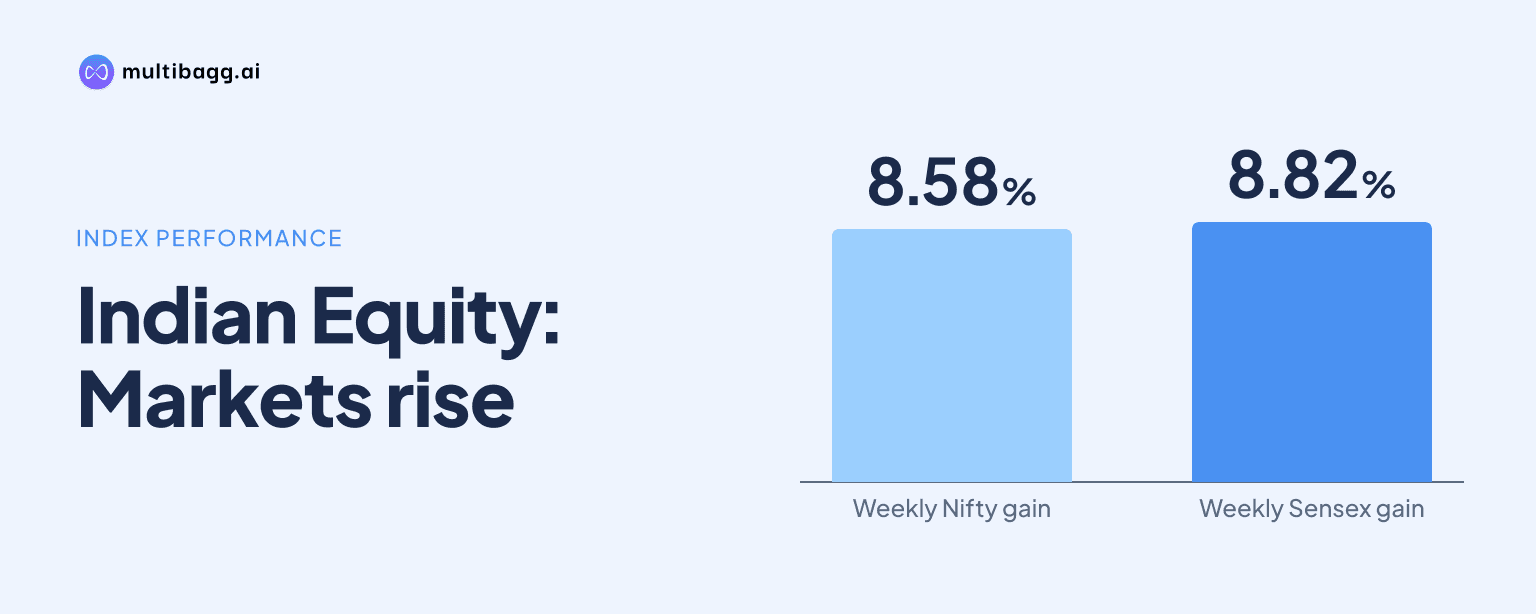
Indian equity markets recorded their strongest weekly rise since February 2021 in the November 2-6, 2026 period, with the Nifty 50 gaining 8.58% to 25,030.35 and the Sensex advancing 8.82% to 81,028.02. Foreign inflows, lower Brent crude prices, a firmer rupee and gains in large-cap stocks supported the move.
Why did Indian markets rally sharply during November 2-6?
Indian markets rallied through all five sessions as foreign institutional investor buying, easing crude prices and currency strength improved sentiment around Indian equities. Strong Q2 FY27 earnings from Reliance Industries, Bharti Airtel and Mahindra & Mahindra were also cited as fundamental support for the advance.
The context also linked the move to a Democratic sweep in the US midterm elections on November 3 and capital being reallocated as India appeared relatively insulated from the global artificial intelligence-related sell-off. Brent crude fell 16% during the week to near $99 a barrel, while the rupee appreciated 1.2% to 93.91 per US dollar. Lower oil prices can reduce India's import bill and ease inflation pressures, while a stronger rupee improves returns for dollar-based investors.
How much did the Sensex and Nifty 50 gain this week?
The Sensex rose 6,568.49 points, or 8.82%, to 81,028.02, while the Nifty 50 added 1,977.25 points, or 8.58%, to 25,030.35. Both benchmarks ended the week at their stated weekly highs after extending their winning run to seven consecutive sessions.
The Sensex started the week at 74,459.53 and rose each day. Its largest one-day move came on Thursday, when it climbed 2,008.61 points, or 2.60%, to 79,310.01. On Friday's Dhanteras session, it gained another 1,718.01 points. The Nifty's weekly range was 23,053.10 to 25,030.35, a span of 1,823 points compared with 731 points in the preceding week.
Which sectors and stocks led the Indian markets advance?
Financials, banking, realty, automobile and consumer shares were among the areas that supported the weekly advance, while private-sector banks led the late-week rally. Finance and pharma were identified as sectoral leaders on November 6, as large-cap stocks provided much of the benchmark strength.
Nifty NBFC was the strongest sector in the supplied weekly data, rising 13.59%. Nifty Capital Markets gained 10.73%, while Nifty IT was the weakest sector index but still rose 1.14%. HDFC Bank was also noted for gaining 16.39% in four sessions from its 52-week low, taking its market capitalisation above ₹12 lakh crore.
The BSE 100, a large-cap benchmark, gained 1.56% on Friday and 6.26% over five trading sessions. That performance underscores how the rally was concentrated in larger companies even as the headline indices delivered their strongest weekly gains in years.
Got a follow-up? Ask IRIS
Did broader Indian markets confirm the benchmark rally?
Broader Indian markets gave mixed signals on Friday, as the Sensex and Nifty 50 gained strongly while mid-cap and small-cap shares faced selling pressure. The final session's breadth was negative in one measure, with 1,037 stocks advancing and 1,769 declining among 2,872 traded stocks.
The Nifty Midcap 100 and Smallcap indices were reported to have fallen about 1% each on November 6. The BSE 250 SmallCap index declined as much as 1.68% intraday before recovering. Other reported breadth measures also showed more declines than advances, highlighting that the week's index gains were not evenly distributed across listed stocks.
This divergence matters because the Nifty 50 and Sensex are heavily influenced by large constituents. A sustained market-wide advance would ordinarily require stronger participation from mid-cap and small-cap stocks, rather than continued dependence on banking and other large-cap names.
What did foreign flows and market value show?
Foreign investor activity was a key part of the weekly narrative, with one reported measure putting cumulative FII net buying at ₹42,980.04 crore over the five trading sessions. Another report in the supplied discussion cited ₹35,781 crore of FII buying, indicating that the reported flow total varied across updates.
BSE-listed companies added ₹28.70 lakh crore in market capitalisation during the week, lifting total value to ₹5,03,06,833.71 crore from ₹4,74,37,038.61 crore in the prior week. The scale of that increase reflected the sharp recovery in benchmark valuations, even though Friday's broader-market participation was uneven.
Conclusion
The November 2-6 advance marked a decisive week for Indian markets: the Sensex climbed 8.82%, the Nifty 50 rose 8.58%, and BSE-listed market value increased by ₹28.70 lakh crore. Lower crude, a stronger rupee, foreign inflows and large-cap earnings created a supportive backdrop, but weakness in smaller shares showed that the rally was not uniform.
Investors will next watch whether foreign buying remains durable, whether Brent crude stays near the reported $99 level, and whether mid-cap and small-cap participation improves. The ability of the Nifty 50 to hold above 25,000 after its highest close since February 27, 2026 will also be a key near-term test.