










Gold Prices in India Could Reach Rs 1.68 Lakh, MOFSL Says
Key highlights
- Motilal Oswal Financial Services projects gold prices at Rs 1.60-1.68 lakh per 10 grams in 6-12 months.
- The brokerage's short-term target is Rs 1.48 lakh per 10 grams, with Rs 1.35 lakh cited as an accumulation zone.
- Indian gold demand rose 24% quarter-on-quarter to 162 tonnes in Q3 2026.
- Indian investment demand for bars, coins and ETFs rose 12% quarter-on-quarter to around 60 tonnes in Q3 2026.
powered by IRIS
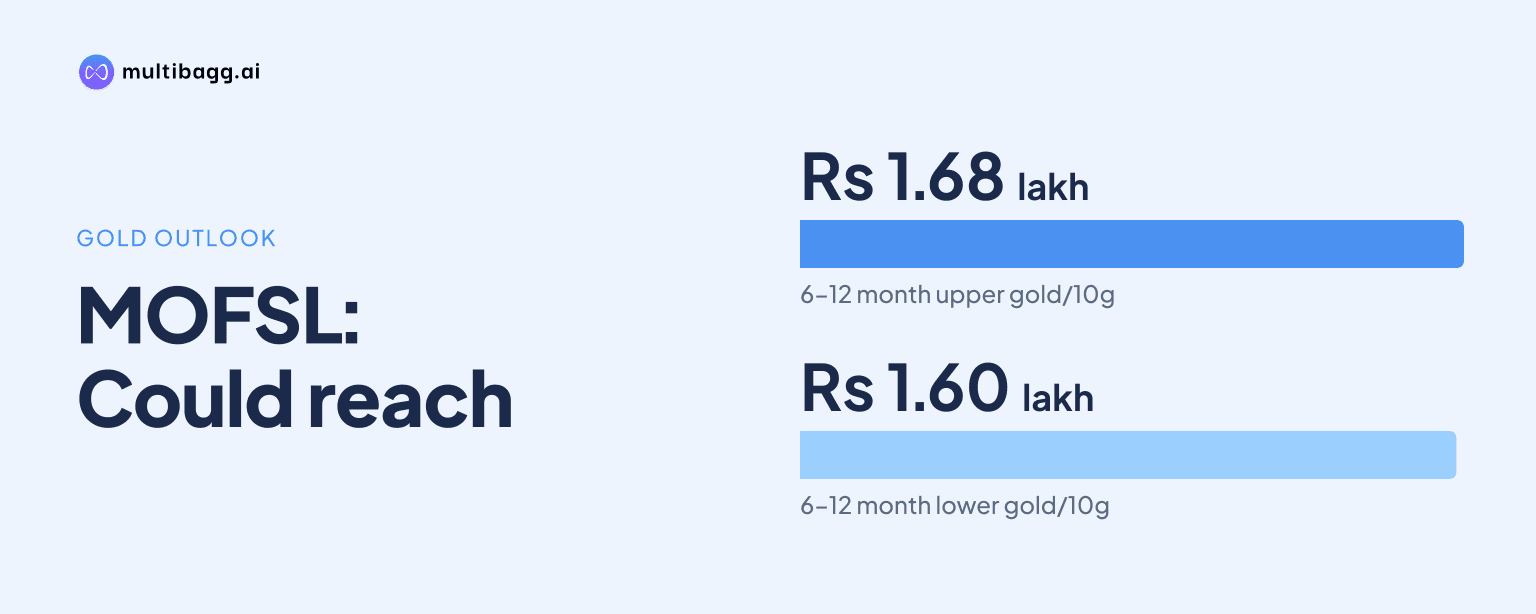
Indian domestic gold prices could rise to Rs 1.60-1.68 lakh per 10 grams over the next 6-12 months, according to Motilal Oswal Financial Services, which cites sustained investment demand and central-bank purchases as key supports. Its outlook assumes a rupee-dollar exchange rate of 96 and places the short-term target at Rs 1.48 lakh.
What is the latest outlook for gold prices in India?
Gold prices are projected by Motilal Oswal Financial Services Ltd to reach Rs 1.60-1.68 lakh per 10 grams in the medium term. The brokerage's precious-metals quarterly report also puts its short-term domestic target at Rs 1.48 lakh per 10 grams. International gold prices, meanwhile, are projected at $4,500-4,700 an ounce over the medium term.
The view is based on continued investment interest and central-bank buying, although the path may not be linear. Elevated US Treasury yields and a stronger dollar have weighed on bullion, according to the outlook cited in market discussions. Those factors can limit gains or create corrections even when the broader demand case remains constructive.
What is supporting the current gold price trend?
Investment demand and central-bank purchases are the main supports identified for gold prices. World Gold Council data cited in the discussion show Indian investment demand, covering bars, coins and ETFs, recovered 12% quarter-on-quarter to around 60 tonnes in the third quarter of 2026. Total Indian gold demand rose 24% quarter-on-quarter to 162 tonnes during the same period.
Domestic pricing is also affected by the rupee, import duty and local physical demand. The international price averaged $4,262 an ounce in the third quarter, down 5% quarter-on-quarter but up 23% year-on-year. Domestic prices averaged Rs 148,891 per 10 grams, down 1% quarter-on-quarter but up 45% year-on-year, with rupee weakness and higher import duty cited as support.
Why could gold prices remain volatile in the near term?
Gold prices could remain volatile because US inflation, bond yields, the dollar and Federal Reserve policy expectations are immediate market drivers. The Federal Reserve kept interest rates unchanged at 3.75%-4.00%, but expectations around a possible December rate increase were described as a factor that could keep bullion range-bound in coming weeks.
Some market views in the discussion place international gold in a $3,900-$4,200 an ounce range and domestic prices at Rs 1.40-1.50 lakh per 10 grams during November. Another cited assessment put MCX gold around Rs 1,43,360 per 10 grams, with a November range of Rs 1.34-1.48 lakh. These ranges underline that the 6-12 month projection should not be treated as a straight-line forecast.
Got a follow-up? Ask IRIS
Are Indian buyers still expecting gold prices to rise?
Indian buyers remain engaged, but expectations of an immediate rise have moderated. The share of respondents expecting prices to increase over the following three months fell to 61% in the second wave of the World Gold Council's Q3 2026 survey, from 69% in the first wave. That shift points to more selective buying rather than a broad withdrawal from gold.
Seasonal demand has improved as festive buying has picked up, narrowing domestic gold discounts to around $2 an ounce. However, high prices may constrain jewellery volumes, and investment demand is described as sensitive to price momentum. A poor monsoon and weakness in the rural economy were also flagged as factors that could temper demand despite the seasonal period.
What levels should gold buyers in India watch?
Gold buyers can watch Rs 1.35 lakh per 10 grams as the accumulation zone identified by Motilal Oswal Financial Services, while Rs 1.48 lakh is its short-term target. Other commentary cited support with buying in the Rs 1.41-1.45 lakh range and resistance at Rs 1.52 lakh, showing that estimates vary across analysts and market conditions.
For people buying for a festival or wedding, the available outlook suggests that a move towards support levels may offer better entry points than reacting to small intraday changes. The rupee-dollar rate matters alongside international bullion prices because it can cushion domestic prices even if global gold weakens. The report's Rs 1.60-1.68 lakh range is conditional on the demand backdrop and currency assumption holding.
Conclusion
The discussion around gold prices combines a constructive medium-term forecast with a clearly volatile near-term setup. Investment demand, central-bank purchases, festive buying and the rupee have supported the domestic market, while stronger US yields and the dollar have limited momentum at times. The differing price ranges cited by market participants reinforce the importance of separating short-term trading moves from a 6-12 month outlook.
The next major signals are US inflation readings, bond-yield and dollar moves, and the December Federal Reserve policy meeting. Indian buyers will also watch whether festive and wedding demand remains firm, whether domestic discounts stay narrow, and whether gold prices hold around the cited Rs 1.35 lakh accumulation level or move toward the Rs 1.48 lakh short-term target.