










Government of India raises nil-tax threshold to Rs 12 lakh
Key highlights
- No income tax is proposed up to Rs 12 lakh under the new regime, excluding special-rate income.
- The nil-tax level for salaried taxpayers is Rs 12.75 lakh after a Rs 75,000 standard deduction.
- The proposed tax rate is 25% for annual income from Rs 20 lakh to Rs 24 lakh.
- Income above Rs 24 lakh is proposed to be taxed at 30% under the new regime.
powered by IRIS
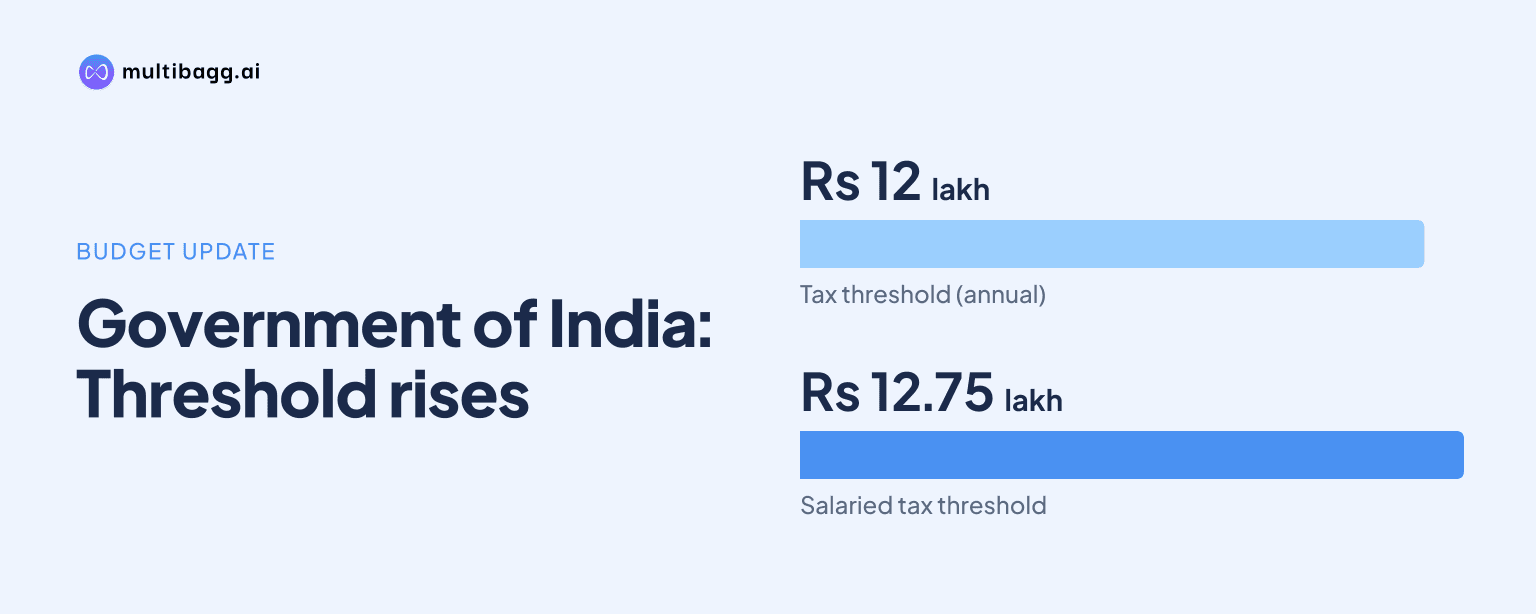
Government of India proposed in Budget 2025-26 that no income tax would be payable on annual income up to Rs 12 lakh under the new tax regime, while the limit for salaried taxpayers would reach Rs 12.75 lakh after the Rs 75,000 standard deduction, excluding special-rate income such as capital gains.
What did the government propose for individual income tax?
The government proposed an across-the-board revision of income-tax slabs and rates under the new tax regime. Finance Minister Nirmala Sitharaman said the structure would provide relief to taxpayers, with a tax rebate designed alongside lower slab rates so that people with income up to Rs 12 lakh would have no tax payable.
For salaried taxpayers, the stated nil-tax limit rises to Rs 12.75 lakh because of the standard deduction of Rs 75,000. The proposal applies to income covered by the regular slab structure. The Finance Minister specifically noted that special-rate income, including capital gains, is outside the Rs 12 lakh statement.
The changes followed reports before the Budget that the government was considering cuts for individuals earning up to Rs 15 lakh a year. Those reports, citing two anonymous government sources, said the scale of any reduction had not been decided before the Budget announcement.
What are the proposed new-regime tax slabs?
The government proposed seven tax bands, beginning with a nil rate up to Rs 4 lakh and rising to 30% on income above Rs 24 lakh. The revised structure changes the income ranges that would be taxed at each rate under the new regime.
The nil-tax outcome up to Rs 12 lakh is not the same as a zero rate across that entire range. The structure includes 5% and 10% slabs, while the government said a tax rebate would ensure no tax is payable up to the stated income level. Taxpayers should therefore distinguish between slab rates and the final tax outcome after the rebate.
How does the Rs 12.75 lakh salaried limit work?
The Rs 12.75 lakh figure reflects the Rs 12 lakh income threshold plus the Rs 75,000 standard deduction available to salaried taxpayers. In practical terms, the government said a salaried individual with annual income at that level could reach taxable income of Rs 12 lakh after taking the standard deduction into account.
This distinction matters because the two figures refer to different starting points. Rs 12 lakh is the income level cited for no income tax under the new regime, while Rs 12.75 lakh is the effective level cited for salaried taxpayers after the standard deduction. The context does not state comparable treatment for every other category of taxpayer.
The Finance Minister linked the revised structure to more money remaining with the middle class, which she said could support household consumption, savings and investment. That was the stated policy objective, rather than a quantified forecast of the measure's economic impact.
Got a follow-up? Ask IRIS
What compliance changes are planned for small taxpayers?
The government also proposed a rule-based automated process for small taxpayers seeking lower or nil tax-deduction certificates. The stated purpose is to reduce the compliance burden and streamline tax procedures for individual taxpayers.
A lower or nil deduction certificate can affect the amount of tax deducted at source, and the proposed automated route is intended to make access to such certificates simpler for eligible small taxpayers. The available context does not specify eligibility thresholds, timelines or the operational process for the new system.
The wider reform agenda includes simplifying tax compliance, reducing litigation and improving ease of living for individuals. It also refers to a comprehensive overhaul of the Income-tax Act, 1961 through the New Income Tax Act, 2025, aimed at simplifying language, removing obsolete provisions and restructuring provisions.
What should taxpayers check under the proposed changes?
Taxpayers should check whether their income falls under the regular new-regime slabs, whether they qualify for the Rs 75,000 standard deduction, and whether any income is taxed at special rates. Capital gains were expressly identified as special-rate income and therefore should not be assumed to fall within the Rs 12 lakh nil-tax statement.
Individuals should also separate confirmed Budget proposals from pre-Budget reports. The earlier reporting about possible cuts up to Rs 15 lakh said the magnitude was undecided, whereas the Budget presentation set out specific slab bands, rates and the Rs 12 lakh and Rs 12.75 lakh thresholds.
Conclusion
The government's proposed personal-tax changes combine a revised new-regime slab structure with a rebate-led nil-tax outcome up to Rs 12 lakh, or Rs 12.75 lakh for salaried taxpayers after the standard deduction. The package also includes a planned automated route for lower or nil tax-deduction certificates for small taxpayers, with an emphasis on reducing compliance friction.
Taxpayers should watch for the detailed implementation of the revised slabs, rebate and automated certificate process, including eligibility rules and treatment of special-rate income. The government has also disclosed a broader move toward the New Income Tax Act, 2025, which could shape the next stage of simplification and administrative changes.