










Indian Terrain LFO gains help offset online sales reversal
Key highlights
- Indian Terrain’s LFO sales increased 183.8% year on year to Rs 20.43 crore in Q2 FY’27.
- Indian Terrain’s online net sales were negative Rs 2.77 crore in Q2 FY’27 because returns exceeded fresh billing.
- Indian Terrain’s LFO revenue share rose to 19.2% from 7.1%, while online share fell to negative 2.6% from 15.0%.
- Indian Terrain’s total Q2 FY’27 revenue rose 5.6% to Rs 106.59 crore despite the online reversal.
powered by IRIS
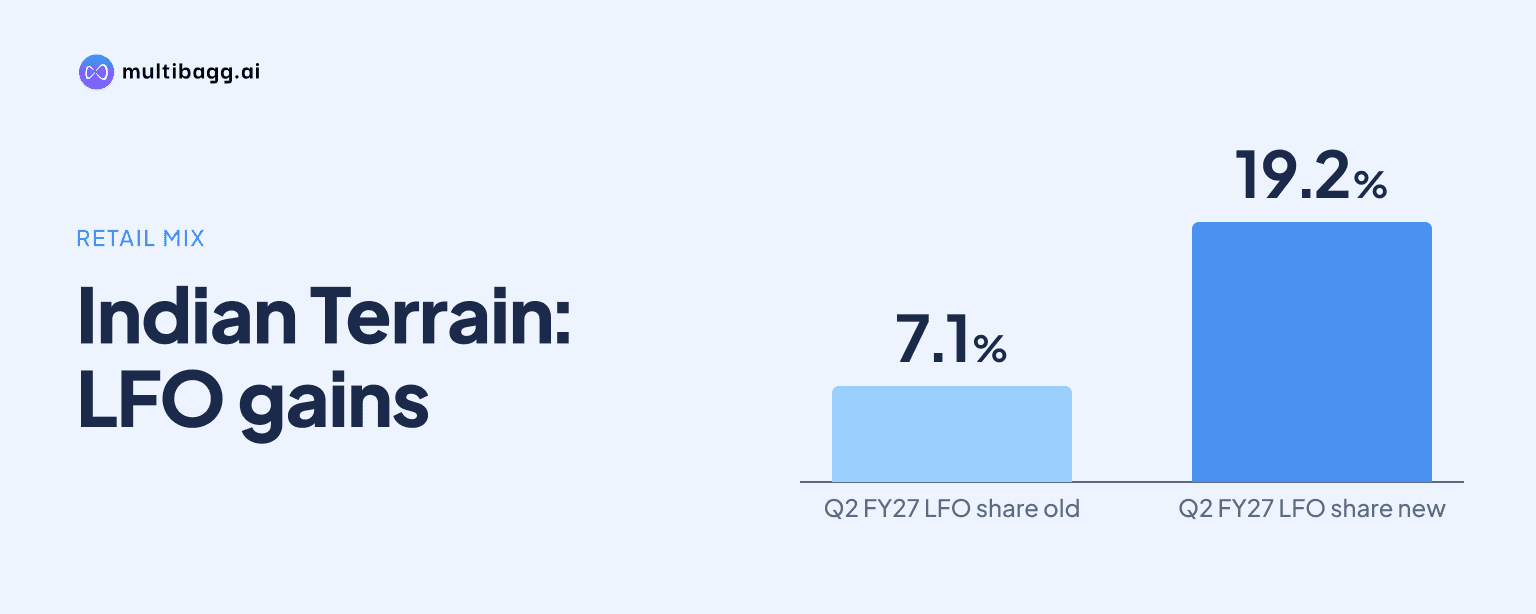
In Q2 FY’27, Indian Terrain Fashions Limited recorded Rs 20.43 crore in large-format outlet (LFO) sales, up 183.8% year on year, while online net sales were negative Rs 2.77 crore because returns exceeded fresh billing. The LFO gain helped lift total revenue 5.6% to Rs 106.59 crore despite the online reversal.
Know Indian Terrain Fashions inside out
Results, valuation, peers and who's buying, in one view.
Why did Indian Terrain’s Q2 channel mix change so sharply?
Indian Terrain’s Q2 FY’27 mix changed as LFO sales increased by Rs 13.23 crore year on year while online sales declined by Rs 17.87 crore. LFO represented 19.2% of Q2 primary revenue, up from 7.1% in Q2 FY’26, a 12.0 percentage-point increase. Online moved from 15.0% of revenue to negative 2.6%, a decline of 17.6 percentage points.
Indian Terrain reported total net sales under Indian Accounting Standards (Ind AS) of Rs 106.59 crore for the quarter ended 30 September, compared with Rs 100.96 crore a year earlier. The Rs 5.62 crore increase was also supported by exclusive retail outlets, which added Rs 4.77 crore, multi-brand outlets (MBO), which added Rs 3.92 crore, and other channels, which added Rs 1.58 crore. Physical channels therefore provided a larger share of sales while online net sales reversed.
How much did Indian Terrain’s LFO business grow in Q2 FY’27?
Indian Terrain’s LFO sales rose 183.8% year on year to Rs 20.43 crore in Q2 FY’27 from Rs 7.20 crore in Q2 FY’26. This was the fastest reported growth rate among the channels and equated to a 2.8-times increase, according to the company’s scorecard. The Rs 13.23 crore absolute gain exceeded the increase reported by each of exclusive retail, MBO and other channels.
Over the half year ended 30 September, LFO sales rose 93.4% to Rs 35.16 crore from Rs 18.18 crore, adding Rs 16.98 crore. The Q2 growth rate was higher than the H1 FY’27 rate, meaning the second quarter contributed substantially to the half-year increase. Indian Terrain also said it rolled out a new shop-in-shop concept in large-format stores during Q2 to improve brand visibility and customer traction on the LFO floor.
LFO’s increased role came alongside gains in other physical channels during Q2 FY’27. Exclusive retail sales increased 12.1% to Rs 44.09 crore and accounted for 41.4% of revenue, compared with 39.0% a year earlier. MBO sales rose 11.5% to Rs 37.99 crore, with Indian Terrain attributing the quarterly increase to dispatches deferred from Q1 being executed in Q2.
Got a follow-up? Ask IRIS
Why were Indian Terrain’s online sales negative in Q2 FY’27?
Indian Terrain’s online net primary sales were negative Rs 2.77 crore in Q2 FY’27 because returns exceeded fresh billing in the channel. This compared with positive online sales of Rs 15.10 crore in Q2 FY’26, a Rs 17.87 crore year-on-year movement. The presentation labels the percentage comparison as not meaningful because the current-quarter net sales figure was negative.
The Q2 result reduced online sales for H1 FY’27 to Rs 7.99 crore, half the Rs 15.99 crore reported in H1 FY’26. The half-year decline was Rs 8.00 crore, or 50.0%, even as total H1 revenue increased 10.9% to Rs 188.33 crore from Rs 169.74 crore. The comparison shows that growth during the half year came from channels other than online.
The negative online outcome occurred in the quarter when Indian Terrain relaunched indianterrain.com on 14 September 2026. The new web store included refreshed model imagery, a chatbot for styling assistance and customer support, and readiness for omni-channel integration. The presentation does not state whether the relaunch affected Q2 returns or billing, leaving returns exceeding fresh billing as the disclosed explanation for negative online sales.
Which channels supported Indian Terrain’s total revenue growth?
Indian Terrain’s total Q2 FY’27 revenue growth was supported by exclusive retail, LFO, MBO and other channels, which together outweighed the online decline. Revenue rose 5.6% to Rs 106.59 crore, while retail, LFO and MBO respectively contributed 41.4%, 19.2% and 35.6% of Q2 primary revenue. Those three channels accounted for 96.2% of revenue share before the negative online contribution and other-channel sales.
The composition of growth differed between the quarter and the half year. Exclusive retail was up 9.9% to Rs 84.99 crore in H1 FY’27, while MBO was 1.4% higher at Rs 50.73 crore. LFO grew 93.4% to Rs 35.16 crore, while other sales increased 14.9% to Rs 9.46 crore and online sales declined 50.0%.
The broader Q2 results paired sales growth with higher reported margins and profit before tax. Gross margin reached 40.8% in Q2 FY’27 from 40.3% in Q2 FY’26, while operating earnings before interest, tax, depreciation and amortisation (EBITDA) rose to Rs 9.58 crore from Rs 8.51 crore. Profit before tax increased to Rs 2.92 crore from Rs 1.15 crore, with the channel figures showing this was achieved despite negative online sales.
Conclusion
Indian Terrain’s Q2 FY’27 channel data show a material shift toward LFO and other physical channels. LFO sales rose by Rs 13.23 crore and its revenue share increased 12.0 percentage points, while online sales moved from Rs 15.10 crore to negative Rs 2.77 crore. Exclusive retail and MBO also grew, allowing total revenue to increase by Rs 5.62 crore.
The next indicator will be whether the 14 September 2026 web-store relaunch, chatbot and planned omni-channel integration affect online billing and returns. Management said it plans to pursue festive and wedding-season opportunities through improved product availability, sharper merchandise planning and customer engagement, while continuing inventory optimisation, receivables management and cost discipline.