










Amber electronics Q2 revenue up 94%, margin reaches 9.3%
Key highlights
- Amber electronics revenue reached Rs 1,248 crore in Q2 FY27, up 94% from Rs 642 crore in Q2 FY26.
- Amber electronics operating EBITDA rose 195% to Rs 116 crore in Q2 FY27, while margin increased to 9.3% from 6.1%.
- Amber electronics reported Rs 2,233 crore of H1 FY27 revenue, up 59%, with a 9.9% operating EBITDA margin.
- Amber electronics reported 10 portfolio additions in fiscal 2026, comprising six organic and four inorganic additions.
powered by IRIS
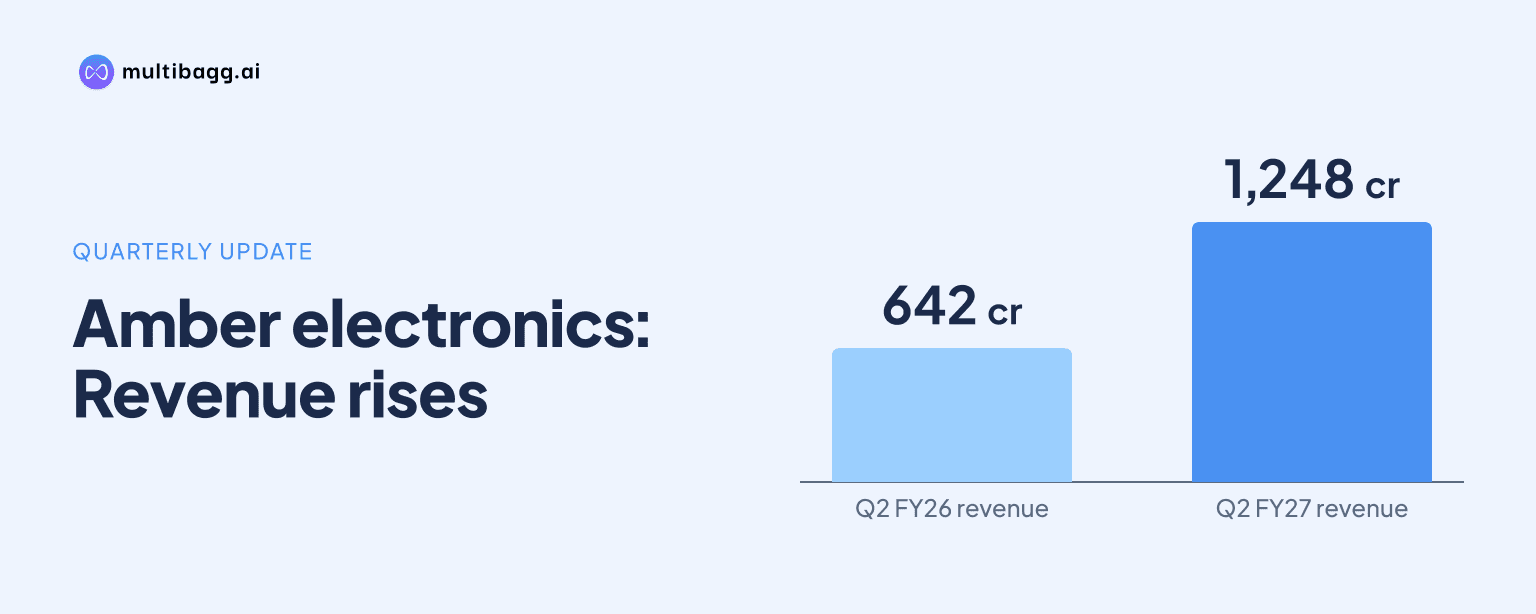
Amber’s electronics division reported Rs 1,248 crore of revenue from operations in the second quarter of fiscal 2027 (Q2 FY27), up 94% from Q2 FY26, while its operating EBITDA margin increased to 9.3% from 6.1%. Operating EBITDA reached Rs 116 crore, up 195% year on year under the presentation’s adjusted measure.
Know Amber Enterprises India inside out
Results, valuation, peers and who's buying, in one view.
How did Amber electronics perform in Q2 FY27?
Amber electronics nearly doubled revenue in Q2 FY27, reporting Rs 1,248 crore compared with Rs 642 crore in Q2 FY26. The presentation identifies this as 94% year-on-year growth, following quarterly revenue of Rs 248 crore in Q2 FY24 and Rs 492 crore in Q2 FY25. It states a 71% compound annual growth rate, or CAGR, across the four reported Q2 periods.
Amber electronics reported operating EBITDA of Rs 116 crore in Q2 FY27, compared with Rs 39 crore a year earlier, Rs 37 crore in Q2 FY25 and Rs 13 crore in Q2 FY24. Operating EBITDA, as defined in the presentation, excludes employee stock option plan expense and other non-operating income and expenses. Its Q2 FY27 margin rose by 3.2 percentage points to 9.3% from 6.1% in Q2 FY26.
Amber electronics’ stated operating EBITDA is after an adjustment for consumption of inventory fair-valued in purchase price allocation, or PPA, for Power-One, Unitronics and Shogini. The adjustment was about Rs 13.5 crore in Q2 FY27 and represented higher raw-material consumption in the consolidated financial statements. Amber also says its revenue and operating EBITDA figures are not comparable with published segment results.
How does Amber electronics compare with consumer durables?
Amber electronics grew faster than Amber’s consumer durables division in Q2 FY27. Electronics revenue rose 94% to Rs 1,248 crore, while consumer durables revenue rose 41% to Rs 1,227 crore. Electronics therefore reported Rs 21 crore more revenue in Q2 FY27, after consumer durables had reported the larger Rs 873 crore revenue base in Q2 FY26 versus electronics’ Rs 642 crore.
The operating EBITDA comparison also differed sharply in Q2 FY27. Amber electronics reported Rs 116 crore and a 9.3% margin, whereas consumer durables reported Rs 4 crore and a 0.3% margin. Management attributed consumer durables margin pressure to commodity inflation, foreign-currency fluctuation, minimum-wage revision and ramp-up costs at the Sri City plant.
The first half of fiscal 2027 (H1 FY27) showed the same difference in growth. Amber electronics revenue rose 59% to Rs 2,233 crore from Rs 1,409 crore in H1 FY26, while consumer durables revenue increased 16% to Rs 3,985 crore. Electronics operating EBITDA rose 152% to Rs 222 crore, while consumer durables operating EBITDA declined 5% to Rs 218 crore.
What businesses are included in Amber electronics?
Amber electronics lists four capability areas: electronics manufacturing services, or EMS; bare printed circuit boards, or PCBs; power electronics; and industrial automation. Its EMS offering includes PCB assembly, or PCB-A, and box-build solutions through ILJIN and STELLTEK. These capabilities span assembly as well as bare-board manufacturing and electronic systems.
Amber electronics identifies Ascent Circuits, Shogini, Technoarts Pvt. Ltd. and Ascent-K Circuit in bare PCBs. The power-electronics portfolio includes Power-One and Micro Systems Pvt. Ltd., while Unitronics represents industrial automation. The Rs 13.5 crore Q2 FY27 PPA inventory adjustment relates specifically to Power-One, Unitronics and Shogini.
Amber electronics lists aerospace and defence, telecom, renewable energy, smart electronics, automotive and consumer durables as organic market segments. It separately identifies industrial, power electronics, data centre and bare PCBs as acquired capabilities. The presentation therefore distinguishes expansion through internally developed markets from capabilities added through transactions.
Got a follow-up? Ask IRIS
How has Amber electronics expanded its portfolio?
Amber electronics reported 10 portfolio additions in fiscal 2026, made up of six organic and four inorganic additions. That was above seven additions in fiscal 2025, six in fiscal 2024, three in fiscal 2023, two in fiscal 2022 and one in fiscal 2021. Inorganic additions appear in the presentation from fiscal 2024, when it reported five organic and one inorganic addition.
The H1 FY27 operating result followed this expansion period. Revenue from operations reached Rs 2,233 crore, compared with Rs 880 crore in H1 FY25 and Rs 515 crore in H1 FY24, for a stated 63% CAGR across the reported half-year periods. Operating EBITDA rose from Rs 24 crore in H1 FY24 to Rs 68 crore in H1 FY25, Rs 88 crore in H1 FY26 and Rs 222 crore in H1 FY27.
The PPA inventory-consumption adjustment was Rs 28.8 crore in H1 FY27, higher than the Rs 13.5 crore disclosed for Q2 FY27. Amber states that this adjustment increased raw-material consumption in consolidated financial statements. This treatment is relevant when comparing the reported Rs 222 crore H1 FY27 operating EBITDA with published segment results, which Amber says are not comparable.
Which PCB projects is Amber electronics developing?
Amber electronics is progressing with construction of a new multi-layer PCB facility in Hosur, Tamil Nadu, through Ascent Circuits. The project has received approval under the Electronic Components Manufacturing Scheme, or ECMS, for multi-layer PCBs. The presentation does not disclose a commissioning date, manufacturing capacity or project cost for the Hosur facility.
Amber electronics is also developing a high-density interconnect, or HDI, PCB facility near Jewar Airport in Uttar Pradesh through Ascent-K Circuit. Ascent-K Circuit is a joint venture between ILJIN and Korea Circuit for HDI, flexible and semiconductor-substrate PCBs. Its groundbreaking ceremony was held in June 2026 at YEIDA near Jewar Airport, and the project has ECMS approval for HDI PCBs.
A third project is an expansion of Amber electronics’ PCB-assembly facility in Pune, where construction is progressing. Unlike the Hosur and Jewar projects, the presentation gives no scheme approval, capacity, completion milestone or capital-expenditure figure for Pune. Together, the projects cover multi-layer boards, HDI boards and PCB assembly.
Conclusion
Amber electronics delivered Rs 1,248 crore of Q2 FY27 revenue and Rs 116 crore of operating EBITDA, with margin reaching 9.3%. Its 94% revenue growth and 195% operating EBITDA growth exceeded the consumer durables division’s 41% revenue growth, while H1 FY27 electronics margin of 9.9% was above consumer durables’ 5.5%.
The next disclosed developments to watch are construction at the Hosur multi-layer PCB facility, the Jewar HDI PCB facility and the Pune PCB-assembly expansion. Amber has disclosed ECMS approvals for Hosur and Jewar and a June 2026 groundbreaking at Jewar, but it has not disclosed commissioning dates, capacities or project costs for these projects.