










Amber Q2 revenue rises 60% as net loss widens to Rs 66 crore
Key highlights
- Amber’s Q2FY27 revenue from operations rose 60% year on year to Rs 2,627 crore.
- Amber’s Q2FY27 reported PAT loss widened to Rs 66 crore from Rs 32 crore.
- Amber’s Q2FY27 Operating EBITDA rose 30% to Rs 127 crore, while margin fell to 4.8% from 5.9%.
- Amber expects mobile-phone trial production in Q4FY27 and commercial production in Q1FY28.
powered by IRIS
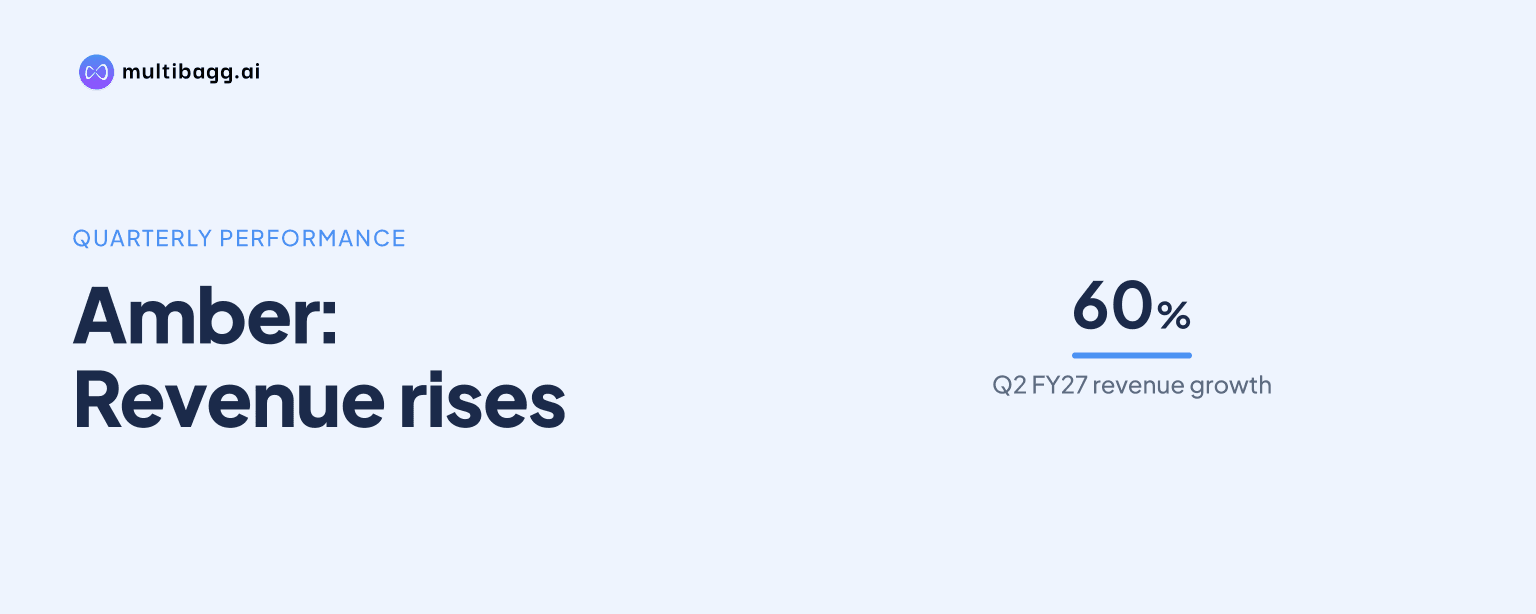
Amber Enterprises India Limited reported consolidated revenue from operations of Rs 2,627 crore in Q2FY27, up 60% year on year, while its reported profit after tax, or PAT, loss widened to Rs 66 crore from Rs 32 crore in Q2FY26. Operating EBITDA rose 30% to Rs 127 crore, but its margin declined to 4.8% from 5.9%.
Know Amber Enterprises India inside out
Results, valuation, peers and who's buying, in one view.
How did Amber perform in Q2FY27?
Amber delivered higher Q2FY27 revenue and operating earnings, but reported a larger loss. Revenue from operations increased by Rs 980 crore from Rs 1,647 crore in Q2FY26 to Rs 2,627 crore in Q2FY27. Operating earnings before interest, tax, depreciation and amortisation, or Operating EBITDA, increased by Rs 29 crore to Rs 127 crore from Rs 98 crore over the same comparison.
Operating EBITDA grew more slowly than revenue in Q2FY27. Operating EBITDA increased 30%, compared with revenue growth of 60%, and the Operating EBITDA margin declined by 1.1 percentage points to 4.8% from 5.9%. Amber defines Operating EBITDA as before employee stock option plan expense and other non-operating income and expenses.
Amber reported a PAT loss of Rs 66 crore for Q2FY27, compared with a Rs 32 crore loss a year earlier. The presentation also gives adjusted PAT of a Rs 57 crore loss for the quarter, before an exceptional loss of Rs 9.5 crore. The supplied results pages do not provide a line-by-line bridge from Operating EBITDA to reported PAT.
Why did Amber report a Q2FY27 loss despite revenue growth?
Amber reported a Q2FY27 loss because its adjusted PAT remained negative before the stated exceptional item. Reported PAT was a Rs 66 crore loss, while adjusted PAT was a Rs 57 crore loss before a Rs 9.5 crore exceptional loss. This shows the business was still loss-making on the presentation’s adjusted PAT measure for the quarter.
The presentation identifies a purchase price allocation, or PPA, inventory valuation effect in its Operating EBITDA measurement. In Q2FY27, consumption of inventory fair-valued at the time of acquisition increased consolidated raw-material consumption by about Rs 13.5 crore. The adjustment relates to the Power-One, Unitronics and Shogini acquisitions and is included in the Operating EBITDA measure presented.
The quarterly outcome contrasts with the first-half adjusted measure. Amber reported an H1FY27 PAT loss of Rs 63 crore, but adjusted PAT was a Rs 69 crore profit before an exceptional loss of Rs 132.2 crore. The supplied pages do not specify the nature of the exceptional items.
Which Amber divisions produced Q2FY27 revenue and Operating EBITDA?
Amber’s Consumer Durables Division generated the largest Q2FY27 revenue, while its Electronics Division generated most of group Operating EBITDA. Consumer Durables recorded Rs 1,227 crore of revenue, Electronics recorded Rs 1,248 crore and Railway Sub-systems & Mobility recorded Rs 152 crore. Together, the three divisions totalled the reported consolidated revenue of Rs 2,627 crore.
The distribution of operating earnings differed from the revenue mix. Electronics generated Rs 116 crore of the group’s Rs 127 crore Operating EBITDA, while Railway Sub-systems & Mobility contributed Rs 7 crore and Consumer Durables contributed Rs 4 crore. Amber notes that these division-level revenue and Operating EBITDA figures are not comparable with its published segment results.
For H1FY27, Consumer Durables was the largest revenue contributor at Rs 3,985 crore, ahead of Electronics at Rs 2,233 crore and Railway Sub-systems & Mobility at Rs 297 crore. Electronics and Consumer Durables made near-equal contributions to first-half Operating EBITDA, at Rs 222 crore and Rs 218 crore respectively, while Railway Sub-systems & Mobility contributed Rs 24 crore.
Got a follow-up? Ask IRIS
What changed in Amber’s first-half FY27 results?
Amber’s H1FY27 revenue and Operating EBITDA both rose from H1FY26, while reported PAT moved from profit to loss. Revenue from operations increased 28% to Rs 6,515 crore from Rs 5,096 crore. Operating EBITDA increased 29% to Rs 464 crore from Rs 361 crore, and the corresponding margin was unchanged at 7.1% in both first-half periods.
The reported PAT movement was larger than the operating change. Amber moved from a reported profit of Rs 74 crore in H1FY26 to a reported loss of Rs 63 crore in H1FY27. On the adjusted basis presented by Amber, H1FY27 PAT was a Rs 69 crore profit before the Rs 132.2 crore exceptional loss; no adjusted PAT was displayed for H1FY26.
The PPA-related inventory effect was also larger across the six months than in the second quarter. Amber said the adjustment increased raw-material consumption by about Rs 28.8 crore in H1FY27, compared with about Rs 13.5 crore in Q2FY27. It relates to inventory acquired through Power-One, Unitronics and Shogini.
What is Amber’s next disclosed growth initiative?
Amber’s next disclosed initiative is mobile-phone manufacturing through its wholly owned Amber Digital Technologies Pvt Ltd, with trial production expected in Q4FY27 and commercial production expected in Q1FY28. Amber Digital will undertake mobile-phone manufacturing operations, including production for Oppo, under a manufacturing collaboration agreement with Oppo Mobiles India Pvt. Ltd.
The agreement covers the Oppo, Realme and OnePlus brands, according to the presentation. Management describes mobile manufacturing as a new growth avenue intended to broaden the product portfolio and addressable markets. It also says mobile revenue is intended to offset group seasonality and describes the model as asset-light with minimum incremental capital expenditure.
Amber also simplified ownership within its electronics structure on 2 November 2026. IL JIN acquired the remaining 40% stake in Power-One and 1.5% stake in Ascent Circuits through compulsorily convertible preference shares, or CCPS, under a share-swap arrangement. Power-One and Ascent Circuits consequently became wholly owned subsidiaries of IL JIN.
Conclusion
Amber’s Q2FY27 results show that 60% revenue growth and 30% Operating EBITDA growth did not translate into reported profitability. The Operating EBITDA margin declined to 4.8%, adjusted PAT was a Rs 57 crore loss before exceptional items, and reported PAT loss widened to Rs 66 crore. Electronics supplied Rs 116 crore of the group’s Rs 127 crore Q2 Operating EBITDA.
The next disclosed milestones are mobile trial production in Q4FY27 and commercial production in Q1FY28 under the Oppo collaboration. Investors can also watch whether mobile manufacturing changes the revenue mix, and whether Amber discloses further detail on the Rs 132.2 crore H1FY27 exceptional loss or the bridge from Operating EBITDA to reported PAT.