










Amber Enterprises India Ltd Q2 FY27 Board Meets November 12
Key highlights
- Amber Enterprises India will approve Q2 FY27 and H1 FY27 results on November 12, 2026.
- Q1 FY27 revenue was ₹3,887.72 crore, up 12.72% year on year.
- Q1 FY27 reported net profit was ₹3.09 crore, versus ₹161.96 crore in Q4 FY26.
- The cited Q2 FY27 consensus estimates revenue of ₹2,137 crore and EPS of ₹5.40.
powered by IRIS
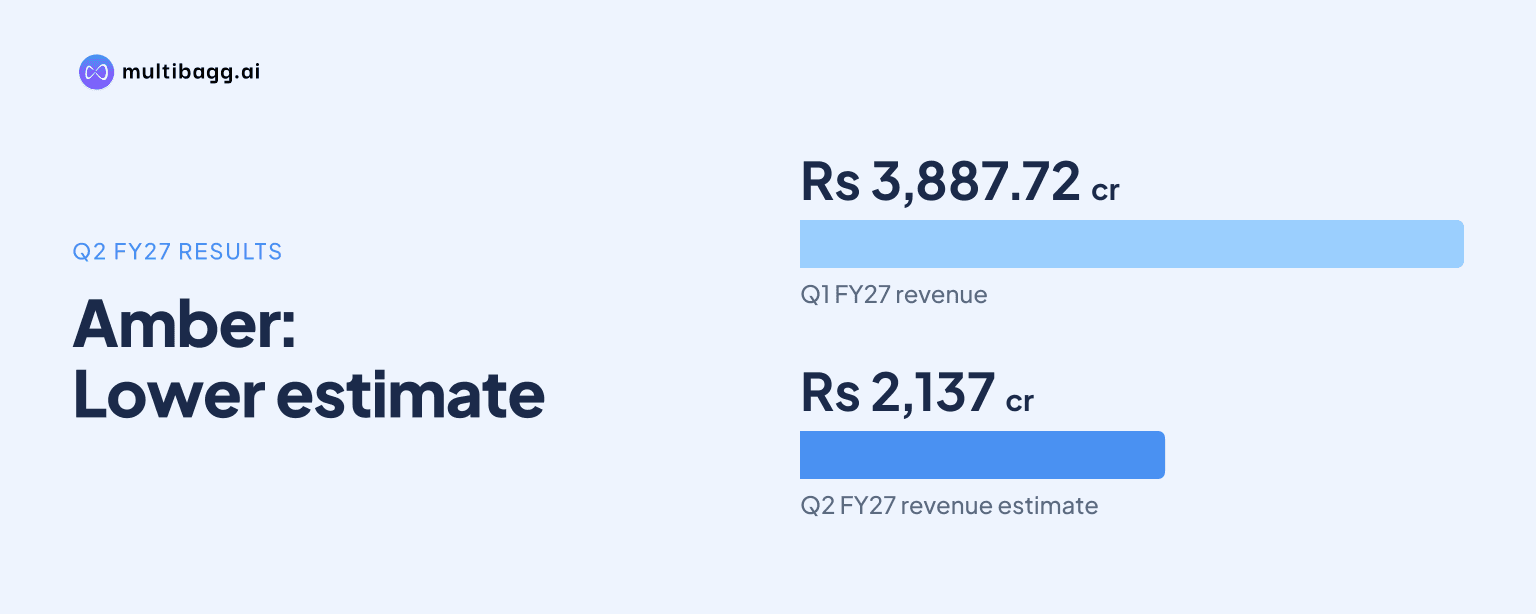
Amber Enterprises India Ltd is scheduled to approve its Q2 FY27 results on November 12, 2026, following Q1 revenue of ₹3,887.72 crore and reported net profit of ₹3.09 crore. The board meeting covers unaudited standalone and consolidated results for the quarter and half year ended September 30, 2026.
Know Amber Enterprises India inside out
Results, valuation, peers and who's buying, in one view.
When will Amber Enterprises India announce Q2 FY27 results?
Amber Enterprises India is due to release its Q2 FY27 financial results after its board meeting on Thursday, November 12, 2026. The company had informed exchanges on November 7 that its board would consider and approve unaudited standalone and consolidated financial statements for the September quarter and first half of FY27.
The company’s trading window for insiders has remained closed from October 1, 2026, according to the board-meeting information. The Q2 filing is expected to provide the formal financial update for the three and six months ended September 30, including revenue, profitability and earnings per share.
The results are part of a broader earnings day that includes several Indian listed companies. However, the available information does not contain Amber’s Q2 FY27 financial outcome. Investors will need to rely on the company’s exchange filing for the final reported numbers.
What did Amber Enterprises report in Q1 FY27?
Amber reported revenue from operations of ₹3,887.72 crore in Q1 FY27, up 12.72% year on year but down 6.26% sequentially. Total income for the June 2026 quarter was ₹3,935.25 crore, compared with ₹4,167.61 crore in Q4 FY26 and ₹3,478.80 crore in Q1 FY26.
Reported net profit for the quarter was ₹3.09 crore, sharply lower than ₹161.96 crore in the preceding quarter and ₹105.98 crore a year earlier. The quarterly data also shows net profit attributable to owners of ₹22.27 crore, while basic earnings per share stood at ₹6.34.
The difference between the reported net-profit line and profit attributable to owners appears in the filed quarterly figures. Another source described Q1 reported profit after tax as ₹308.56 lakh and referred to adjusted profit after tax of ₹126 crore before a ₹123 crore exceptional loss. The forthcoming Q2 filing and management discussion may provide further context on comparable profit measures.
How did Q1 FY27 compare with analyst expectations?
Amber’s Q1 FY27 revenue of ₹3,887.72 crore was 9.14% below the analyst revenue expectation of ₹4,279 crore cited in the available data. Actual earnings per share of ₹6.33 were also below the cited expectation of ₹30.27 per share.
These comparisons matter because they establish the immediate reference point for the September-quarter update. The available consensus for Q2 FY27 puts revenue at ₹2,137 crore and earnings at ₹5.40 per share. These are estimates, not company guidance or reported results.
For the full FY27, the cited consensus projects revenue of ₹14,953 crore and earnings per share of ₹105.28. Neither estimate confirms Amber’s operating outlook, as the company has not yet released Q2 FY27 results in the supplied information.
Got a follow-up? Ask IRIS
What financial trend does the quarterly record show?
Amber’s revenue has been volatile across recent quarters, ranging from ₹1,647.01 crore in Q2 FY26 to ₹4,147.52 crore in Q4 FY26. Revenue then stood at ₹3,887.72 crore in Q1 FY27, showing a much higher base than the year-earlier September quarter but a decline from the immediately preceding March quarter.
Operating profit was ₹203 crore in Q1 FY27, down 21.28% quarter on quarter and up 4.59% year on year. Operating profit margin was 5.2%, compared with 6.2% in Q4 FY26 and 5.7% in Q1 FY26. This indicates that profitability measures moved differently from revenue during the June quarter.
The prior-year quarterly record also includes losses in Q2 FY26 and Q3 FY26. Net profit was negative ₹32.14 crore in Q2 FY26 and negative ₹9.34 crore in Q3 FY26 before recovering to ₹161.96 crore in Q4 FY26. The sequence makes the Q2 FY27 result relevant for assessing whether profitability has stabilised after the Q1 exceptional item.
How could the Q2 filing affect investors and operations?
The Q2 release will give shareholders a current view of Amber’s first-half revenue and earnings performance. It will also allow investors to compare the reported September-quarter figures with the cited revenue estimate of ₹2,137 crore and EPS estimate of ₹5.40.
For the company’s operations, the filing will be important because it is expected to contain consolidated as well as standalone numbers. Consolidated reporting can help investors assess the contribution of the wider group, while the half-year figures will place the Q1 revenue and profitability movement in a longer reporting period.
Management is scheduled to discuss the Q2 and H1 FY27 performance in an earnings call on November 13, 2026, at 5:30 PM IST. The company has said the CEO, managing director, chief financial officer and head of investor relations will participate. That call is the next disclosed forum for management commentary after the result announcement.
Conclusion
Amber’s scheduled Q2 FY27 board meeting is significant because the June-quarter figures showed revenue growth from a year earlier but a substantial reduction in reported net profit. The September-quarter filing will provide the confirmed financial data needed to evaluate first-half performance, including how revenue, margins, profit and earnings per share changed after Q1.
Investors should watch for the NSE filing after the November 12 board meeting and the management earnings call at 5:30 PM IST on November 13. The disclosed consensus of ₹2,137 crore in Q2 revenue and ₹5.40 in EPS offers a comparison point, while the company’s reported results and management explanation will determine the actual outcome.