










Amber Group’s Consumer-Durables Margin Fell to 0.3% in Q2
Key highlights
- Amber’s Q2 FY27 consumer-durables revenue rose 41% year on year to Rs 1,227 crore.
- Amber’s Q2 FY27 consumer-durables operating EBITDA fell 89% year on year to Rs 4 crore.
- Amber’s Q2 FY27 operating EBITDA margin fell to 0.3% from 4.3% in Q2 FY26.
- Amber expects a 50 to 100 basis point FY27 margin impact in consumer durables.
powered by IRIS
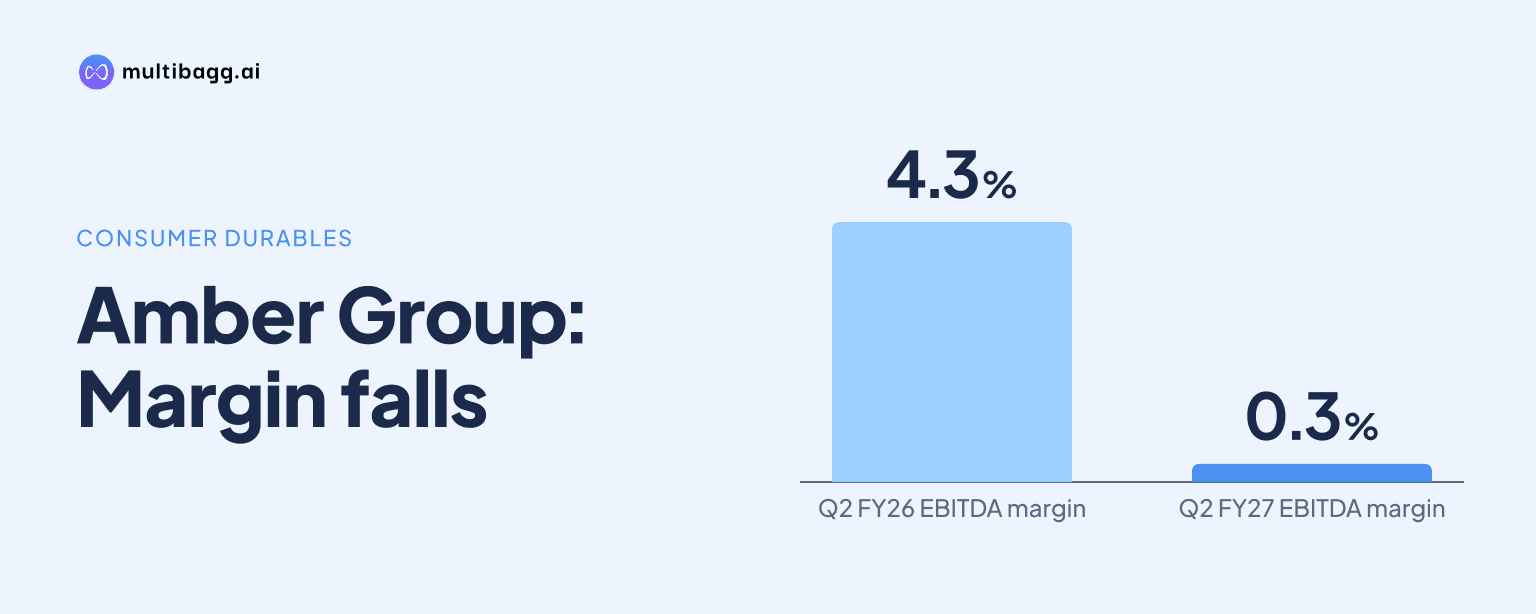
Amber Group’s consumer-durables operating EBITDA margin fell to 0.3% in Q2 FY27 from 4.3% a year earlier, even as revenue increased 41% to Rs 1,227 crore and operating EBITDA declined 89% to Rs 4 crore. Management cited commodity inflation, foreign-currency fluctuation, a minimum-wage revision and Sri City new-plant costs during ramp-up.
Know Amber Enterprises India inside out
Results, valuation, peers and who's buying, in one view.
Why did Amber’s consumer-durables margin fall in Q2 FY27?
Amber’s Q2 FY27 margin fell because management said commodity inflation, foreign-currency fluctuation, a minimum-wage revision and the Sri City plant ramp-up affected costs. These factors coincided with consumer-durables revenue increasing by Rs 354 crore, to Rs 1,227 crore in Q2 FY27 from Rs 873 crore in Q2 FY26, while operating EBITDA declined by Rs 33 crore to Rs 4 crore.
The Sri City plant was still in its ramp-up phase in Q2 FY27, according to Amber. The presentation does not allocate the Rs 33 crore year-on-year operating EBITDA decline between commodity costs, currency movements, wage revisions and the new-plant cost, so the individual weight of each pressure is not disclosed.
Amber defines operating EBITDA, or earnings before interest, tax, depreciation and amortisation, as before employee stock option plan expense and other non-operating income and expenses. It also says its revenue and operating EBITDA measures are not comparable with published segment results, making the 0.3% Q2 FY27 figure a division-specific operating measure.
How did Amber’s Q2 FY27 revenue and EBITDA compare?
Amber’s Q2 FY27 consumer-durables revenue was the highest in the four Q2 periods presented, while its Rs 4 crore operating EBITDA was the lowest. Revenue rose to Rs 1,227 crore from Rs 873 crore in Q2 FY26, but operating EBITDA declined from Rs 37 crore and margin contracted from 4.3% to 0.3%.
Revenue more than doubled from Rs 547 crore in Q2FY24 to Rs 1,227 crore in Q2FY27, for a stated compounded annual growth rate of 31%. Over the same four reported Q2 periods, operating EBITDA rose from Rs 21 crore to Rs 62 crore in Q2FY25 before falling to Rs 37 crore in Q2FY26 and Rs 4 crore in Q2FY27.
The margin decline accelerated in the latest quarter. It eased from 5.8% in Q2FY25 to 4.3% in Q2FY26, then declined by 4.0 percentage points to 0.3% in Q2FY27 as operating EBITDA fell 89% despite 41% revenue growth.
How did Amber perform in H1 FY27?
Amber’s H1 FY27 consumer-durables revenue increased 16% to Rs 3,985 crore, but operating EBITDA declined 5% to Rs 218 crore and margin fell to 5.5%. In H1 FY26, revenue was Rs 3,433 crore, operating EBITDA was Rs 229 crore and margin was 6.7%.
The first-half margin decline was narrower than the Q2 FY27 decline. H1 FY27 margin was 1.2 percentage points below the prior-year 6.7%, compared with the 4.0-percentage-point Q2 FY27 reduction from 4.3% to 0.3%.
Amber reported H1 revenue of Rs 1,878 crore in H1FY24, Rs 2,987 crore in H1FY25, Rs 3,433 crore in H1FY26 and Rs 3,985 crore in H1FY27. The company stated a 29% compounded annual growth rate across this H1 period.
Amber also said it added new customers in the light commercial air-conditioner segment during H1FY27. Its commercial air-conditioner portfolio includes cassette, tower, duct, water heat pump and outdoor-unit products, but the presentation provides no customer count or revenue contribution from the additions.
Got a follow-up? Ask IRIS
What is Amber’s FY27 consumer-durables outlook?
Amber expects full-year consumer-durables revenue growth to be broadly in line with room air-conditioner industry growth, while management expects a 50 to 100 basis point margin impact for FY27. A basis point is one-hundredth of a percentage point, so the indicated margin effect is 0.5 to 1.0 percentage point.
The guidance follows a 5.5% H1 FY27 operating EBITDA margin and a 0.3% Q2 FY27 margin. Amber did not provide a numerical room air-conditioner industry growth forecast or specify whether the commodity, currency, wage and Sri City ramp-up pressures would change during the remainder of FY27.
The source presents the 50 to 100 basis point range as management guidance rather than a reported outcome. Its FY27 revenue expectation is similarly tied to room air-conditioner industry growth, not to a separate numerical target for the division.
Which products and capabilities does Amber’s division have?
Amber’s consumer-durables division covers room air conditioners, commercial air conditioners and components, with about 70% room-air-conditioner bill-of-materials catering capability. This estimate includes the air-conditioner printed circuit board controller, although Amber says that controller is part of its electronics division.
The room-air-conditioner portfolio includes split, outdoor, window and top-through-window units. Its commercial range includes cassette, tower, duct, water heat pump and outdoor units, while components include heat exchangers, plastic moulding, motors, copper tubing, cross-flow and axial fans, sheet-metal components and tooling.
Amber’s portfolio graphic shows an expansion from FY20 to FY27 across finished goods and components. It does not quantify products added, capital expenditure or product-level revenue, while Sri City is the only plant specifically identified as contributing to Q2 FY27 margin pressure.
Conclusion
Amber’s consumer-durables division continued to grow revenue, reaching Rs 1,227 crore in Q2 FY27 and Rs 3,985 crore in H1 FY27. Yet operating EBITDA fell to Rs 4 crore in the quarter and Rs 218 crore in the half year, showing that commodity inflation, currency fluctuation, wage revisions and Sri City ramp-up costs outweighed revenue growth in the latest quarter.
The next measure to watch is whether full-year revenue growth tracks the room air-conditioner industry and whether the margin effect remains within management’s 50 to 100 basis point range. Amber has not disclosed the duration or separate financial effect of the four Q2 FY27 cost pressures, including the Sri City plant ramp-up.