










Indigo Paints Q2 Revenue Rises 15% as EBITDA Margin Falls
Key highlights
- Indigo Paints reported Q2 FY27 consolidated revenue of ₹358.7 crore, up 15.0% year on year.
- Consolidated EBITDA was ₹31.0 crore, down 33.5% year on year, with an 8.6% margin.
- Standalone gross margin fell 660 basis points to 38.5% from 45.1% a year earlier.
- Consolidated PAT declined 47.0% year on year to ₹13.4 crore in Q2 FY27.
powered by IRIS
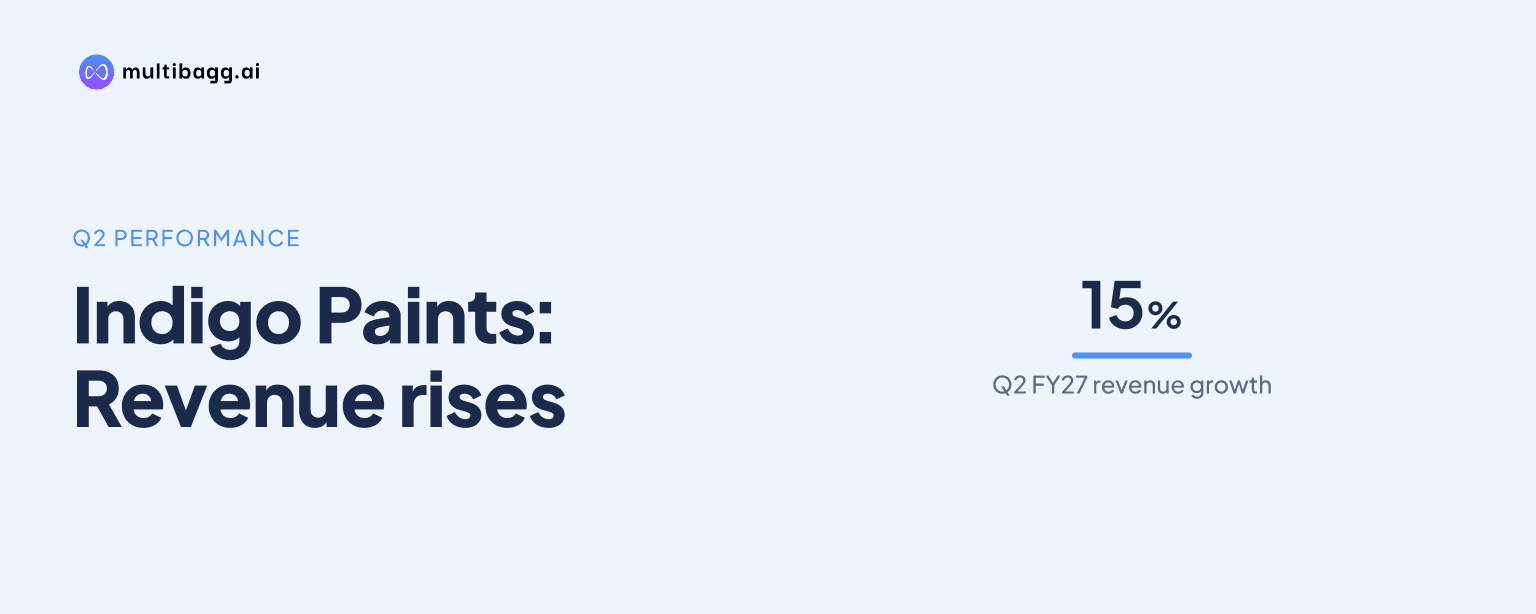
Indigo Paints Limited reported 15% year-on-year consolidated revenue growth to ₹358.7 crore in Q2 FY27, while EBITDA margin declined to 8.6% from pressure linked to high-cost raw-material inventory and an unfavourable product mix. The results show that sales growth continued, but the conversion of revenue into profit weakened materially during the quarter.
Know Indigo Paints inside out
Results, valuation, peers and who's buying, in one view.
What did Indigo Paints report for Q2 FY27?
Indigo Paints reported standalone revenue from operations of ₹340.5 crore for Q2 FY27, up 14.1% year on year. On a consolidated basis, including subsidiary Apple Chemie India Limited, revenue stood at ₹358.7 crore, up 15% from the year-earlier quarter.
The company said gross revenue growth on a standalone basis was 18.8%. However, a less favourable product mix led to higher discounts than in the corresponding quarter of the previous year. This reduced reported net revenue growth to 14.1%.
Consolidated EBITDA was ₹31.0 crore, down 33.5% year on year, with an EBITDA margin of 8.6%. Consolidated profit after tax was ₹13.4 crore, down 47.0% year on year, translating into a PAT margin of 3.7%.
Why did Indigo Paints' margins decline despite revenue growth?
Indigo Paints said almost all of the margin decline was due to lower gross margins. Standalone gross margin fell to 38.5% in Q2 FY27 from 45.1% in Q2 FY26, a contraction of 660 basis points.
Management attributed the decline mainly to high-cost raw-material inventory carried over from the preceding quarter. The company also cited an unfavourable product mix and higher discounts, which affected net realisation and profitability.
On a standalone basis, EBITDA was ₹30.3 crore, down 33.8% year on year. Standalone PAT was ₹13.8 crore, down 45.9%. These declines were steeper than revenue growth, underlining the effect of gross-margin compression on quarterly earnings.
The company described profitability as materially affected even as top-line momentum remained healthy. Its comments indicate that the key issue during the quarter was cost and mix, rather than a slowdown in reported sales growth.
Got a follow-up? Ask IRIS
What did management say about demand and operations?
Indigo Paints said October sales were at a record high, indicating stronger sales activity after the September quarter. Management also said it expects margin recovery from Q3, although geopolitical volatility remains an uncertainty for the business environment.
The company operates a newer plant in South India that was commissioned two to three years ago. Management said the facility has substantial excess capacity, giving it room to support future production without an immediate need for additional capacity at that location.
The Q2 FY27 earnings call was held on November 2, 2026, and was hosted by ICICI Securities Limited. Indigo Paints subsequently made the audio recording available on its website for shareholders and other market participants.
Apple Chemie India Limited remains part of the consolidated financial results. The difference between standalone and consolidated revenue reflects the inclusion of this subsidiary in the group numbers.
How do the results matter for investors and the paints sector?
The results matter because Indigo Paints maintained double-digit revenue growth while its profitability weakened significantly. Revenue increased 15% on a consolidated basis, but EBITDA and PAT declined by 33.5% and 47.0%, respectively, showing that earnings were more sensitive to input-cost inventory and discounting than sales growth during the quarter.
For investors, gross margin will be an important measure to track in subsequent results. Management has linked the Q2 decline to high-cost inventory from the prior quarter, and its expectation of recovery from Q3 places attention on whether lower-cost inventory, product mix and discounting improve as indicated.
The paints industry is affected by raw-material costs, product category mix and competitive pricing. Indigo Paints' Q2 performance illustrates how these factors can affect profitability even when revenue expands. The company has not provided a quantified margin target in the supplied commentary.
The record October sales comment provides an operational data point beyond the September-ended quarter. But management also flagged geopolitical volatility as a key uncertainty, meaning the company has identified an external factor that could affect cost conditions or demand visibility.
Conclusion
Indigo Paints delivered Q2 FY27 consolidated revenue of ₹358.7 crore, up 15% year on year, but the quarter was marked by lower profitability. High-cost inventory, a weaker product mix and higher discounts contributed to a 660-basis-point decline in standalone gross margin and a consolidated EBITDA margin of 8.6%.
The next key item to watch is the company’s stated expectation of margin recovery from Q3, alongside the progression of sales after record October levels. Investors will also monitor the effect of geopolitical volatility, inventory costs and discounting on gross margin and earnings in the coming quarters.