










Indigo Paints says Q2 margin hit should ease from Q3
Key highlights
- Indigo Paints' standalone Q2 FY27 EBITDA margin fell to 8.9% from 15.3% a year earlier.
- Indigo Paints' standalone Q2 FY27 revenue rose 14.1% year on year to Rs 340.5 crore.
- Indigo Paints' Q2 FY27 gross margin declined 660 basis points to 38.5%, mainly due to high-cost inventory, management said.
- Indigo Paints said the costly inventory effect was largely absorbed by August and margins were near normal from September.
powered by IRIS
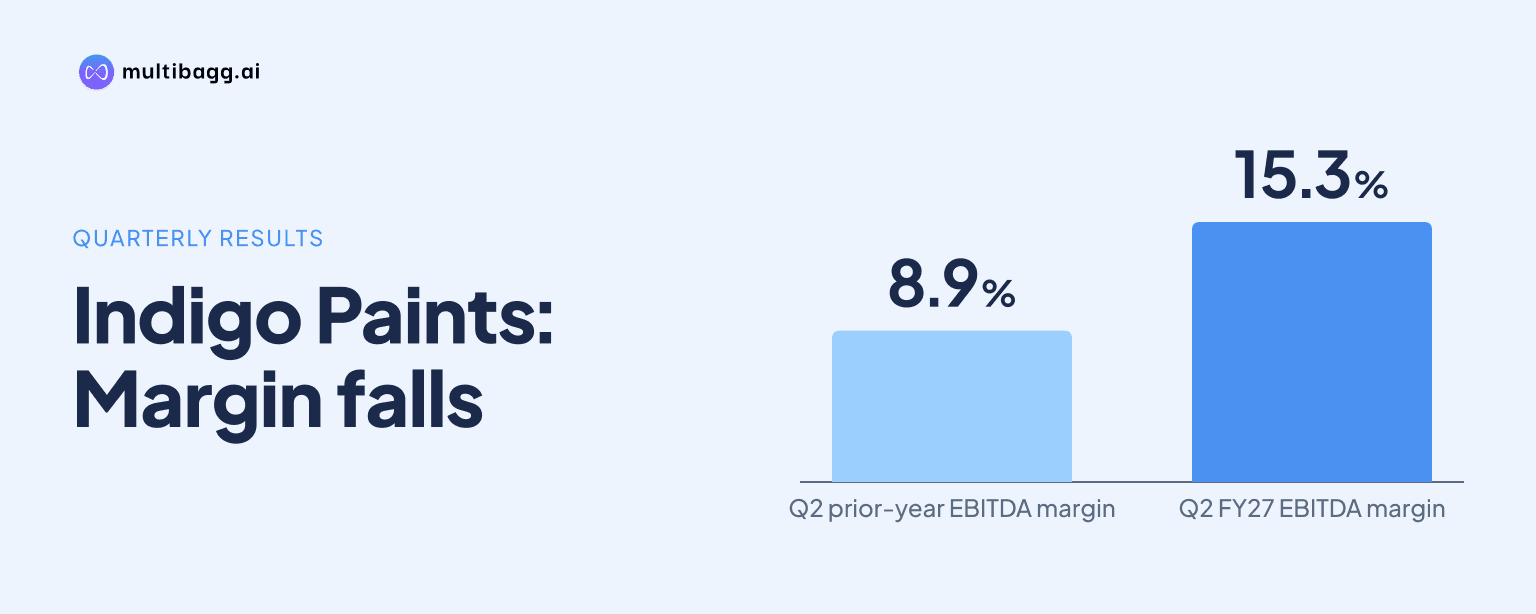
Indigo Paints Limited said its Q2 FY27 EBITDA margin fell to 8.9% from 15.3% a year earlier because costly raw-material inventory bought in March and April reached the profit and loss account, while management said that effect was largely absorbed by August and margins were near normal from September.
Know Indigo Paints inside out
Results, valuation, peers and who's buying, in one view.
Why did Indigo Paints' Q2 FY27 EBITDA margin fall?
Indigo Paints' Q2 FY27 EBITDA margin fell mainly because high-cost inventory was recognised in the quarter, management said. Standalone revenue from operations increased 14.1% year on year to Rs 340.5 crore, but earnings before interest, tax, depreciation and amortisation, or EBITDA, declined 33.8% to Rs 30.3 crore. The resulting EBITDA margin was 8.9%, down 640 basis points from 15.3% in Q2 FY26.
Management said prices of several key raw materials almost doubled in March and April 2026 following the start of the Iran war. The paint industry responded with price increases of about 10% to 12%. Raw-material costs then declined sharply in May and June before rising again in July and August, making the cost of goods sold sensitive to when inventory purchased at different prices was consumed.
The Q2 outcome was the reverse of Q1 FY27, according to management. In Q1, low-cost inventory acquired before March was expensed, helping revenue grow 19% year on year, EBITDA rise 42% and profit after tax, or PAT, increase 61%. In Q2, the higher-cost March-April inventory entered the accounts, producing the sharp decline in reported profitability.
How did gross margin and product mix affect Indigo Paints?
Gross margin was the main driver of Indigo Paints' Q2 FY27 earnings decline, falling to 38.5% from 45.1% a year earlier. Management attributed part of the 660-basis-point fall to an unfavourable product mix, but said the major factor was expensive raw-material inventory purchased in the preceding quarter. It said the pass-through of this inventory was largely complete by August.
The mix also widened the difference between gross and reported revenue growth. Q2 gross revenue rose 18.8%, while net revenue increased 14.1%, because the company gave higher discounts than in Q2 FY26. In emulsions, its largest category, value grew 13.3% and volume rose 10.4%, but management said sales were tilted towards lower-end emulsions, which it described as typical for the second quarter.
Advertising and promotion, or A&P, costs increased but were a smaller factor in the margin decline. A&P spending was Rs 18.3 crore, or 5.4% of Q2 revenue, against Rs 15.7 crore in Q2 FY26. Management said the additional spending supported media and below-the-line engagement with painters and contractors, rather than accounting for the bulk of margin pressure.
PAT fell to Rs 13.8 crore, or 4.0% of revenue, from Rs 25.5 crore, or 8.5%, a year earlier. Management said adverse bond-yield movements reduced treasury income, but characterised this as a non-operational and smaller contributor. It said the bulk of the PAT decline came from lower operating profitability.
Got a follow-up? Ask IRIS
Does Indigo Paints' H1 FY27 performance support the timing explanation?
Indigo Paints' H1 FY27 result showed a narrower margin decline than the standalone Q2 result, which management cited as evidence of the inventory timing effect. Standalone revenue increased 16.4% year on year to Rs 690.5 crore in the six months to September 30, 2026. EBITDA was Rs 92.3 crore, up 3.2% in absolute terms, while EBITDA margin declined to 13.4% from 15.1% in H1 FY26.
H1 gross margin was 41.9%, compared with 45.6% a year earlier, a decline of 370 basis points that was smaller than the Q2 reduction. PAT increased 8.3% to Rs 56.2 crore, although PAT margin decreased to 8.0% from 8.6%. A&P expense represented 4.8% of H1 revenue, below the 5.4% recorded in Q2 alone.
All four product categories recorded value growth in Q2 FY27. Primers, distempers and others led, with value up 29.4% and volume up 9.4%. Enamels and wood coatings rose 17.8% by value and 8.2% by volume, while putty and cement paints grew 12.6% by value but recorded a 0.2% decline in volume.
Consolidated results, which include subsidiary Apple Chemie India Limited, reflected similar input-cost pressure. Consolidated Q2 revenue increased 15% to Rs 358.7 crore, EBITDA was Rs 31 crore at an 8.6% margin, and PAT was Rs 13.4 crore at a 3.7% margin. Apple Chemie's revenue rose 35.3% to Rs 18.4 crore, though management said its margins were also affected by elevated raw-material costs and higher promotional expenditure.
What does Indigo Paints expect from Q3 FY27 onward?
Indigo Paints expects gross margin to improve substantially from Q3 FY27 and EBITDA margin to normalise over the second half, based on management's assessment that the high-cost inventory impact has been absorbed. Management said gross and EBITDA margins were near normal from September, but did not provide a numerical margin target for Q3 or the full year.
The company said one of two Q3 price increases had been implemented by its November 2, 2026 earnings call, with the second due in the third week of November. Management linked its margin outlook to inventory calibrated to market conditions, the price actions, a better product mix and seasonally stronger demand in Q3 and Q4.
Indigo Paints also expects growth initiatives to take one or two quarters to show results. As of September 30, 2026, it had 19,730 active dealers, more than 12,700 tinting machines, 56 depots across 28 states and six manufacturing plants. It opened its fourth Rajasthan depot at Bikaner in Q2 and said it was considering two to three additional depots during Q3 and Q4.
A capacity addition is scheduled to support premium water-based products in North, East and Central India. The Jodhpur water-based plant, with annual capacity of 90,000 kilolitres, started trial production in September 2026. Management said it hoped the plant would be fully operational by the end of November, improving supply-chain responsiveness in those markets.
Conclusion
Indigo Paints' Q2 FY27 margin decline was severe in reported terms, with EBITDA margin falling to 8.9% from 15.3%, but management attributed the movement chiefly to the delayed accounting effect of costly March-April inventory. The H1 margin of 13.4%, compared with 15.1% a year earlier, shows a less pronounced decline across the two quarters, while revenue continued to grow 16.4% to Rs 690.5 crore.
The next test is Q3 FY27, when management expects the inventory effect to be absent and gross margin to recover. Investors can also watch the implementation of the second November price increase, the planned addition of two to three depots in Q3 and Q4, and whether the 90,000-kilolitre Jodhpur water-based plant reaches full operation by the end of November 2026.