










Indo Count targets full U.S. utility plant utilisation by CY28
Key highlights
- All three Indo Count U.S. utility-bedding plants were operating above 65% utilisation.
- Indo Count targets full utilisation of its U.S. utility plants by CY28.
- New-business EBITDA margins are in the low double digits versus 15% guidance for the core business.
- Indo Count targets Rs 8,000 crore revenue and US$10 crore branded business by CY28.
powered by IRIS
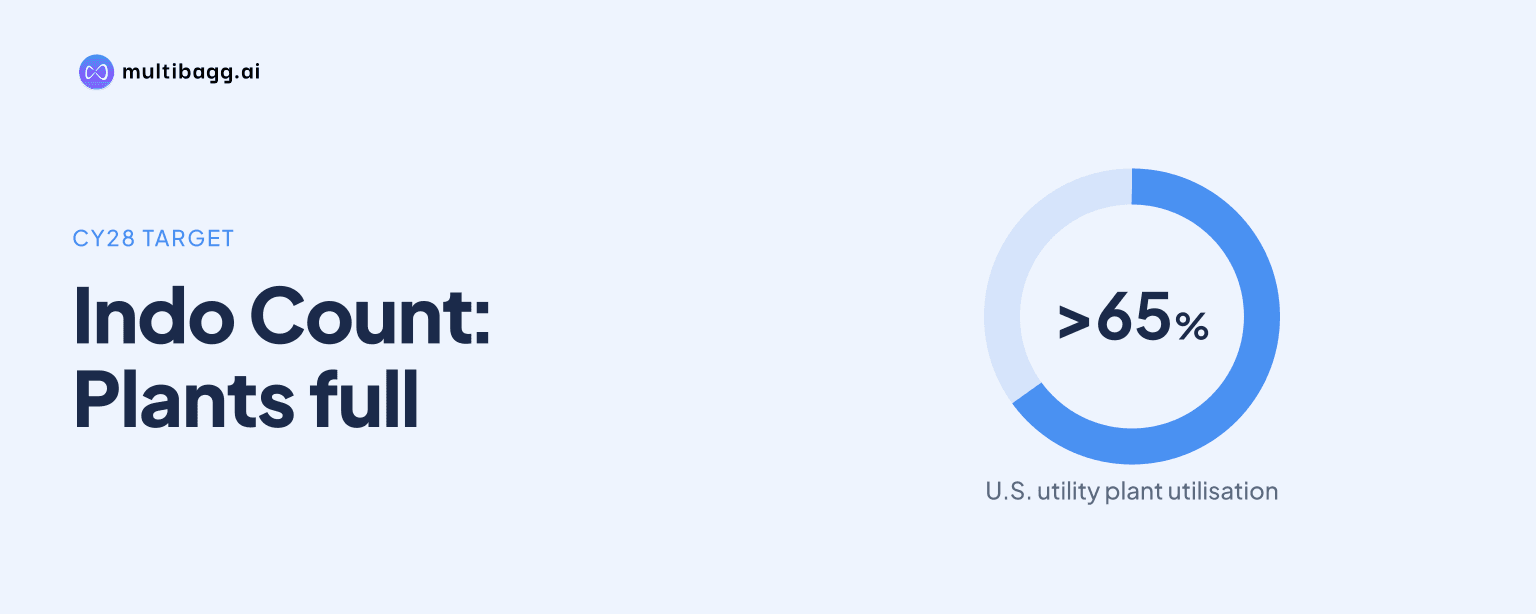
Indo Count Industries Limited targets full utilisation of all three U.S. utility-bedding plants by CY28, after management said each facility exceeded 65% utilisation and new-business earnings before interest, tax, depreciation and amortisation (EBITDA) margins were in the low double digits, below the core business’s 15% guidance.
Know Indo Count Industries inside out
Results, valuation, peers and who's buying, in one view.
When will Indo Count’s U.S. utility plants reach full utilisation?
Indo Count expects its utility-bedding operations in the U.S. to reach full capacity utilisation by calendar year 2028, or CY28. Management said all three plants were operating above 65% utilisation, confirming that the figure applies to every facility rather than representing an average across the U.S. manufacturing network.
The stated target is specifically for the utility business, which accounted for two-thirds of new-business activity at the time of the call. Branded products made up the remaining one-third, meaning management’s utilisation objective relies principally on higher output from utility manufacturing while branded sales provide a separate growth channel.
Management did not disclose individual plant capacities or a quarterly utilisation trajectory from the current level of above 65% to 100%. It did, however, tie the CY28 ramp-up to its broader plan to build U.S. operations through manufacturing scale and branded bedding sales, including products sold under Wamsutta.
How will Indo Count improve margins in its new businesses?
Indo Count said new-business EBITDA margins were in the low double digits, compared with its 15% guidance for the core business. Management expects the new businesses to reach the core-business margin level as operations achieve fuller scale, and said convergence could emerge over the next two or three quarters.
Management identified two mechanisms for that improvement: larger manufacturing operations and a higher share of products sold under brands. The margin outcome is therefore not presented as an automatic result of moving plant utilisation from above 65% to 100%; it also depends on the development of branded sales within the U.S. platform.
For the current financial year, Indo Count had guided for a 13% blended EBITDA margin and said it expected to exceed that figure. Management said the consolidated margin could reach 14% or 15% during the year, but did not indicate an immediate move beyond 15%.
The core business performed above its 15% margin guidance in the reported quarter, according to management, although it did not provide a precise segment margin. It also said gross margin should be assessed annually because quarterly product mix can fluctuate, with annual gross margin expected to range from 50% to 55%.
What role will Wamsutta and branded bedding play by CY28?
Indo Count retained its target for branded business to reach US$10 crore by CY28. Management said Wamsutta played a major role in the reported quarter’s improvement in branded business, but it did not raise the US$10 crore target when asked whether the expansion of Wamsutta and other licensed brands could generate upside.
The company maintained a two-thirds utility and one-third branded split within new businesses. This places utility production at the centre of the plant-utilisation plan, while the one-third branded component is important to management’s expectation that new-business margins can move from low double digits toward the 15% core-business level.
Management said higher average realisation in the reported quarter came from higher-value orders and product mix, not refunds related to U.S. tariffs. It described the product mix as sustainable, but cautioned that realisation and gross margin should be evaluated over a full year rather than from one quarter alone.
Indo Count also said tariff refunds were not included in the reported result. That distinction means management attributed the improvement to operating efficiencies and product mix, rather than to a non-recurring tariff-related recovery, while giving no separate revenue or margin number for Wamsutta.
Got a follow-up? Ask IRIS
Can Indo Count meet its CY28 revenue target without growth capex?
Indo Count said it does not need growth capital expenditure to meet its Rs 8,000 crore revenue target for CY28, which would double revenue from Rs 4,000 crore in FY25. Management said the core business retains available capacity and that the CY28 objective can be met through the existing manufacturing footprint and planned utilisation increases.
For the current financial year, Indo Count had issued revenue guidance of Rs 5,500 crore. After reviewing first-half performance, management said it expected to surpass that guidance, but did not provide a revised revenue target or quantify the contribution expected from U.S. utility operations, branded business or non-U.S. exports.
The company has announced capital expenditure of Rs 250 crore to be deployed over 12 to 18 months, of which around Rs 40 crore was spent in the first half. The programme covers spinning and effluent-treatment projects, rather than a disclosed growth-capacity requirement for the Rs 8,000 crore CY28 revenue target.
Management expects most spending on the spinning project to be completed before the current year-end. The effluent-treatment project may extend into the following year, and management did not give a split between second-half spending and the amount expected to carry into FY28.
How are non-U.S. markets and trade agreements changing Indo Count’s mix?
Indo Count said non-U.S. markets represented around 30% of its core business and were growing by 20%. The U.S. consequently accounted for about 70% of core-business revenue at the time of the call, although management did not disclose the absolute revenue attached to either geography.
Management expects the core-business mix to shift in favour of non-U.S. markets over the next three years. It suggested the U.S. share could decline from 70% to around 60%, but stressed that it did not want to provide a formal percentage target for the eventual geographic mix.
The U.K. free trade agreement was implemented in July, while an agreement with the European Union had not yet taken effect. Management reported better customer interactions, more enquiries and greater interest from the U.K. and Europe after the U.K. agreement began, but did not quantify orders, shipments or resulting volumes.
Annual volume is returning close to the FY25 level of around 106 million metres, management said. It attributed that recovery to the U.S. and non-U.S. businesses together, leaving no separate volume disclosure that would show the contribution from U.S. utility plants versus other markets.
Conclusion
Indo Count’s CY28 strategy combines fuller use of three U.S. utility-bedding plants with a larger branded business. Every U.S. facility is already above 65% utilisation, while management expects manufacturing scale and branded sales, including Wamsutta, to lift low-double-digit new-business EBITDA margins toward the core business’s 15% level.
The next disclosures to watch are progress toward full utility utilisation by CY28, whether new-business margins begin closing the gap over the next two or three quarters, and the pace of the Rs 250 crore capital programme. Management also expects most spinning expenditure before the current year-end, while effluent-treatment spending may continue into FY28.