










Insecticides (India) Limited Rethinks Products on Resistance
Key highlights
- Insecticides (India) reported 42% year-on-year growth in PAT for Q3 FY25.
- Insecticides (India)'s Q3 FY25 gross profit was Rs 129.2 crore, up 20% from Rs 108.0 crore a year earlier.
- Insecticides (India) has outlined a Rs 150 crore capacity-expansion investment over two years.
- Rajesh Aggarwal said pest resistance is most challenging where the same pest pressures recur across seasons.
powered by IRIS
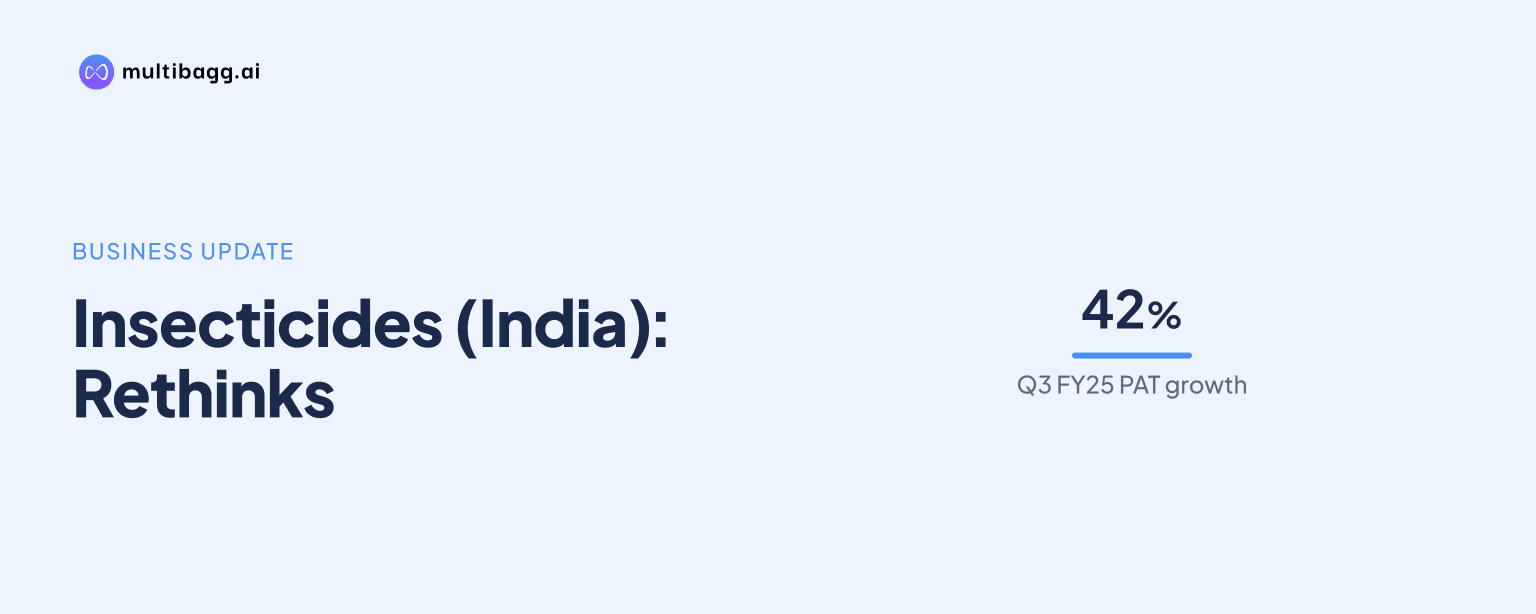
Insecticides (India) Limited is rethinking product strategies as recurring pest pressure can make pests resistant to chemicals and formulations, while the company reported 42% year-on-year growth in profit after tax for Q3 FY25. Managing Director Rajesh Aggarwal said resistance remains an evolving challenge, particularly where identical pest threats recur over successive seasons.
Know Insecticides India inside out
Results, valuation, peers and who's buying, in one view.
Why is Insecticides (India) changing its product strategy?
Insecticides (India) is reviewing its product approach because resistance to chemicals and formulations can emerge when crop fields face the same pest pressure over multiple seasons. Aggarwal identified this as an evolving issue for crop-protection companies, linking the challenge directly to repeated pest exposure in particular crops.
The observation places product strategy at the centre of operations for companies that sell insecticides and fungicides. A formulation that faces persistent resistance concerns may require a different commercial or product-development response than one used in crops with changing pest conditions. The available information does not specify individual products, crops, pest species, or changes to the company's product portfolio.
Insecticides (India) operates in crop protection and nutrition. Its stated concern is not limited to a single season: the key issue is the recurring nature of pest pressure, which can continue across seasons and affect the usefulness of chemical and formulation-based solutions.
What did Rajesh Aggarwal say about pest resistance?
Rajesh Aggarwal said resistance to chemicals and formulations is an evolving challenge, especially in crops where the same pest pressures continue over multiple seasons. His comments describe a practical operating issue for the agrochemical sector rather than a one-time disruption.
Resistance matters because crop-protection products are designed to manage specific pest and disease pressures. When the same pressure remains present season after season, companies need to assess whether their product strategies continue to address field conditions. Aggarwal's comments indicate that this assessment is becoming increasingly relevant for Insecticides (India).
The source does not provide a quantified estimate of the financial impact of resistance, nor does it state a product launch, regulatory filing, research budget, or timeline for any revised strategy. It does, however, establish pest resistance as a factor management is considering while shaping the company's product direction.
What financial data has Insecticides (India) reported?
Insecticides (India) reported 42% year-on-year growth in profit after tax for Q3 FY25, while gross profit rose 20% year on year to Rs 129.2 crore. The company reported gross profit of Rs 108.0 crore in Q3 FY24, according to its results for the quarter and nine months ended December 31, 2024.
The figures show that the company reported higher gross profit alongside stronger year-on-year PAT growth in Q3 FY25. The source does not disclose the absolute PAT figures, revenue, margin percentages, or the specific factors behind the PAT movement. Therefore, the available data supports a comparison of the reported growth rates but not a fuller profitability breakdown.
The company had also said it would invest Rs 150 crore over two years for capacity expansion. Separately, it incorporated wholly owned subsidiary IIL Overseas DMCC in Dubai on May 1 to trade insecticides and agricultural and veterinary products. These developments indicate that product strategy sits alongside expansion and trading activities within the broader business.
Got a follow-up? Ask IRIS
How does pest resistance affect the crop-protection industry?
Pest resistance affects the crop-protection industry by requiring companies to reassess the suitability of chemicals and formulations in fields with recurring pest pressure. For manufacturers, the issue can influence product planning, portfolio decisions and the way they address crop-specific needs.
For farmers and other users of crop-protection products, the relevance is operational. Persistent pest pressure across seasons can make effective pest management more difficult, particularly if existing solutions face resistance concerns. The source does not provide information on changes in customer demand, product prices, farm yields, or regional exposure.
The issue also provides context for Insecticides (India)'s efforts to build its business. The company has previously indicated that it is looking to acquire more brands to expand in India, and it has acquired several brands in the past. Brand acquisitions and capacity expansion are separate business actions, but both can broaden the company's operating platform as it addresses changing crop-protection requirements.
What does this mean for Insecticides (India) investors?
For Insecticides (India) investors, management's comments show that pest resistance is a product-strategy consideration alongside the company's reported Q3 FY25 profit growth. The 42% increase in PAT and 20% rise in gross profit provide the disclosed financial context, while the resistance issue highlights a longer-term operating challenge.
The available information does not report a share-price reaction, forecast, revised earnings target, or quantified cost linked to resistance. Investors therefore have confirmed evidence of management's concern and the company's recent financial performance, but not enough disclosed detail to measure the likely financial effect of any future product changes.
Capacity expansion of Rs 150 crore over two years and the Dubai subsidiary's trading mandate are additional operational points to monitor. Their eventual contribution to financial performance cannot be determined from the information provided. The central disclosed development remains the need to reconsider crop-protection product strategies where pest pressure repeats across seasons.
Conclusion
Insecticides (India) has identified pest resistance as an evolving challenge that is influencing how crop-protection companies approach chemicals and formulations. The concern is especially relevant in crops facing the same pest pressure repeatedly, while the company reported 42% year-on-year PAT growth and gross profit of Rs 129.2 crore in Q3 FY25.
Investors can watch for further disclosures on product strategy, brand acquisitions and the Rs 150 crore capacity-expansion plan. The source does not disclose a timetable for changes linked to pest resistance, leaving future product actions and their financial implications unresolved.