










IIL moves full Dahej commissioning target to December
Key highlights
- IIL expects Dahej to reach full production after a December restart in Q3 FY '27.
- IIL targets Sotanala formulation production by May in the next fiscal year if its April target slips.
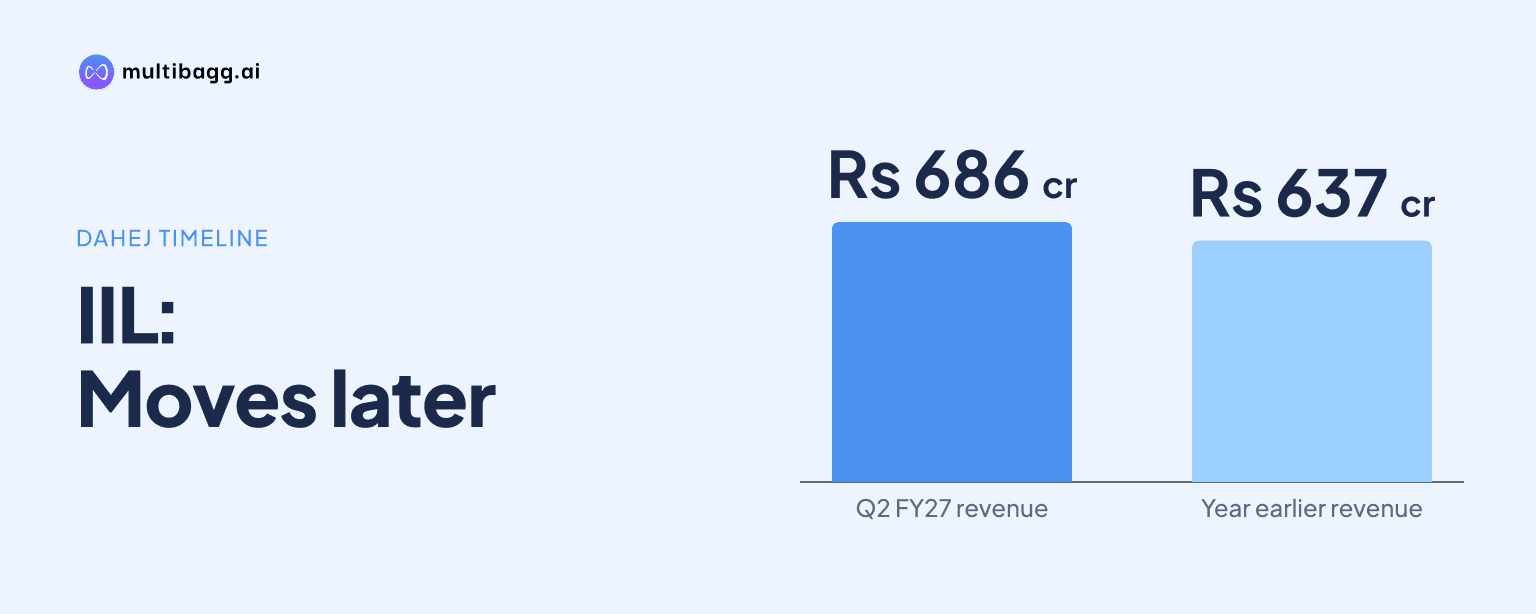
- IIL reported Q2 FY '27 revenue of Rs 686 crore, up 8% from Rs 637 crore a year earlier.
- IIL's net working capital was about Rs 1,000 crore on September 30, versus Rs 828 crore on March 31, 2026.
powered by IRIS
Insecticides India Limited now expects its Dahej plant to begin full production after a December restart in Q3 FY '27, moving completion from the first half of the year. IIL said partial manufacturing has begun, while Sotanala formulation is targeted for April and could shift by one month to May in the next fiscal year.
Know Insecticides India inside out
Results, valuation, peers and who's buying, in one view.
When will IIL fully commission the Dahej plant?
IIL expects to complete Dahej in Q3 FY '27 and run the plant at full scale after its December shutdown and restart. Management had previously expected to clear the project in the first half of FY '27, but said Dahej is currently only partly manufacturing and partly capitalised. It expects full capitalisation by the end of December.
The revised schedule is linked to gaps identified in electricity and utilities at the site. Management said these gaps had been sorted out and that production had already started in part. It said the post-shutdown restart would enable full production, while further improvements planned for the following year would not prevent the December operating milestone.
Management described the additional Dahej work as small maintenance capital expenditure rather than a major new cost. The company did not disclose a revised project cost, a capex budget, or the financial impact of moving full commissioning from H1 FY '27 to Q3 FY '27.
Why did IIL move Dahej completion into Q3 FY '27?
IIL moved the Dahej completion timetable into Q3 FY '27 after finding electricity and utility gaps that required correction before full-scale production. Management said the plant would restart “in full swing” after the December shutdown, indicating that the core operating work is expected to be completed before that restart.
The company separated the December production milestone from later optimisation work. Management said some plant improvements would continue in the next year, but characterised them as maintenance capex. That distinction means the company expects Dahej to be available for production before all subsequent enhancements are finished.
The later completion comes during a period of lower sales volumes. Management said Q2 FY '27 volume growth was negative by about 6% to 7%, while value growth was about 4% to 5% because IIL sold more value-added and premium products. Revenue from operations nevertheless rose 8% year on year to Rs 686 crore in Q2 FY '27 from Rs 637 crore.
Profitability also reflected the product mix during the quarter. Earnings before interest, tax, depreciation and amortisation, or EBITDA, were Rs 92.44 crore in Q2 FY '27, with an EBITDA margin of 13.5%. Management attributed the volume pressure to low rains, which reduced demand for herbicides and granular products that typically account for substantial volumes.
When will IIL start Sotanala formulation and technical manufacturing?
IIL targets the start of formulation production at Sotanala in April of the next fiscal year, although management said this could move by one month to May. It cited a “gap in force” in the National Capital Region, or NCR, as the reason for a possible delay of one or two months.
Management said the complete formulation unit and the first part of technical manufacturing would start in the next fiscal year. Its earlier ambition for technical manufacturing was a Diwali start; if that does not occur, management said the timing could move to December or January. The call therefore provides a narrower May target for formulation and a broader next-fiscal-year window for technical output.
Sotanala is intended to support both IIL's own manufacturing and contract work. Management said it is building a state-of-the-art distributed control system, or DCS, plant and plans to pursue contract development and manufacturing organisation, or CDMO, business from the site. It also plans to upgrade Dahej to a similar standard so both sites can undertake CDMO activities.
Management described CDMO as contracted supply in which a customer may buy a molecule on an exclusive or semi-exclusive basis. It said most discussions were with Japanese companies, although talks also involved other companies. Registrations, product data and customer qualification must be completed before such business begins, and management gave no CDMO revenue target or contract value.
Got a follow-up? Ask IRIS
How do Dahej and Sotanala support IIL's export plans?
IIL intends the two plants to support technical-product exports and CDMO opportunities, while its present international business is weighted toward formulation exports. Management said IIL supplies white-labelled formulations to more than 25 countries and has about 35 formulations registered across multiple markets.
Technicals are the planned export growth area, according to management. IIL has filed registrations for about 12 technical products in various countries, with many already receiving registrations, and is working on 15 technicals in total. Management said technicals have started moving to Commonwealth of Independent States markets, Europe, America and Asian countries.
IIL also has a domestic technical base. Management said it has 28 technical products in domestic markets and generates more than Rs 400 crore of business-to-business sales. It expects two or three products to be added annually, although older products can also be removed from the portfolio.
Management said export products require higher active-ingredient content, lower impurities, improved quality and better manufacturing yields. These requirements mean commissioning alone does not establish CDMO revenue. Management said small CDMO breakthroughs had begun and that it intended to pursue the business more actively in the next fiscal year.
What operating and cash-flow measures should be tracked?
The main operating measures to track are Dahej's December restart, Sotanala formulation by May, and technical manufacturing during the next fiscal year. Management said that after Sotanala is completed, the major capex cycle would be behind IIL and the focus would shift toward raising utilisation at the facilities it is building.
Working capital is a related measure because management said inventory and debtors were elevated. Net working capital was about Rs 1,000 crore on September 30, compared with Rs 966 crore on September 30, 2025, and Rs 828 crore on March 31, 2026. Working-capital days rose to 158 in H1 FY '27 from 151 in H1 FY '26.
Inventory increased to Rs 814 crore from Rs 744 crore year on year, while debtors rose to Rs 719 crore from Rs 643 crore. Creditors increased to Rs 533 crore from Rs 420 crore. Management said it was focused on improving working-capital efficiency and cash-flow generation and expected interest costs to normalise with positive cash flow after Sotanala's completion.
For the first half, IIL reported EBITDA of Rs 161 crore and an EBITDA margin of 12.3%. Gross profit margin was 32.7% in H1 FY '27, compared with 31.7% in the comparable prior-year half. Management said it expected value growth rather than volume growth for the full year, supported by premium products and raw-material cost pass-through.
Conclusion
The revised timetable changes the sequence of IIL's manufacturing expansion rather than its stated plan. Dahej is expected to reach full production after a December restart, while Sotanala formulation is targeted by May in the next fiscal year and technical manufacturing is expected later in that year. Management links both sites to utilisation gains, technical exports and CDMO development, but has not disclosed project-cost revisions, contract values or revenue targets for these activities.
The next disclosed milestones are Dahej's December restart, the possible shift of Sotanala formulation from April to May, and the start of Sotanala technical manufacturing in the next fiscal year. Management's plan also makes working-capital improvement a key unresolved measure, after net working capital reached about Rs 1,000 crore on September 30 and working-capital days increased to 158 in H1 FY '27.