










Insecticides India Limited Q2 revenue rises 8% despite volumes
Key highlights
- IIL reported Q2 FY27 revenue of Rs 686 crore, up 8% from Rs 637 crore in Q2 FY26.
- Management reported a 6% to 7% Q2 FY27 volume decline, while premium products supported sales value.
- IIL reported Q2 FY27 EBITDA of Rs 92.44 crore at a 13.5% margin and profit after tax of Rs 56.17 crore.
- H1 FY27 working-capital days rose to 158 from 151 a year earlier, with net working capital at about Rs 1,000 crore.
powered by IRIS
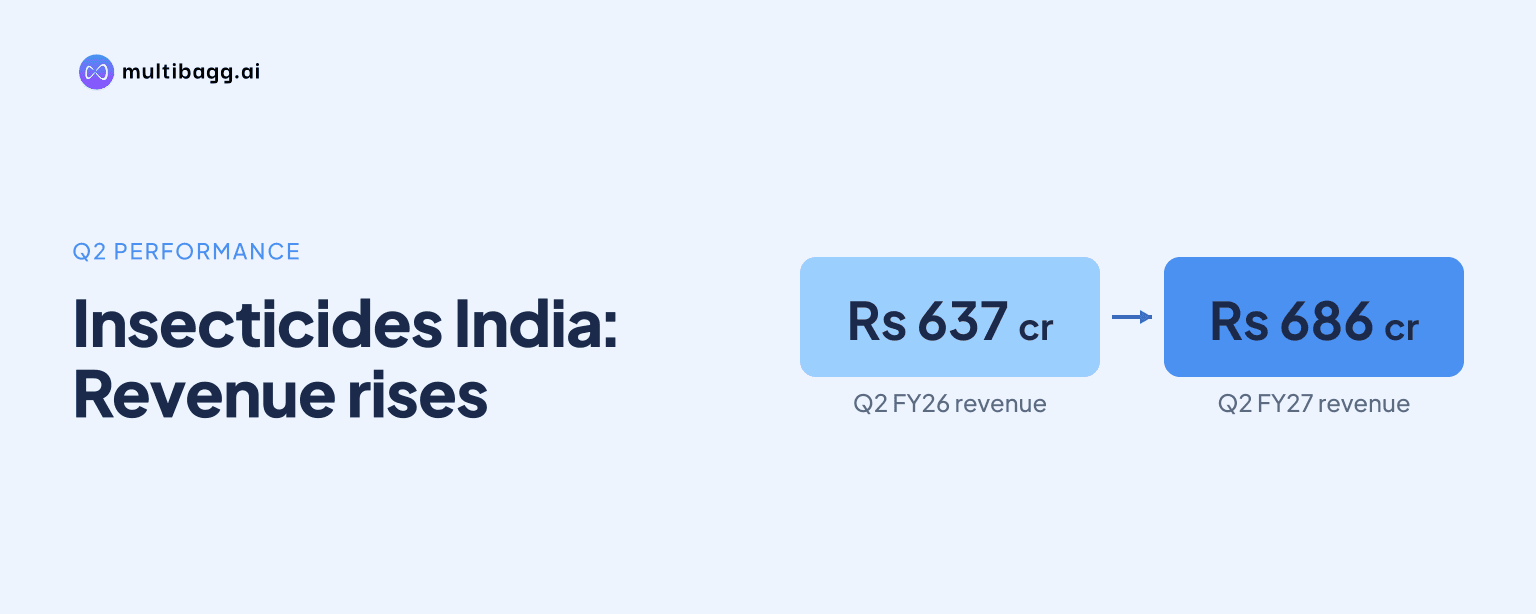
Insecticides India Limited reported Q2 FY27 revenue of Rs 686 crore, up 8% year on year from Rs 637 crore, despite management reporting a 6% to 7% decline in sales volumes. IIL said sales of premium and value-added products, alongside some input-cost pass-through, supported revenue during a weather-disrupted crop season.
Know Insecticides India inside out
Results, valuation, peers and who's buying, in one view.
What drove IIL's Q2 FY27 revenue growth?
IIL's Q2 FY27 revenue growth was driven by product mix and sales value rather than higher physical volumes. Revenue from operations increased to Rs 686 crore from Rs 637 crore in Q2 FY26, while Managing Director Rajesh Aggarwal said volume declined by about 6% to 7%. He said IIL had sold value-added and premium products better, resulting in 4% to 5% value growth in the product-sales measure he discussed.
Management attributed the volume pressure partly to low rainfall and weather disruption across agricultural regions. It said herbicide and granule sales, categories that carry substantial volumes, were lower because of low rains. Weather also affected sugarcane and paddy, as well as maize, cotton, soybean and chilli, although management said farmers continued to seek new-technology crop-protection products.
IIL said farmers had reduced the number of sprays but were choosing better crop-protection solutions. Management also reported an inflationary trend in agricultural commodity prices, excluding vegetables affected by seasonal pressures, and said farmer profitability had remained intact to a greater extent despite low yields. That backdrop supported demand for premium products but did not reverse the Q2 volume decline.
How did lower volumes affect IIL's earnings?
IIL reported Q2 FY27 earnings before interest, tax, depreciation and amortisation, or EBITDA, of Rs 92.44 crore, equal to a 13.5% margin, and profit after tax of Rs 56.17 crore. Gross profit margin was 33.7%, compared with 34.5% in Q2 FY26, a decline of 80 basis points, where 100 basis points equal one percentage point. Revenue rose despite lower volume, but the quarterly gross-margin comparison declined.
The H1 FY27 gross-margin comparison moved in the other direction. Gross profit margin was 32.7% in H1 FY27, against 31.7% in the comparable prior-year half, an improvement of about 100 basis points. H1 FY27 EBITDA was Rs 161 crore at a 12.3% margin, while profit after tax was about Rs 100 crore.
Management did not quantify the contribution of premium products versus pricing to Q2 value growth. In response to an analyst question, Rajesh Aggarwal said value growth reflected a combination of raw-material cost pass-through and greater premium-product sales. He added that FY27 was not expected to be a year of volume growth, although management expected value growth and some improvement in H2.
Got a follow-up? Ask IRIS
Which products and channels supported IIL's sales mix?
IIL said newer-generation products drew farmer interest, while Gold products accounted for a particular part of the decline. Management said both Focus Maharatna and Maharatna recorded an increase in H1 FY27, and that Maharatna delivered a decent increase in Q2. IIL did not provide product-wise H1 FY27 revenue figures on the call.
Kaeros was a second focus for distribution and brand expansion in H1 FY27. Management said Kaeros brand business recorded gross turnover of about Rs 75 crore, while total Kaeros sales were Rs 114 crore in the half year. IIL had opened its North, East and West networks and said its target was to open southern India during FY27 for nationwide availability.
Management targets more than Rs 125 crore of Kaeros brand turnover in FY27, while saying standalone Kaeros could reach roughly Rs 200 crore for the fiscal year. These are management targets rather than reported results. IIL also held more than 18,000 farmer meetings, completed more than 9,000 demonstrations and met more than 2.5 lakh farmers in H1 FY27.
The field programme included about 70 IIL crop-solution plots across rice, cotton, soybean and chilli, compared with about 30 plots in the previous year. Management said the plots demonstrated productivity and cost outcomes from IIL's recommended solutions, sometimes with fewer sprays. The expansion in plots and farmer meetings was part of IIL's effort to support adoption of premium and new-generation products.
What are IIL's cash flow and capacity priorities?
IIL's working-capital requirement rose as inventory and debtors increased. Working-capital days were 158 in H1 FY27, compared with 151 days in H1 FY26. Inventory increased to Rs 814 crore from Rs 744 crore, debtors rose to Rs 719 crore from Rs 643 crore, and creditors increased to Rs 533 crore from Rs 420 crore.
Net working capital was about Rs 1,000 crore on September 30, 2026, compared with Rs 966 crore a year earlier and Rs 828 crore on March 31, 2026. Management said inventory and debtors were elevated and identified working-capital efficiency and cash-flow generation as priorities. It also said most channel returns had already been received in Q2 FY27 and reported sales were net of those returns.
IIL expects the Dahej project to be fully completed and capitalised by December 2026, after partial manufacturing had begun. Management said production should operate fully after a December restart following a shutdown, with further smaller improvements classified as maintenance capital expenditure planned for the following year.
Management targets the start of formulation production at Sotanala in April of the next fiscal year, while allowing for a one- or two-month delay to May. Technical manufacturing is also planned to begin in the next fiscal year. IIL intends to raise utilisation after the capital-expenditure cycle and pursue contract development and manufacturing organisation, or CDMO, work from Sotanala and Dahej.
Conclusion
IIL's Q2 FY27 revenue increase to Rs 686 crore came from sales value, product premiumisation and some pricing rather than a recovery in physical demand. The reported 6% to 7% volume decline, Q2 gross-margin decline to 33.7% from 34.5%, and increase in working-capital days to 158 qualify the 8% top-line growth, although H1 gross margin improved to 32.7% from 31.7%.
The next measures to watch are management's expected H2 value-growth improvement, Dahej's planned full completion by December 2026, and the targeted Sotanala formulation start around April or potentially May of the next fiscal year. Kaeros performance against management's FY27 target of more than Rs 125 crore in brand turnover, along with inventory, debtors and net working capital after the September 30, 2026 balance, will also show whether revenue growth converts into improved cash flow.