










Insecticides India builds technical exports and early CDMO base
Key highlights
- IIL said international business contributes about 5% of revenue.
- IIL is working on about 15 technical active ingredients for overseas markets.
- IIL supplies white-label formulations in more than 25 countries.
- IIL said B2B sales contribute more than Rs 400 crore.
powered by IRIS
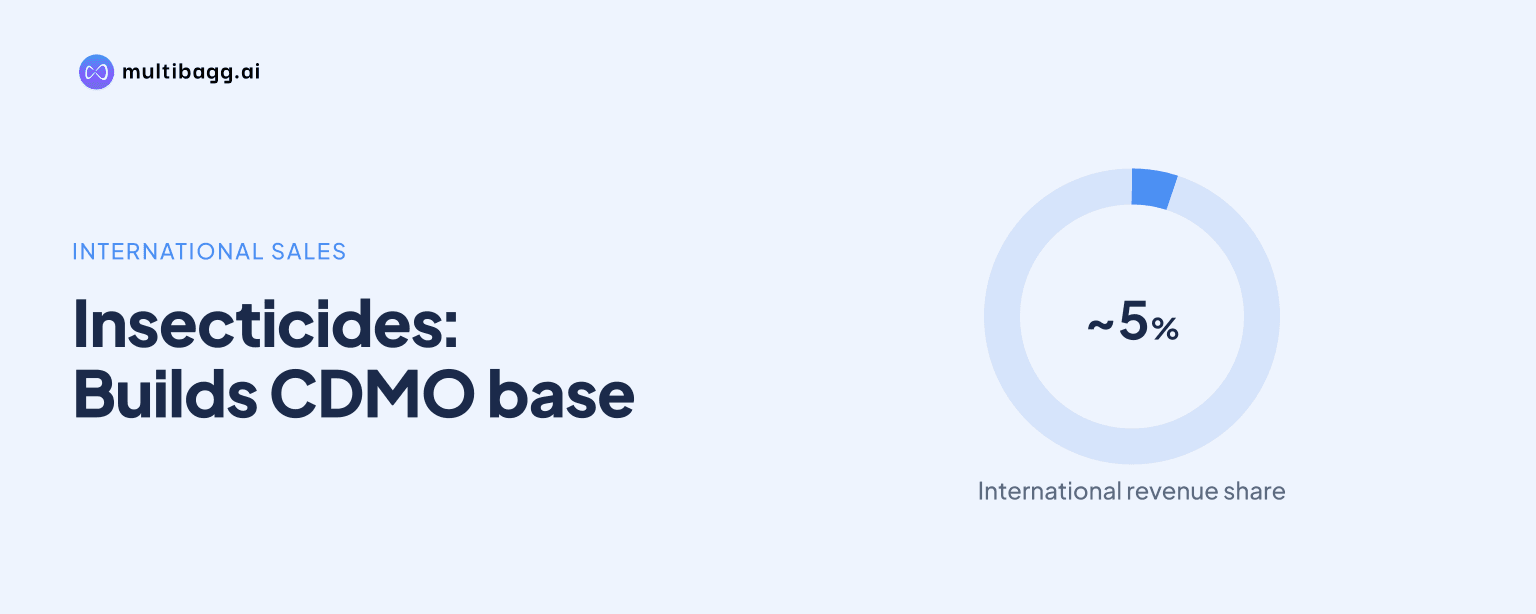
Insecticides India is shifting its export emphasis toward technical active ingredients and contract development and manufacturing organisation, or CDMO, work, with more than 10 technicals registered and about 15 active ingredients under development. Management said international business currently contributes about 5% of revenue and that CDMO activity remains at an early stage.
Know Insecticides India inside out
Results, valuation, peers and who's buying, in one view.
How is IIL changing its export strategy?
IIL is retaining white-label formulation exports while positioning technical products and CDMO contracts as the next sources of international growth. Its earlier export model involved packing formulations in small to large packs for customers in the Middle East, the Association of Southeast Asian Nations, or ASEAN, and the Commonwealth of Independent States, or CIS. Management said IIL supplies these customer-branded products in more than 25 countries.
The export mix is changing because technicals have begun moving to CIS markets and are also being supplied to Europe, America and Asian countries. Management said formulations remain the majority of current exports and technicals had not held a major share in the past. It nevertheless expects future export growth to come from technicals, making the strategy an expansion of the existing formulation business rather than its replacement.
IIL said international business contributes about 5% of revenue. Its domestic technical portfolio contains 28 products, and its business-to-business, or B2B, sales account for more than Rs 400 crore. Management is seeking to use this manufacturing and B2B base to serve overseas customers that require technical-grade material.
What registrations support IIL technical exports?
IIL’s technical-export plan is supported by more than 10 registered technicals and work across about 15 active ingredients, or AIs. Management said the AIs cover herbicides, insecticides and fungicides, and that it has made registrations or applications in the Americas, Europe, ASEAN and CIS markets. Registrations are required before the company can supply technical products in a customer’s destination country.
The registration pipeline is narrower than IIL’s domestic technical range, while the formulation footprint is broader by product count and geography. Management said many of the roughly 12 technicals filed for overseas registrations had already received approvals. It also said two or three products are generally added each year, although older products can also be removed from the portfolio.
Management said export-oriented technicals require higher AI content and lower impurities. IIL is working on quality, production yield and manufacturing efficiency to meet these requirements at competitive prices. Registration therefore enables market access, but it does not itself establish sales volumes, which also depend on customer qualification and demand.
How would IIL’s CDMO business operate?
IIL describes CDMO as a contracted business in which a customer takes a molecule on an exclusive or semi-exclusive basis. Management said some overseas companies are looking for an Indian supplier alongside China, while others may appoint IIL as a second supplier. The arrangement is intended to give customers a parallel sourcing option for a specified molecule.
Before such a business can begin, IIL may need to generate product data, meet country-specific requirements and obtain registrations in the relevant market. Management said IIL generally handles research and development, although a customer can provide paper technology that IIL must develop or enhance. The process combines product development, regulatory registration and manufacturing qualification.
Management said small CDMO breakthroughs and initial agreements have started, but it did not disclose customer names, contracted volumes or revenue. It said the majority of discussions are with Japanese companies, alongside discussions with other companies. Management added that a one-container shipment would not amount to significant commercialisation and that it would announce CDMO business when a long-term agreement and larger-scale activity begin.
Got a follow-up? Ask IRIS
Can IIL’s plants support technical exports and CDMO work?
IIL is developing its Dahej and Sotanala facilities in a direction intended to qualify them for CDMO customers. At Dahej, management expected completion in the third quarter after identifying electricity and utility gaps. Partial production had already started, and management said the plant would operate at full scale after its shutdown and restart in December.
Further Dahej improvements are planned for the next year and were described as maintenance capital expenditure rather than a major outlay. For Sotanala, management targeted an April start for formulation production but said this could slip by one or two months to May because of a gap in the National Capital Region, or NCR. The first technical-manufacturing part and the complete formulation unit are expected to start in the next fiscal year, potentially by December or January if delayed.
The facility schedule matters because registrations alone do not establish CDMO eligibility. Management linked the development of Dahej and Sotanala to qualifying for international customers, but gave no capacity figures, export-volume targets or date for a large CDMO launch. Customer approval remains a separate step after production capability is installed.
What could limit IIL’s export expansion?
IIL said international markets are also experiencing weak conditions because the impact of El Nino extends beyond India. Management cited competition, currency pressure in certain overseas markets and demand that can involve long credit without letters of credit, or LC, backing. These conditions mean exports are not presented as an immediate offset to weak domestic demand.
The company is moving from a formulation-led export base in more than 25 countries to a technical and contract-manufacturing model involving about 15 AIs. Management said technical sales have only started and CDMO arrangements are still in their initial stages. The gap between the established white-label network and the technical-registration pipeline shows the regulatory, quality and customer-development work still required.
Conclusion
IIL’s export strategy adds technical sales and potential contracted supply relationships to a formulation business that already reaches more than 25 countries. More than 10 registered technicals, about 15 AIs under development and B2B sales of more than Rs 400 crore provide the disclosed base for that shift, while international business remains about 5% of revenue.
The next disclosed milestones are Dahej’s full-scale restart after December, Sotanala formulation production targeted for April or potentially May, and Sotanala technical manufacturing in the next fiscal year. Management has also said it will announce CDMO activity when long-term agreements move beyond initial shipments into larger-scale commercial business.