










Insolation Energy Limited Revenue Nearly Doubles in Q2, Profit Falls
Key highlights
- Insolation Energy reported Q2 FY27 revenue of ₹836.69 crore, up 96.45% year on year.
- Q2 FY27 net profit declined 32.18% year on year to ₹25.06 crore.
- H1 FY27 revenue reached ₹1,582.09 crore, while EBITDA margin was 8.87%.
- Insolation Energy reported an order book of more than 2.1 GW and plans for 4.5 GW of TOPCon cell capacity.
powered by IRIS
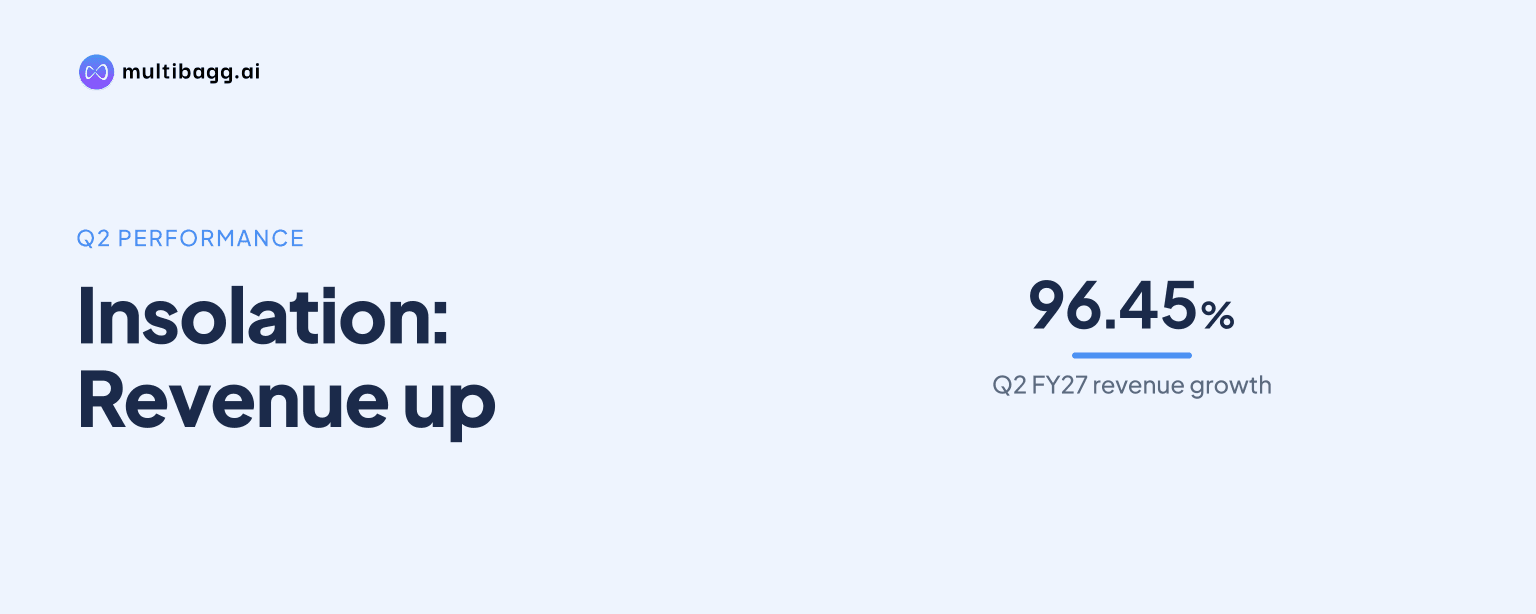
Insolation Energy Limited reported Q2 FY27 revenue of ₹836.69 crore, up 96.45% year on year, while net profit fell 32.18% to ₹25.06 crore. The results show continued sales expansion from manufacturing scale-up, but also reflect margin pressure from industry pricing and input costs.
Know Insolation Energy inside out
Results, valuation, peers and who's buying, in one view.
What did Insolation Energy report for Q2 FY27?
Insolation Energy reported revenue of ₹836.69 crore for the quarter ended September 30, 2026, compared with the corresponding quarter a year earlier, representing 96.45% year-on-year growth. Net profit for Q2 FY27 was ₹25.06 crore, down 32.18% year on year despite the sharp increase in revenue.
For the first half of FY27, revenue rose 100.56% year on year to ₹1,582.09 crore. H1FY27 net profit declined 21.22% to ₹63.08 crore, while the EBITDA margin stood at 8.87%. The half-year numbers incorporate the June-quarter performance, when the company reported revenue of ₹745.40 crore and profit after tax of ₹38.02 crore.
Why did Insolation Energy's profit decline despite revenue growth?
Insolation Energy attributed the pressure on margins to industry pricing and input costs, even as revenue increased at a rapid pace. The company has indicated that it expects margin improvement, but the results provided do not specify a timeline or a quantified margin target.
The contrast between revenue and profit growth is relevant because solar module manufacturing can be affected by selling-price competition and movements in raw-material costs. In Q1 FY27, EBITDA rose 32.97% year on year to ₹76.87 crore, which was slower than the 105.37% rise in revenue, and EBITDA margin was 10.31%. The H1 FY27 EBITDA margin of 8.87% provides a broader indication of the margin environment during the first six months of the year.
The company is seeking to address cost and supply-chain factors through backward integration. Its plans include solar-cell production and aluminium-frame manufacturing, which are intended to increase control over important components. These projects remain central to management's expectation of improving margins.
What expansion projects is Insolation Energy pursuing?
Insolation Energy has reported 5.5 GW of photovoltaic module manufacturing capacity across its Jaipur facilities and is building additional backward-integrated operations. The company has outlined plans for 4.5 GW TOPCon solar-cell lines and an aluminium-frame plant with annual capacity of 18,000 metric tonnes at Narmadapuram.
According to the Q1 FY27 investor presentation, civil work and pre-engineered building erection for the cell project were complete, utilities had been ordered, and the first funding tranche had been disbursed. The company had targeted factory commercial operation for December 2026, followed by trial production. The presentation also referred to a September 2026 target for commercial operation of the aluminium-frame facility, but the supplied information does not provide a subsequent commissioning update.
The company's order book was stated at more than 2.1 GW, including module supply, rooftop and government-linked projects. The investor presentation cited an NTPC Renewable Energy order valued at ₹558 crore among recent orders. It also listed a target of building an independent power producer portfolio of more than 400 MW by FY27 and scaling EPC and operations and maintenance activity from more than 100 MW to 400 MW by FY27.
Got a follow-up? Ask IRIS
How do the results affect Insolation Energy investors and operations?
For investors, the results present two distinct trends: revenue growth remains high, while profitability has weakened because of margin pressure. The H1 FY27 revenue of ₹1,582.09 crore represents a substantial share of FY26 revenue of ₹2,163.52 crore, although period-to-period comparisons should account for the different duration of the reporting periods.
The company's expansion programme requires capital alongside operating execution. At the end of FY26, Insolation Energy reported long- and short-term borrowings of ₹841 crore and cash of ₹521 crore. These figures provide context for the funding needs of its cell and frame projects, but the available disclosures do not state fresh borrowing, capital expenditure or cash-flow figures for Q2 FY27.
For customers and project counterparties, the reported order book and operating capacity indicate a sizeable pipeline of module supply and solar-project activity. However, the company has not provided project-level execution updates for the September quarter in the information supplied. Its ability to convert the order book into revenue and to improve margins will therefore remain important operational measures.
What will management discuss in the Q2 FY27 earnings call?
Insolation Energy has scheduled an earnings conference call for Monday, November 16, 2026, at 3:30 PM IST to discuss its unaudited Q2 and H1 FY27 results. The company invited analysts and institutional investors to participate through dial-in arrangements and a pre-registration link.
The call provides a formal opportunity for management to address the revenue increase, the decline in quarterly and half-year profit, and the expected effect of backward integration on costs and margins. Investors may also seek details on the commissioning status of the aluminium-frame plant, progress toward the December 2026 cell-facility target, order-book execution and funding requirements.
Conclusion
Insolation Energy's Q2 FY27 results show that manufacturing scale-up and project execution are supporting rapid revenue growth, with quarterly revenue reaching ₹836.69 crore. Yet the fall in net profit to ₹25.06 crore and the H1 EBITDA margin of 8.87% underline the effect of pricing and input-cost pressure on financial performance.
The next disclosures to watch are management's comments during the November 16 earnings call and updates on the planned 4.5 GW TOPCon cell lines, for which factory commercial operation had been targeted for December 2026. Progress on the 18,000-tonne aluminium-frame plant, the 2.1 GW-plus order book and the company's funding position will also be relevant.