










Interarch says heavy structures reach 20% of order book
Key highlights
- Interarch said heavy structures represented about 15% to 20% of its Rs 2,000 crore-plus residual order book on 31 October.
- Management said both new heavy-structure lines were fully loaded, with current heavy-structure capacity of 25,000 tonnes.
- H1 FY27 revenue rose 10.7% to Rs 965 crore, while EBITDA increased to Rs 81.1 crore.
- Interarch reaffirmed its FY27 revenue expectation of Rs 2,150 crore to Rs 2,200 crore.
powered by IRIS
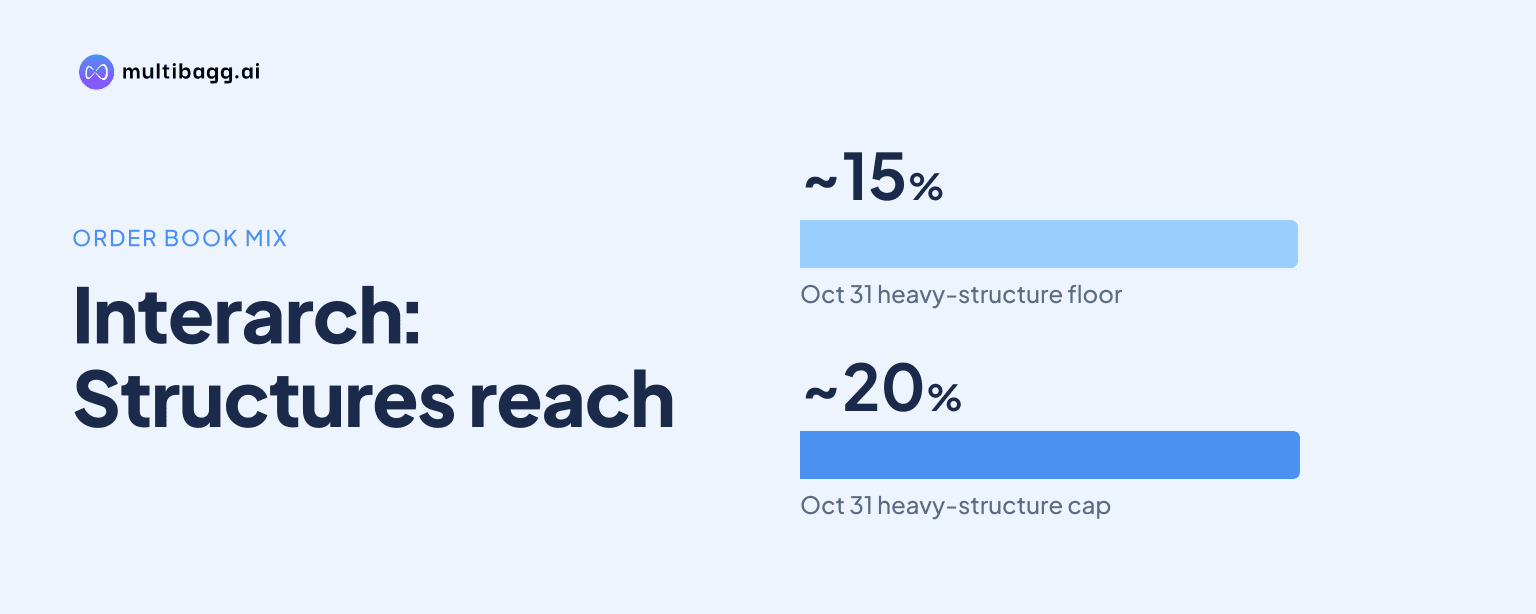
Interarch said on 31 October that heavy structures represented about 15% to 20% of its residual order book of more than Rs 2,000 crore, as its new heavy-structure lines were fully loaded. The work includes data centres, hospitals, hotels and commercial buildings, widening the projects it can manufacture.
Know Interarch Building Solutions inside out
Results, valuation, peers and who's buying, in one view.
How much of Interarch’s order book is in heavy structures?
Interarch said approximately Rs 350 crore to Rs 400 crore of its residual order book of a little over Rs 2,000 crore was heavy-structure work, equating to about 15% to 20% of the total. Management described this as unexecuted work, rather than revenue already recognised.
Later in the call, management gave a narrower estimate of about Rs 300 crore to Rs 350 crore in heavy structures within the Rs 2,000 crore net order book. The stated ranges differ, but both indicate that heavy-structure projects form a minority of the book while providing a sizeable pipeline of projects outside conventional pre-engineered buildings.
Interarch said the Rs 2,000 crore-plus order book represented about nine to 10 months of capacity. Management said it could not book work beyond customers’ required delivery schedules, noting that most pre-engineered building projects take four to nine months while data-centre projects can take 10 to 11 months.
What does Interarch classify as a heavy structure?
Interarch classifies a heavy structure by the weight of each manufactured component, with pieces from the dedicated plant weighing more than five tonnes and up to 20 tonnes or 25 tonnes. Management said most components from its existing pre-engineered building facilities weigh below five tonnes.
The capability allows Interarch to bid for data centres, high-rise buildings, lithium-battery plants and microchip plants that require heavier structural pieces. Management also identified hospitals, hotels, institutions, process buildings and multi-storey commercial projects as applications for the heavier steel components.
Interarch said its current heavy-structure work includes two data centres, a hospital, a multi-storey hotel, a commercial building in Delhi and heavy process buildings for global companies in India. Management also said the company had recently won an airport-hangar project, adding another specialised application to its project pipeline.
Is Interarch’s heavy-structure capacity fully used?
Yes, Interarch said both heavy-structure lines that it had started were completely loaded at the time of the call. Management said current heavy-structure capacity was 25,000 tonnes and that the capacity enables the company to address projects it could not bid for previously.
The lines form part of a broader expansion that includes Andhra Pradesh Phase 1 and both phases of the Gujarat facility, which Interarch said were operational. Management expects those facilities to ramp up in subsequent quarters, supporting greater production and order-book capacity.
Interarch said it had spent more than Rs 250 crore on capital expenditure over roughly two-and-a-quarter years. That spending included completion of the Andhra plant, both Gujarat phases, upgrades at other plants, a line at Kichha and the Andhra Pradesh Phase 1 heavy-structure plant.
Got a follow-up? Ask IRIS
How did Interarch perform while expanding capacity?
Interarch reported Q2 FY27 revenue of Rs 505 crore, compared with Rs 491 crore in Q2 FY26, while earnings before interest, tax, depreciation and amortisation, or EBITDA, were Rs 41.7 crore. EBITDA margin was 8.3%, compared with 8.5% in the corresponding quarter of the prior year.
Profit after tax, or PAT, was Rs 30.7 crore in Q2 FY27, compared with Rs 32.3 crore in Q2 FY26. Management attributed the change to higher depreciation after capitalising the Gujarat and Andhra facilities, as well as lower interest income following spending on capital projects.
For H1 FY27, revenue increased 10.7% to Rs 965 crore from Rs 872 crore in H1 FY26. EBITDA rose to Rs 81.1 crore from Rs 73.3 crore, while the EBITDA margin was 8.4%; PAT was Rs 58.9 crore, compared with Rs 60.7 crore a year earlier.
Management said the first half is usually softer for project-related businesses because monsoon conditions can slow project execution. It reaffirmed its FY27 revenue expectation of Rs 2,150 crore to Rs 2,200 crore, citing available capacity, the order book and project clearances expected in the second half.
Why does management expect heavy structures to change margins?
Management expects heavy-structure work to have better-protected and potentially higher net margins than standard pre-engineered building projects, but Interarch did not report a separate segment margin. It said steel prices in these projects are passed through to customers, unlike in some conventional pre-engineered building contracts.
Management also said payment terms are stricter for heavy-structure projects, with payment not received after material leaves the factory, and that customers or contractors may handle some design or execution work. Those mechanisms could reduce commodity-price exposure and execution responsibilities, according to management.
Interarch management said it was aiming for margins of 10% to 12% over the next 12 months and expected to reach 11% to 12% within two years. It said heavy structures and exports may initially raise expenses because the company is investing in sales, detailing, execution and production capabilities before revenues scale.
Conclusion
Interarch’s heavy-structure capacity has become a visible part of its business mix, with about 15% to 20% of a Rs 2,000 crore-plus residual order book linked to data centres, hospitals, hotels and commercial projects. The shift coincides with H1 FY27 revenue growth of 10.7% to Rs 965 crore and the commissioning of new manufacturing facilities.
The next measures to watch are H2 FY27 execution, the ramp-up of Andhra Pradesh Phase 1 and Gujarat, and conversion of the fully loaded heavy-structure lines into revenue. Management is targeting capacity equivalent to Rs 200 crore to Rs 220 crore of monthly business over the next 12 months and expects the margin effect of heavy structures and exports to take one to two years.