










Interarch targets 11%-12% EBITDA margin within two years
Key highlights
- Interarch reported H1 FY27 revenue of Rs 965 crore, up 10.7% from Rs 872 crore.
- Interarch's H1 FY27 EBITDA margin was 8.4%, while Q2 FY27 margin was 8.3%.
- Interarch targets an EBITDA margin of 11%-12% within two years.
- Heavy structures represented about Rs 350 crore-Rs 400 crore of the Rs 2,000 crore-plus residual order book.
powered by IRIS
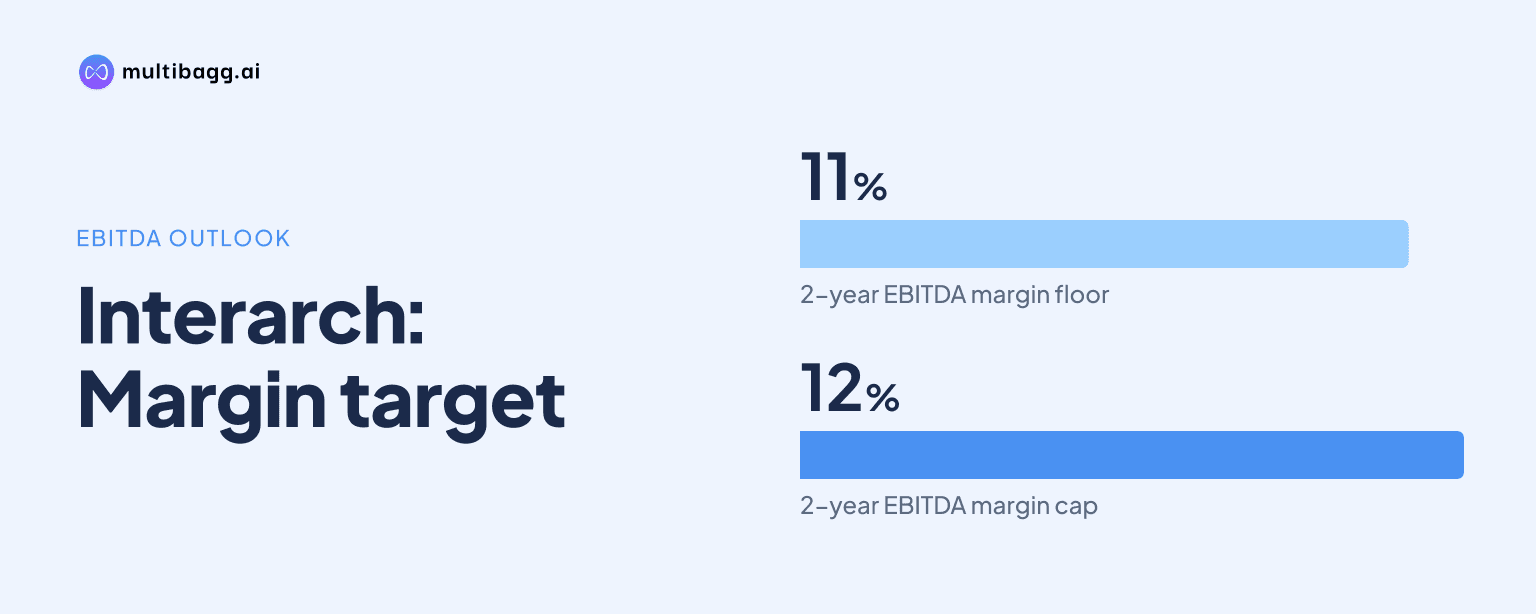
Interarch said it targets an earnings before interest, tax, depreciation and amortisation (EBITDA) margin of 11%-12% within two years, versus 8.4% in the first half (H1) of FY27, as export orders, heavy steel structures and larger project volumes are expected to improve operating leverage after initial capability-building costs.
Know Interarch Building Solutions inside out
Results, valuation, peers and who's buying, in one view.
Why does Interarch expect EBITDA margin to rise?
Interarch expects exports and heavy steel structures to lift net margins because they can use much of its existing overhead base while adding revenue. Management said export buildings can be manufactured and supplied without substantial sales costs, while larger projects should increase turnover without general overhead rising at the same rate.
Management's stated objective is an 11%-12% EBITDA margin within two years, compared with 8.3% in Q2 FY27 and 8.4% in H1 FY27. It also described a longer-term aspiration of more than 14%-15%, but did not give a timetable for that level. The nearer target depends on scaling exports, heavy structures and larger orders.
Heavy structures are components weighing more than 5 tonnes, while most pieces from Interarch's conventional pre-engineered building facilities weigh below 5 tonnes. Management said some heavy pieces weigh 20-25 tonnes. This capability expands bidding into data centres, high-rise buildings, hospitals, hotels, airport hangars, lithium-battery plants and microchip plants.
What was Interarch's H1 FY27 earnings performance?
Interarch reported Q2 FY27 revenue of Rs 505 crore, compared with Rs 491 crore in Q2 FY26, while EBITDA was Rs 41.7 crore in both periods. EBITDA margin declined by 0.2 percentage points to 8.3% from 8.5%. Profit after tax (PAT) fell to Rs 30.7 crore from Rs 32.3 crore, which management attributed to depreciation on newly capitalised Gujarat and Andhra Pradesh facilities and lower interest income after capital spending.
For H1 FY27, revenue rose 10.7% to Rs 965 crore from Rs 872 crore in H1 FY26, and EBITDA rose 10.7% to Rs 81.1 crore from Rs 73.3 crore. EBITDA margin remained 8.4%, while PAT declined to Rs 58.9 crore from Rs 60.7 crore. Thus, operating profit increased in line with revenue over the half year, but the margin did not expand.
Management said it does not expect a major FY27 margin increase despite indicating revenue of about Rs 1,200 crore in the final two quarters, after about Rs 950 crore in H1. Higher second-half execution should provide operating leverage, but management said spending on exports and newer building categories means FY27 EBITDA margin may not exceed the previously achieved 9%-9.5% range.
How can heavy structures and exports improve Interarch's economics?
Interarch said heavy-structure projects have more protected margins because steel prices are passed through to customers, unlike some pre-engineered building contracts. Management also cited stricter payment terms, client-led design in some projects and cases where the client or contractor undertakes project execution. These mechanisms, it said, reduce price and execution risk while supporting higher net margins.
Interarch's residual order book exceeded Rs 2,000 crore on 31 October, of which management put heavy structures at about Rs 350 crore-Rs 400 crore, or roughly 15%-20%. The business included a commercial building in Delhi, two data centres, a hospital, a multi-storey hotel and heavy process buildings. Management said the two heavy-structure lines that had started were fully loaded for the next year.
Exports are the second identified margin lever. Interarch had announced a memorandum of understanding in Q4 with ER Steel Canada for Open Web Steel Joist systems, with planned initial funding of Rs 80 crore. It also said it was executing some African projects. Management said exports of Rs 100 crore-Rs 200 crore in two to three years could add better-margin business, without providing a separate export-margin target.
Got a follow-up? Ask IRIS
What could delay Interarch's margin improvement?
Management said the benefits from exports and heavy structures could take one to two years because design engineering, travel and selling costs arise before corresponding revenue is recognised. The heavy-structure operation began on 24 September, so management expects sales from that facility mainly in Q3 and Q4 rather than H1 FY27.
Steel-price movement and supply disruption also affected the cost base over the preceding six to eight months, according to management. Interarch said it had to carry higher inventory to maintain deliveries. Around 35%-40% of the Rs 2,000 crore order book had variable pricing, allowing steel-cost changes to pass through, while about 60% was fixed-price business booked at a mix of current and earlier prices.
Working-capital requirements increased as larger, longer-duration orders were executed and two plants became operational. An analyst cited gross working-capital days of 86, versus 66 previously, while management said net working capital, after customer advances, stood at 44 days. Management cited larger orders, inventory stocking and the critical mass needed at new plants, while saying receivables and inventory offered scope for improvement.
How much capacity and revenue does Interarch plan to add?
Interarch said its Rs 2,000 crore-plus order book represented about nine to 10 months of capacity, with a blended execution period of 10-11 months. Management aims for an order-book level equivalent to Rs 200 crore-Rs 220 crore of monthly business over the next 12 months as Gujarat and heavy-structure capacity ramps up. It said order intake must match customers' delivery schedules and available production capacity.
The fully functional Gujarat plant is expected to add about 40,000 tonnes of annual pre-engineered-building capacity from next year. Management expects 35,000-40,000 tonnes from the Andhra Pradesh heavy-structure plant in FY28 and targets at least 100,000 tonnes of additional saleable capacity by March 2028. It then plans another 100,000 tonnes between March-April 2028 and June-July 2029, potentially taking capacity to about 400,000 tonnes by 2029.
Interarch maintained FY27 revenue guidance of Rs 2,150 crore-Rs 2,200 crore. Q2 sales volume was 41,600 metric tonnes, up 1% year on year, while revenue rose 2.9% to Rs 505 crore. Management expects stronger H2 execution because customer clearances typically arrive later in the financial year.
Conclusion
Interarch's 11%-12% EBITDA-margin objective relies on changing revenue mix and improving scale rather than an immediate cost reduction. In H1 FY27, revenue and EBITDA each grew 10.7%, but the 8.4% margin remained unchanged as depreciation, export-development activity, heavy-structure selling costs and steel procurement conditions offset early operating leverage.
The next milestones are Q3 and Q4 sales from the heavy-structure plant that began operations on 24 September, delivery of current export orders and execution against FY27 revenue guidance of Rs 2,150 crore-Rs 2,200 crore. Management's plan to add at least 100,000 tonnes of saleable capacity by March 2028 will also determine how quickly the order book and the newer businesses can expand.