










Interarch shifts 40% of order book to steel pass-through pricing
Key highlights
- Interarch said 40% of its Rs 2,000 crore order book, or Rs 800 crore, has variable steel pricing.
- Management said Interarch had probably accepted no fixed-price orders in the preceding two to three months.
- Heavy-structure projects account for about Rs 350 crore to Rs 400 crore of Interarch's Rs 2,000 crore order book.
- Interarch said EBITDA margin declined to 8.3% from 8.5% in the prior year.
powered by IRIS
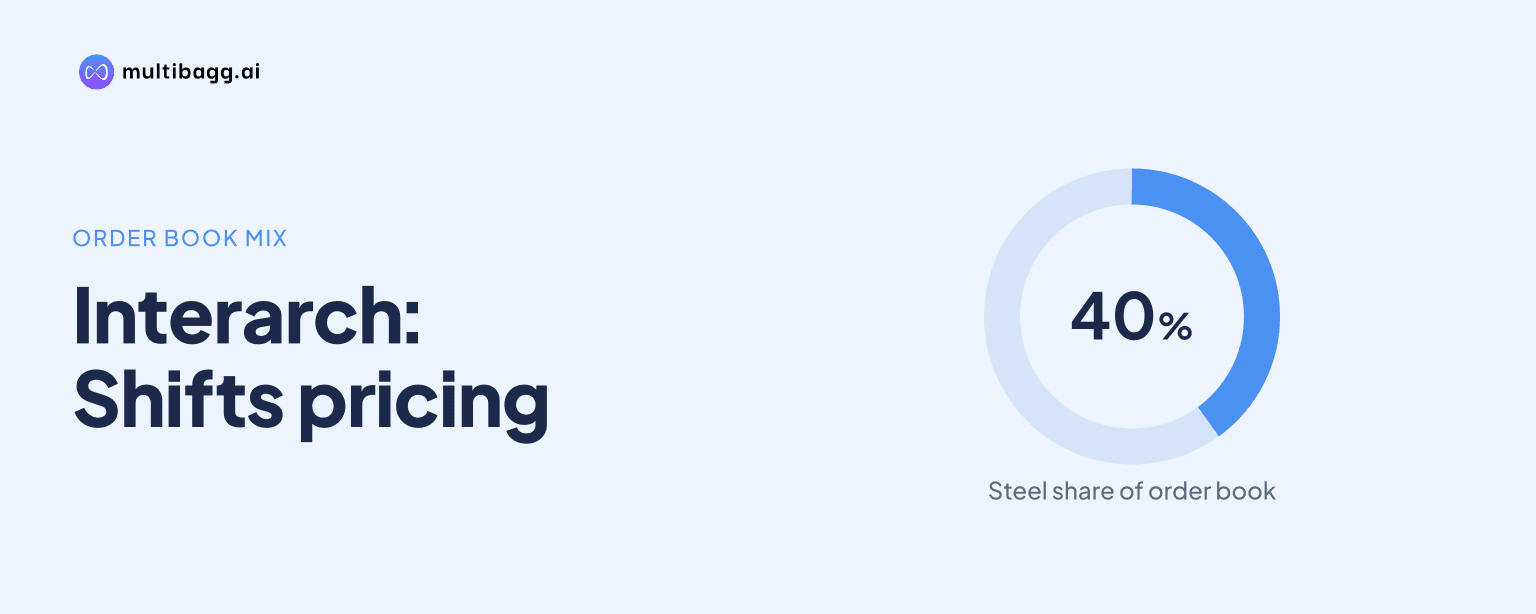
Interarch shifted 40% of its Rs 2,000 crore order book to variable steel pricing and said it had probably accepted no fixed-price orders in the preceding two to three months, reducing exposure to steel-cost changes while 60% of the book remained fixed price.
Know Interarch Building Solutions inside out
Results, valuation, peers and who's buying, in one view.
Why did Interarch stop accepting fixed-price orders?
Interarch said it had probably stopped accepting fixed-price orders because steel prices had moved outside their usual pattern over the preceding five to six months. Management said steel, which is a major input cost, was at levels not seen since 2022 and that it did not know whether prices would move higher or lower.
Under a fixed-price contract, Interarch carries the impact of steel-cost changes after an order is booked; under a variable-price contract, the customer pays the steel price applicable when the work is executed. Management said it was seeking variable pricing even if it meant losing an order, because a persistent one-way movement in steel prices is harder to manage than a normal cycle.
Supply disruption added to the pricing concern. Management said steel producers were supplying more material to exports, requiring Interarch to carry higher inventories and sometimes buy from traders and dealers to obtain a required size of steel and complete a building on schedule.
How much of Interarch's order book uses variable pricing?
Interarch said about 40% of its Rs 2,000 crore net order book as of 31 October used variable steel pricing, while about 60% was fixed price. Management initially described the variable portion as almost 35%, but its stated overall order-book split was 40% variable and 60% fixed.
The Rs 800 crore variable-price component includes orders booked at different dates because the steel price is reset at execution. Management gave the example of an order booked in April that could be executed in September or November, with the customer paying the steel price then prevailing.
The Rs 1,200 crore fixed-price portion includes work booked at current, previous and older steel-price levels. Management said orders under negotiation are priced dynamically at current costs, or at anticipated costs where it has visibility one or two months ahead, but the remaining fixed-price book still carries the procurement timing risk.
How do heavy structures change Interarch's price risk?
Heavy-structure projects reduce Interarch's direct steel-price exposure because management said steel prices are always passed through in those contracts. These projects use components above five tonnes, compared with most pieces below five tonnes at its pre-engineered building facilities, and individual heavy-structure pieces can weigh 20 to 25 tonnes.
Interarch said Rs 350 crore to Rs 400 crore of the Rs 2,000 crore residual order book qualified as heavy-structure work, or about 15% to 20% of the total. This work includes two data centres, a commercial building in Delhi, a hospital, a multi-storey hotel and heavy process buildings for global companies in India.
Management said these projects can also have stricter payment terms, with no payment remaining after material leaves the factory. Heavy-structure operations started on 24 September, and management said both production lines were fully loaded for the next year, making this segment a growing source of pass-through pricing.
Got a follow-up? Ask IRIS
What does variable pricing mean for Interarch's margins?
Variable pricing is intended to protect Interarch's margin from raw-material volatility, but management did not expect a major margin improvement in the current year. Management said earnings before interest, taxes, depreciation and amortisation, or EBITDA, had declined to 8.3% from 8.5% in the prior year amid steel, oil and freight movements, higher inventory requirements and investment in new verticals.
Management expects about Rs 1,200 crore of turnover in the second half after Rs 950 crore in the first half. It said the higher second-half revenue could improve margin through operating leverage because overheads should not rise in proportion with turnover, though it did not expect the full-year EBITDA margin to exceed the previously achieved 9% to 9.5% range.
Management separately said it was aiming for 10% to 12% margins over the next 12 months and discussed a longer-term aspiration of above 14% to 15%. Those outcomes depend on capacity ramp-up, export deliveries and the mix of larger heavy-structure orders, rather than solely on the shift from fixed to variable steel pricing.
Erection and installation charges rose to 11% of revenue from 9% a year earlier, but management said these costs are charged to customers. It said every project is separately costed, so freight and erection costs can differ materially between a building in Assam and one near a plant without necessarily changing the underlying project margin.
How quickly can Interarch execute its order book?
Interarch said its Rs 2,000 crore order book represented about nine months of production capacity, with a blended execution period of 10 to 11 months. Management said 70% to 75% of the book should be completed in about nine to 10 months, while two or three orders have longer 12- to 16-month execution schedules.
Management is targeting monthly business of Rs 200 crore to Rs 220 crore over the next 12 months as capacity rises. Its inquiry pipeline is generally five to six times quarterly order throughput of Rs 600 crore to Rs 700 crore, although management said it will select work based on customer quality, pricing and the ability to enter sectors such as data centres and high-rise buildings.
The capacity plan supports the order-book target. Management said Gujarat should add about 40,000 tonnes from the following year, while the Andhra heavy-structure plant could add about 35,000 to 40,000 tonnes in 2027-28, with an additional 1,00,000 tonnes of saleable capacity targeted by March 2028.
Conclusion
Interarch's reported 40% variable-price order-book share transfers a larger portion of steel-price movements to customers, while the 60% fixed-price balance remains exposed to the timing of procurement and execution. The policy is also aligned with heavy-structure projects, where management said steel is fully passed through and Rs 350 crore to Rs 400 crore of current orders qualify for that segment.
The next measures to watch are execution of the Rs 2,000 crore order book, the expected Rs 1,200 crore of second-half turnover and the contribution from heavy-structure operations that began on 24 September. Management said it intends to continue taking variable-price work for now and plans to build an additional 1,00,000 tonnes of saleable capacity by March 2028.