








Ipca Labs lifts institutional outlook to Rs 325-340 crore

Find your next multibaggerBe a Pro Investor
Research stocks and track your picks on the go. Download the app.
Key highlights
- Ipca expects FY '27 institutional-business sales of Rs 325 crore to Rs 340 crore, versus its earlier Rs 300 crore target.
- Ipca reported Rs 236 crore of institutional-business sales in the first half of FY '27.
- About Rs 25 crore of prior-year shipments shifted into Q1 FY '27 because ships were unavailable.
- Ipca said institutional generic business grew about 45% in Q2 FY '27.
powered by IRIS
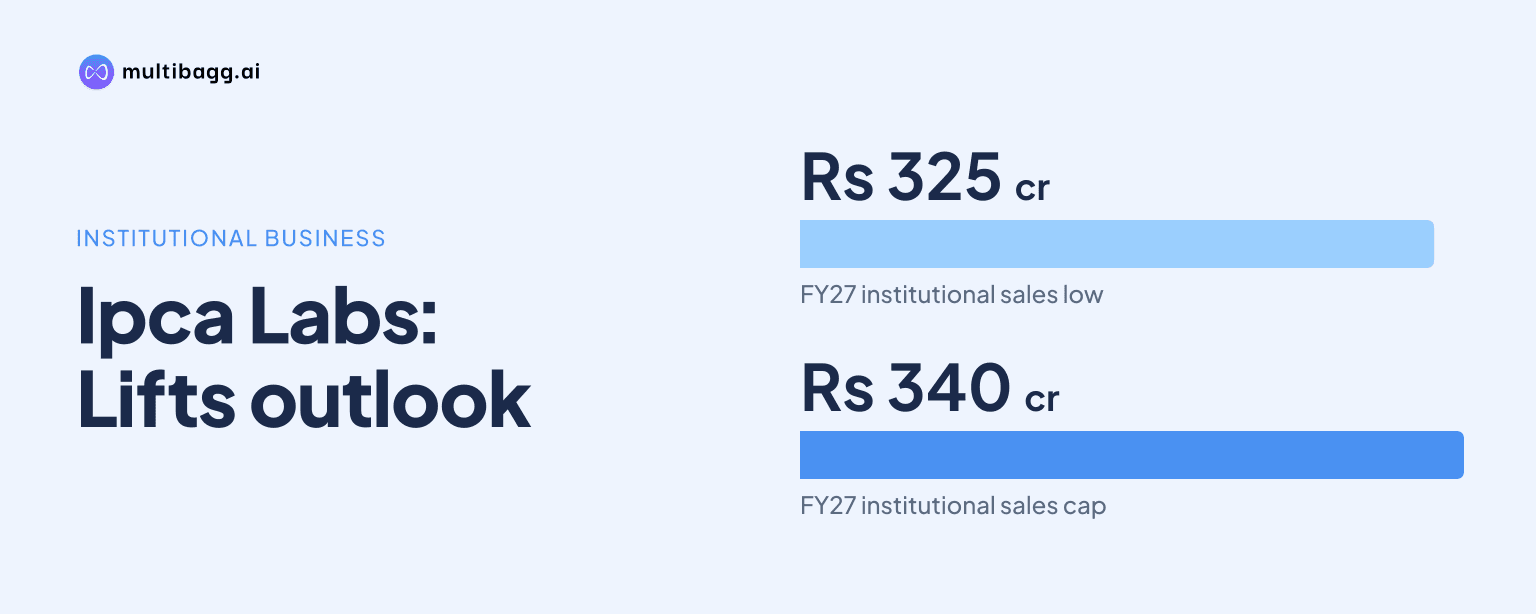
Ipca Labs expects FY '27 institutional-business sales of Rs 325 crore to Rs 340 crore after recording Rs 236 crore in the first half, but management said about Rs 25 crore of delayed shipments helped that result and cautioned that the business remains variable.
Know Ipca Laboratories inside out
Results, valuation, peers and who's buying, in one view.
What is Ipca’s revised institutional-business outlook for FY '27?
Ipca expects institutional-business sales to exceed its earlier FY '27 target of Rs 300 crore and reach about Rs 325 crore to Rs 340 crore. Management gave the revised range after an analyst said the business had recorded Rs 236 crore in the first half of FY '27. Based on that first-half figure, the range implies second-half sales of Rs 89 crore to Rs 104 crore.
Management did not describe the range as a change in the business’s underlying long-term growth profile. It said institutional business is variable by nature and that it normally avoids aggressive guidance for the segment. Still, institutional generic business grew about 45% in Q2 FY '27, while stand-alone export formulations rose 32% to Rs 653 crore from Rs 493 crore in Q2 FY '26.
Why did Ipca exceed its original institutional-business target?
Ipca’s first-half result was partly aided by about Rs 25 crore of shipments that were expected in the prior financial year but moved into Q1 FY '27. Management said those orders shifted because ships were unavailable during the earlier period. The delayed Rs 25 crore was not included in the original Rs 300 crore guidance, which led management to say the initial target would certainly be exceeded.
The shipment timing did not account for all of the first-half performance. Management said institutional business also grew well in Q2 FY '27 and that the trend would continue, although it does not expect the current growth rate to persist. The reported Rs 236 crore therefore reflects both underlying sales progress and a timing benefit from orders that had been due in the preceding financial year.
How does institutional business compare with Ipca’s other export operations?
Ipca’s institutional generic growth of about 45% in Q2 FY '27 exceeded the 32% increase in stand-alone export formulations. Generic-market sales excluding tenders rose 36% to Rs 364 crore from Rs 268 crore, while promotional branded business in rest-of-world markets increased 19% to Rs 172 crore from Rs 145 crore. Management did not disclose the quarterly institutional-business sales value.
Management also reported growth across several generic geographies in Q2 FY '27. European business grew about 23%, Australia and New Zealand 24%, the United States 31%, Canada 45%, and South Africa 46%. These figures show that the institutional upgrade came during broad export growth, but the call did not provide a geographic split for institutional sales.
Got a follow-up? Ask IRIS
What could affect Ipca’s second-half institutional-business sales?
Management said institutional business can decline in the following year even after exceeding the FY '27 target because orders and shipment schedules vary. Its Rs 325 crore to Rs 340 crore range is a current-year expectation rather than a target for maintaining the first-half sales pace. The second half needs Rs 89 crore to Rs 104 crore of sales to reach that range.
Shipping conditions could affect both delivery timing and costs. Ipca said Q2 FY '27 brought significant increases in input, logistics, shipping, fuel and energy costs. At Unichem, higher freight accounted for Rs 31.2 crore of a Rs 47 crore increase in other expenses, while air shipments rose to about 25% of shipments from 5% to 6% as sea freight took longer.
How does the new outlook fit Ipca’s broader FY '27 guidance?
Ipca retained overall FY '27 growth guidance of 14% to 16% and consolidated earnings before interest, tax, depreciation and amortisation, or EBITDA, margin guidance of 22% to 23%. Management said it was not revising those company-wide measures after raising the institutional-business outlook. Consolidated business grew about 14% to Rs 2,910 crore in Q2 FY '27 from Rs 2,557 crore in Q2 FY '26.
Consolidated EBITDA margin increased to 22.97% in Q2 FY '27 from 21.68% a year earlier despite the cost pressures cited by management. On a stand-alone basis, EBITDA margin rose to 26.6% from 25.46%. Management’s decision to keep the 22% to 23% consolidated margin range unchanged indicates that the institutional uplift has not prompted a revision to wider operating guidance.
What other businesses supported Ipca’s Q2 FY '27 growth?
Ipca’s domestic formulations business grew about 14% to Rs 1,157 crore in Q2 FY '27 from Rs 1,019 crore in Q2 FY '26. Its pain segment increased about 16% to Rs 628 crore from Rs 543 crore in the quarter. Management said this segment, including rheumatoid arthritis and osteoarthritis products, had grown about 14% in the first half.
The Zerodol umbrella brand had crossed Rs 1,500 crore of sales, according to IQVIA data for September 2026, and ranked as the fourth-largest brand in the Indian pharmaceutical market. Management attributed about 8% to 9% of the pain-segment growth to volumes and about 4% to 4.5% to prices. It said it expects similar growth in the Zerodol franchise over the next three to four years.
Conclusion
The revised institutional-business range places Ipca above its original FY '27 expectation, while the export portfolio also recorded growth across generic, branded and geographic channels in Q2. The delayed Rs 25 crore shipment explains part of the outperformance, so the first-half result does not by itself establish a stable run rate for a segment management describes as variable.
The next result to watch is second-half institutional sales against the Rs 89 crore to Rs 104 crore needed to meet management’s new range. Management also retained its 14% to 16% overall growth guidance and 22% to 23% consolidated EBITDA-margin guidance, making freight, shipping and energy costs relevant factors for the remainder of FY '27.

