








Ipca retains FY27 targets as Q2 margin rises despite costs

Find your next multibaggerBe a Pro Investor
Research stocks and track your picks on the go. Download the app.
Key highlights
- Ipca retained FY27 guidance for 14%-16% consolidated growth and a 22%-23% consolidated EBITDA margin.
- Q2 FY27 consolidated business increased 14% to Rs 2,910 crore from Rs 2,557 crore in Q2 FY26.
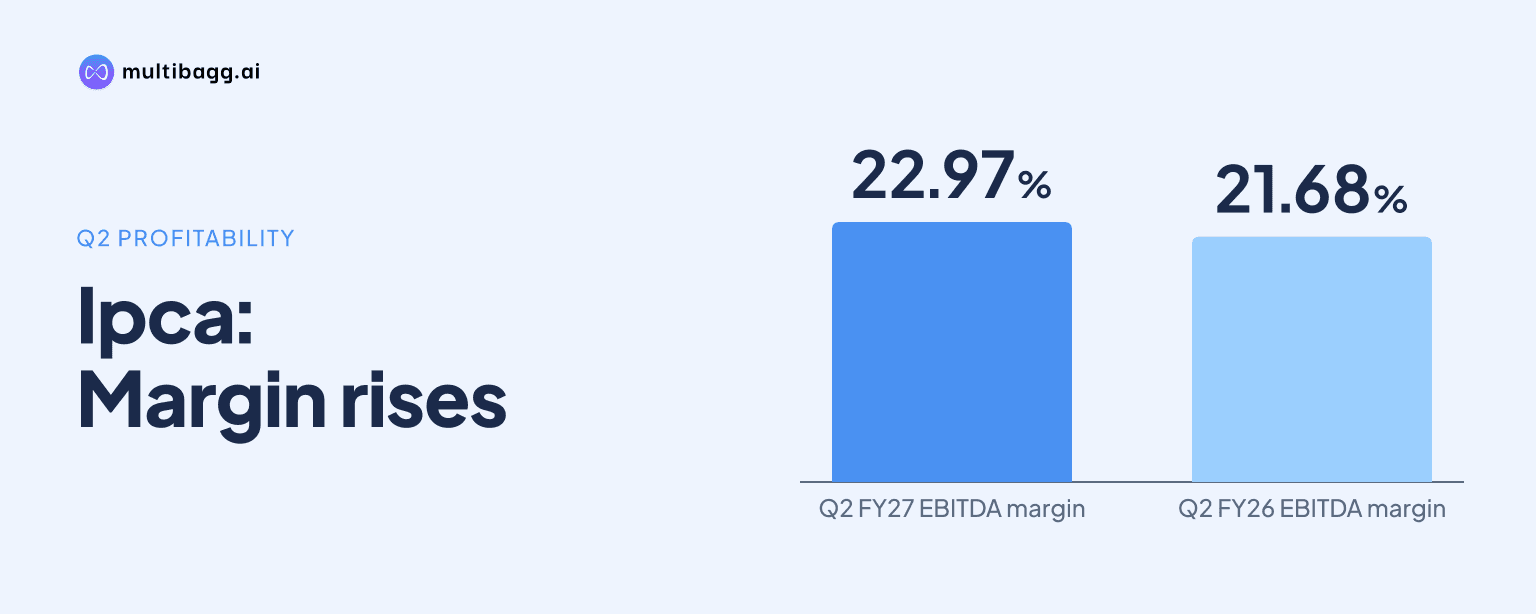
- Consolidated EBITDA margin rose to 22.97% in Q2 FY27 from 21.68% a year earlier.
- Unichem's freight expense increased by Rs 31.2 crore as air shipments rose to about 25% from 5%-6%.
powered by IRIS
Ipca Laboratories Limited retained its FY27 targets of 14%-16% consolidated growth and a 22%-23% EBITDA margin after Q2 FY27 business rose 14% to Rs 2,910 crore and margin reached 22.97%, despite management reporting significant increases in input, logistics, shipping, fuel and energy costs.
Know Ipca Laboratories inside out
Results, valuation, peers and who's buying, in one view.
What are Ipca's FY27 growth and margin targets?
Ipca's FY27 guidance remains 14%-16% consolidated growth and a 22%-23% consolidated earnings before interest, tax, depreciation and amortisation (EBITDA) margin. Managing Director A. K. Jain said on the November 5, 2026 earnings call that management was not revising either target after having previously raised growth guidance from 12%-13% to 14%-16%.
The retained guidance follows 14% growth in consolidated business during Q2 FY27, when revenue reached Rs 2,910 crore from Rs 2,557 crore in Q2 FY26. Consolidated EBITDA margin rose to 22.97% from 21.68%, while Ipca's stand-alone EBITDA margin increased to 26.6% from 25.46% over the same period.
The Q2 FY27 consolidated margin of 22.97% was within Ipca's stated 22%-23% guidance range. The year-on-year increase of 1.29 percentage points in consolidated margin and 1.14 percentage points in stand-alone margin was reported alongside the company's unchanged FY27 outlook.
How did higher costs affect Ipca's Q2 FY27 margin?
Higher input, logistics, shipping, fuel and energy costs coincided with Ipca's consolidated EBITDA margin rising to 22.97% in Q2 FY27 from 21.68% in Q2 FY26. Management described the cost increases as significant, but did not quantify the consolidated increase separately for inputs, logistics, shipping, fuel or energy.
Freight was a specifically quantified pressure at Unichem during Q2 FY27. Other expenses increased to Rs 189 crore from Rs 142 crore, an increase of Rs 47 crore, of which management attributed Rs 31.2 crore to additional freight expense.
Management said delayed deliveries by shipping lines led to more consignments being sent by air. Air shipments increased to about 25% of Unichem's business in the quarter from about 5%-6% previously, contributing to the higher freight cost and lower EBITDA margin at that operation.
Which businesses supported Ipca's Q2 FY27 growth?
Ipca's domestic formulations and stand-alone export formulations grew in Q2 FY27, with domestic formulations up 14% to Rs 1,157 crore and export formulations up 32% to Rs 653 crore. The comparable Q2 FY26 figures were Rs 1,019 crore for domestic formulations and Rs 493 crore for export formulations.
Within exports, promotional branded business in rest-of-world markets rose 19% to Rs 172 crore from Rs 145 crore. Generic markets excluding tenders grew 36% to Rs 364 crore from Rs 268 crore, while institutional generic business grew 45% and active pharmaceutical ingredients, or API, grew 6% in Q2 FY27.
Ipca's pain segment increased 16% in Q2 FY27 to Rs 628 crore from Rs 543 crore. For April to September, the segment grew 14% to Rs 1,216 crore from Rs 1,065 crore, with management identifying rheumatoid arthritis and osteoarthritis products, including Zerodol, as contributors.
According to IQVIA data cited by management, Zerodol as an umbrella brand exceeded Rs 1,500 crore in sales in September 2026 and became the fourth-largest brand in the Indian pharmaceutical market. Management estimated growth of 14%-16% for the franchise included about 8%-9% volume growth and 4%-4.5% price growth, and said it expected similar growth over the next three to four years.
Got a follow-up? Ask IRIS
What is affecting Unichem's profitability?
Unichem reported an EBITDA margin of about 11.3% in Q2 FY27, with freight costs limiting profitability despite management saying its European business had performed well and Brazil had started to deliver profit. Management said Unichem's margin could remain in an 11%-13% range if freight and energy costs stay elevated.
Management said Brazil had incurred losses in the first two quarters of the current financial year before moving into profit. It also said Unichem's gross margin could vary by 1%-2% as input costs fluctuate, in response to an analyst's reference to gross margin of close to 58% in Q2 FY27.
Ipca said all subsidiaries except Pisgah were profitable. Pisgah had good API order positions, but management said improvement could start by the next financial year, leaving its recovery dependent on the conversion of those orders into improved performance.
How does Ipca expect margins to develop over time?
Ipca expects consolidated EBITDA margin to improve by about 1%-1.25% annually over the next two to three years, according to management. Management also said stand-alone EBITDA margin could improve by about 1.5% annually, which was a medium-term expectation rather than a revision to the FY27 target of 22%-23% on a consolidated basis.
The Q2 FY27 gap between Ipca's 26.6% stand-alone EBITDA margin and its 22.97% consolidated margin included subsidiary performance, notably Unichem's 11.3% quarterly EBITDA margin. Management's comments on freight, energy costs, Brazil and Pisgah therefore remain relevant to the group-level margin path.
Management said institutional business could reach about Rs 325 crore to Rs 340 crore during the year, above an earlier indication of Rs 300 crore. It cautioned that the business is inherently variable and said about Rs 25 crore of shipments expected in the previous financial year had shifted into the first quarter of the current year.
For branded business, Ipca maintained an overall India growth view of 15%-16%. Management said branded business had grown about 22% in the first half, apart from a 3% decline in one geography where West Asia shipments were delayed, while other markets had grown well.
Conclusion
Ipca retained its FY27 growth and margin ranges after Q2 FY27 consolidated business increased 14% to Rs 2,910 crore and consolidated EBITDA margin rose to 22.97%. Domestic formulations, exports and the Rs 628 crore pain segment delivered growth, while elevated freight at Unichem showed the continuing effect of logistics and energy-related cost pressures within the group.
The next point to watch is whether freight, air-shipment and energy costs ease, because management said Unichem's EBITDA margin could remain at 11%-13% if they stay high. Management also expects annual consolidated EBITDA-margin improvement of about 1%-1.25%, sees Pisgah beginning to improve by the next financial year, and expects institutional business of about Rs 325 crore to Rs 340 crore during the year.

