








Unichem freight surge keeps EBITDA margin at 11%-13%

Find your next multibaggerBe a Pro Investor
Research stocks and track your picks on the go. Download the app.
Key highlights
- Unichem reported EBITDA margin of about 11.3% in Q2 FY '27.
- Unichem’s other expenditure rose Rs 47 crore to Rs 189 crore, including Rs 31.2 crore of higher freight expense.
- Air shipments increased to around 25% from about 5%-6% in Q2 FY '27.
- Management said Unichem EBITDA margin may remain at 11%-13% if freight and energy costs stay high.
powered by IRIS
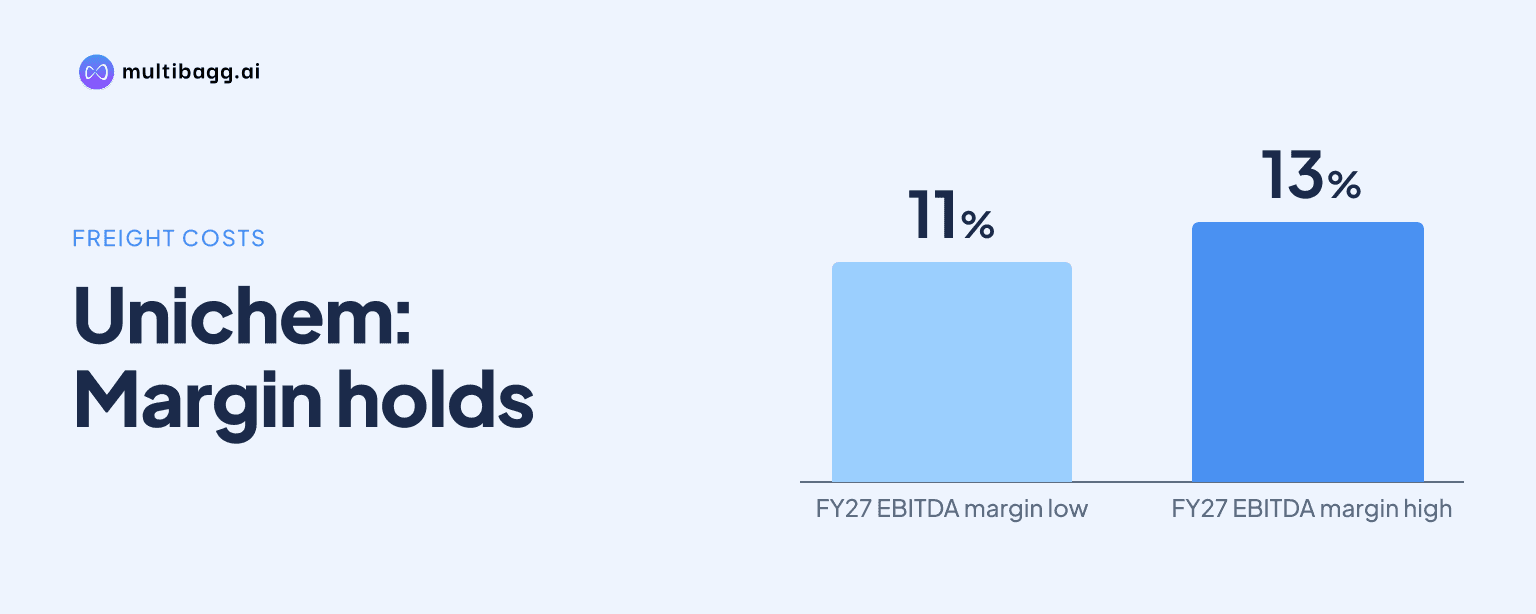
Unichem reported an EBITDA margin of about 11.3% in Q2 FY '27 after Rs 31.2 crore of higher freight expense, as air shipments rose to around 25% from 5%-6%. Ipca Laboratories Limited said Unichem’s margin could remain within 11%-13% if freight and energy costs do not normalise.
Know Ipca Laboratories inside out
Results, valuation, peers and who's buying, in one view.
What caused Unichem’s Q2 FY '27 margin pressure?
Unichem’s Q2 FY '27 margin pressure was chiefly caused by a sharp increase in freight costs and greater use of air transport. Management said shipping lines were taking longer to deliver goods, which required some consignments to be sent by air. The air-shipment share rose to around 25% in the quarter from about 5%-6%, lifting logistics costs and reducing EBITDA, or earnings before interest, tax, depreciation and amortisation.
Management quantified the increase in freight expense at Rs 31.2 crore, while also referring to an impact of about Rs 30 crore on EBITDA. The company linked the increase to higher overall freight costs and the changed transport mix, rather than to a disclosed weakening in Unichem’s sales. Ipca had also cited increases in logistics, shipping, fuel and energy costs for its consolidated operations in Q2 FY '27.
The logistics issue occurred even as an analyst described Unichem’s gross margin as close to 58% in the quarter. Management said that measure could vary by 1-2 percentage points because input costs were fluctuating. This distinction matters because the reported 11.3% EBITDA margin reflected both product-cost movements and unusually high distribution costs.
How much did Unichem’s other expenditure increase?
Unichem’s other expenditure increased by Rs 47 crore to Rs 189 crore in Q2 FY '27 from Rs 142 crore, and the Rs 31.2 crore increase in freight accounted for most of that movement. Freight therefore represented roughly two-thirds of the disclosed rise in this cost line, explaining management’s focus on shipping conditions in discussing the quarter’s 11.3% EBITDA margin.
The transcript does not provide Unichem revenue, absolute EBITDA, or the prior freight-expense base. It therefore does not support calculating the exact EBITDA-margin effect, in percentage points, of the Rs 31.2 crore freight increase. Management also did not itemise the remaining Rs 15.8 crore increase within other expenditure.
The comparison nevertheless identifies what changed in the quarter: other expenditure rose by Rs 47 crore, while freight alone rose by Rs 31.2 crore. The balance may include other costs, but management did not specify them. The air-shipment increase from 5%-6% to around 25% was the operational mechanism identified for the higher freight bill.
Got a follow-up? Ask IRIS
Can Unichem’s EBITDA margin recover from 11.3%?
Unichem’s EBITDA margin can improve if logistics conditions normalise, but management said it may remain in an 11%-13% range if freight and energy costs stay high. This was a conditional outlook rather than a formal annual margin target. The practical trigger is whether shipping delays ease enough to reduce the need for air dispatches from the Q2 FY '27 level of around 25%.
Management identified Europe and Brazil as operating developments that could support the subsidiary. It said Unichem’s European business had done well, while the Brazil business had begun delivering profit after losses in the first two quarters of the current financial year. The call did not disclose Brazil’s profit amount, nor did it set a timetable for a return above the 11%-13% margin range.
Unichem’s 11.3% margin was below Ipca’s consolidated EBITDA margin of about 22.97% in Q2 FY '27, compared with 21.68% in Q2 FY '26. Ipca’s standalone EBITDA margin rose to 26.6% from 25.46% over the same comparison. The difference indicates that the freight and air-shipment burden was specific to Unichem’s cost position rather than a disclosed group-wide margin decline.
Ipca retained its FY '27 consolidated EBITDA-margin guidance of 22%-23% and its revenue-growth guidance of 14%-16%. Management also said it expected consolidated EBITDA margin to improve by around 1%-1.25% annually over time and standalone Ipca EBITDA margin by around 1.5%. It gave no equivalent annual margin-improvement target for Unichem.
Which markets are supporting Unichem’s operations?
Unichem’s European business and Brazil operation were the two supports management specifically identified during the Q2 FY '27 discussion. Europe was described as having done well, while Brazil turned profitable after two loss-making quarters in the current financial year. Those developments provide an offset to the Rs 31.2 crore freight increase, although neither market’s quarterly profit was disclosed.
Across Ipca’s generics business in Q2 FY '27, Europe grew around 23%, Australia and New Zealand around 24%, the United States around 31%, Canada around 45%, and South Africa around 46%. These are generics-business growth rates cited by management, not a country-by-country profitability statement for Unichem. They show that the logistics pressure emerged alongside growth in several export markets.
Management also said its United Kingdom subsidiary had returned to profit in the current financial year after an overall loss of about Rs 2.5 crore in the prior financial year. The prior loss reflected older generic products being sold below cost, while the recovery was linked to supply shortages and improving prices. No quarterly United Kingdom profit or margin was provided.
The transcript also recorded overall United States portfolio growth of around 9% in dollar terms, while Ipca’s portfolio booked through Unichem grew around 74% in value terms. Those figures should not be treated as Unichem’s standalone United States growth rate because management did not disclose that measure. The relevant disclosed comparison is between the 9% overall portfolio growth and the 74% growth of the Ipca portfolio within it.
Conclusion
Unichem’s Q2 FY '27 EBITDA margin of about 11.3% was held back principally by logistics costs: other expenditure increased by Rs 47 crore to Rs 189 crore, including Rs 31.2 crore of higher freight expense. The shift in air shipments to around 25% from 5%-6% explains why improved gross-margin conditions and progress in Europe and Brazil did not translate into a faster margin recovery.
The next development to watch is whether shipping-line delivery times improve and reduce Unichem’s need for air freight. Management said margins could move up if conditions normalise, but could remain at 11%-13% if freight and energy costs stay elevated. Brazil’s move into profit after two loss-making quarters is also an unresolved contributor to the subsidiary’s future margin path.

