








Airpro Has Not Ordered Machinery for Its Jaipur Facility
MAX Plan at ₹4,999/yr

Find your next multibaggerBe a Pro Investor
Research stocks and track your picks on the go. Download the app.
Key highlights
- Airpro had placed no orders for Rs 2.04 crore of proposed imported machinery as of the prospectus date.
- Airpro estimates the Jaipur manufacturing project cost at Rs 7.12 crore.
- The Rs 2.04 crore imported machinery amount represents 100% of Airpro's disclosed proposed plant and machinery cost.
- Airpro's foreign-currency purchases were Rs 9.18 crore, or 71.00% of total purchases, in the period ended September 30, 2026.
powered by IRIS
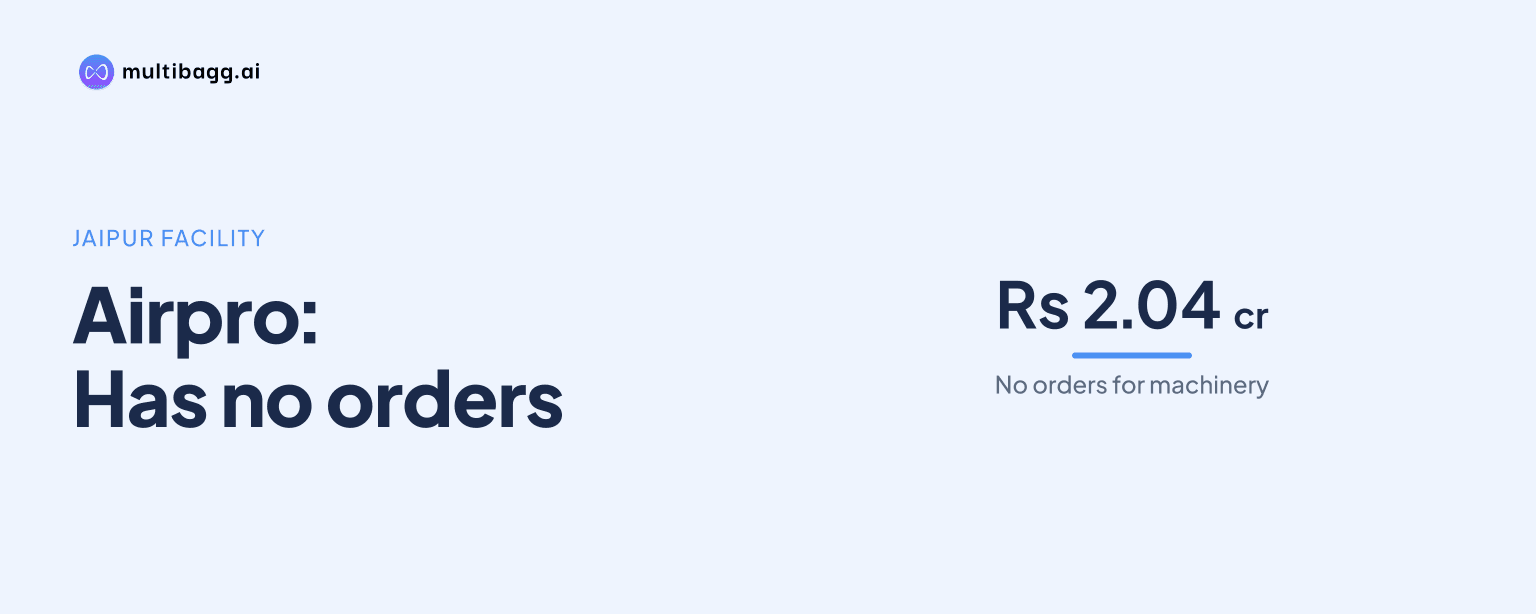
Airpro had placed no orders, as of the prospectus date, for Rs 2.04 crore of proposed imported plant and machinery for its Jaipur facility, which the prospectus identifies as 100% of the proposed machinery cost. The project therefore still depends on specification finalisation, supplier selection, delivery, installation, commissioning and technical know-how transfer.
Why has Airpro not ordered machinery for its Jaipur facility?
Airpro had not placed orders aggregating Rs 2.04 crore for the proposed Jaipur machinery as of the prospectus date. The company says procurement remains subject to finalising technical specifications, identifying and selecting vendors, commercial negotiations, executing supply arrangements and other project-implementation activities. The prospectus does not disclose a completed machinery purchase order or a named equipment vendor.
Airpro intends to establish the Jaipur, Rajasthan facility to manufacture electronic assemblies and components used in networking products, including printed circuit board assemblies and related electronic modules. The facility had not commenced commercial operations as of the prospectus date. Its move from planning to production also requires utilities and infrastructure, skilled-person recruitment and training, raw-material procurement, approvals and licences, in addition to machinery installation.
How much does Airpro plan to spend on the Jaipur project?
Airpro estimates the total Jaipur project cost at Rs 7.12 crore. The prospectus also states that Rs 6.57 crore is proposed for procurement, installation and commissioning of plant and machinery and related infrastructure, while identifying Rs 2.04 crore as the expected cost of imported machinery. These disclosures describe different spending categories within the proposed manufacturing project.
Airpro states that the Rs 6.57 crore allocation represents 24.64% of total project cost and 28.60% of net proceeds, while the Rs 2.04 crore imported-machinery cost represents 100% of proposed plant and machinery cost and 28.61% of total project cost. The prospectus does not explain the relationship between the broader Rs 6.57 crore allocation and the separately disclosed Rs 2.04 crore imported-machinery amount. Completing the project within the stated Rs 7.12 crore estimate would require procurement and related infrastructure work to remain within the project’s planned scope and cost.
What does imported machinery dependence mean for Airpro?
Airpro expects the proposed plant and machinery to be procured from overseas suppliers, with imported equipment estimated at Rs 2.04 crore. The dependency extends beyond delivery because suppliers or their representatives are expected to provide installation, testing, commissioning, calibration, operational stabilisation, employee training and transfer of technical know-how. Commercial production could be deferred if any of those steps is delayed.
Airpro identifies potential obstacles including equipment-manufacturing delays, shortages of critical equipment or components, supply-chain disruptions, logistics constraints, customs clearances, export controls, sanctions, foreign-jurisdiction restrictions and changes in international trade policy. The company also says that finding alternative suppliers or technical service providers for specialised machinery could require significant time, cost and validation. The machinery order is therefore only the first stage of a supplier-dependent commissioning process.
After commissioning, Airpro may continue to rely on overseas suppliers for spare parts, upgrades, maintenance support, replacement components, software updates and future technical assistance. The prospectus says an inability of Airpro personnel to assimilate technical know-how, operate machinery efficiently or maintain production standards could affect output and the expected benefits of the facility. The project’s operating outcome consequently depends on both supplier support and Airpro’s ability to absorb the transferred processes.
Got a follow-up? Ask IRIS
How could foreign exchange change Airpro's Jaipur facility cost?
Airpro says procurement costs for the proposed imported machinery may be denominated in foreign currencies, including US dollars. An adverse movement between the Indian rupee and relevant foreign currencies before acquisition, installation and commissioning could increase the Rs 2.04 crore machinery cost and require financial resources beyond the Rs 7.12 crore total project estimate. The company states that contractual arrangements, hedging mechanisms or other measures may not fully mitigate this exposure.
Airpro already reports substantial foreign-currency purchases in its operating procurement. Foreign-currency purchases were Rs 9.18 crore, or 71.00% of total purchases, in the period ended September 30, 2026, compared with Rs 14.59 crore, or 79.26%, in fiscal 2026. The September 2026 period is a partial period, so the absolute amounts are not directly comparable with a full fiscal year, but both disclosures show foreign-currency exposure in procurement.
Foreign-currency purchases rose from Rs 12.31 crore in fiscal 2024 to Rs 14.59 crore in fiscal 2026, while their share of total purchases moved from 74.82% to 79.26%. The proposed Jaipur machinery is a separate capital expenditure from these operating purchases, but both are exposed to exchange-rate movements. Airpro says higher imported-equipment costs could affect project implementation, use of net proceeds, cash flows and expected returns from the facility.
Can in-house manufacturing reduce Airpro's external supplier reliance?
Airpro intends the Jaipur facility to increase in-house manufacturing and domestic value addition by producing selected electronic assemblies internally instead of relying entirely on third-party suppliers and imported assemblies. The company expects the facility to support localisation, supply-chain optimisation and operational efficiencies. Those expected outcomes depend on production volumes, capacity utilisation, yields, procurement savings, product demand, technology performance and future market conditions.
Airpro says successful internal manufacturing requires specialised technical expertise, process controls, quality-management systems, skilled manpower and continuous operational oversight. It does not assure that the facility will attain anticipated production capacity, quality standards, operating efficiencies, cost benefits or financial returns within its expected timeline. The expected benefits therefore require both successful execution of the Rs 7.12 crore project and stable manufacturing operations after commissioning.
The Jaipur facility will not eliminate supplier dependence. Airpro says it may still depend on third parties for raw materials, components and ancillary items, specifically plastic enclosures, packaging materials and other non-core components. The facility may reduce external sourcing for selected product categories, but its supply chain will remain linked to third-party inputs and equipment-supplier support.
Conclusion
Airpro’s Jaipur backward-integration plan remained at a pre-procurement stage for its Rs 2.04 crore proposed imported machinery as of the prospectus date. The company’s estimated Rs 7.12 crore project depends on placing equipment orders and completing the wider chain of infrastructure work, approvals, delivery, installation, commissioning, technical transfer and workforce preparation. Internal manufacturing may increase domestic value addition for selected assemblies, but it will not remove all external supplier reliance.
The next disclosed implementation steps are finalising machinery specifications, selecting vendors, negotiating commercial terms and executing supply arrangements, followed by delivery, installation, testing and commissioning. Airpro also needs overseas supplier support for training and operational stabilisation, while project costs may be affected by foreign-exchange movements and the conditions of its April 23, 2026 lease with Rajasthan State Industrial Development and Investment Corporation Limited for the Jaipur industrial plot.

