










Crystal Crop India revenue share was 95.29% in first half
Key highlights
- Crystal Crop generated Rs 1,884.91 crore of domestic India sales, equal to 95.29% of Revenue from Operations, in the six months ended September 30, 2025.
- Seeds contributed Rs 420.454 crore, or 21.59%, of Crystal Crop’s segment revenue in the six months ended September 30, 2025.
- Crystal Crop’s seeds revenue share increased from 12.66% in Fiscal 2023 to 21.59% in the latest six-month period.
- Crop protection products and natural crop solutions remained 77.82% of Crystal Crop’s segment revenue in the six months ended September 30, 2025.
powered by IRIS
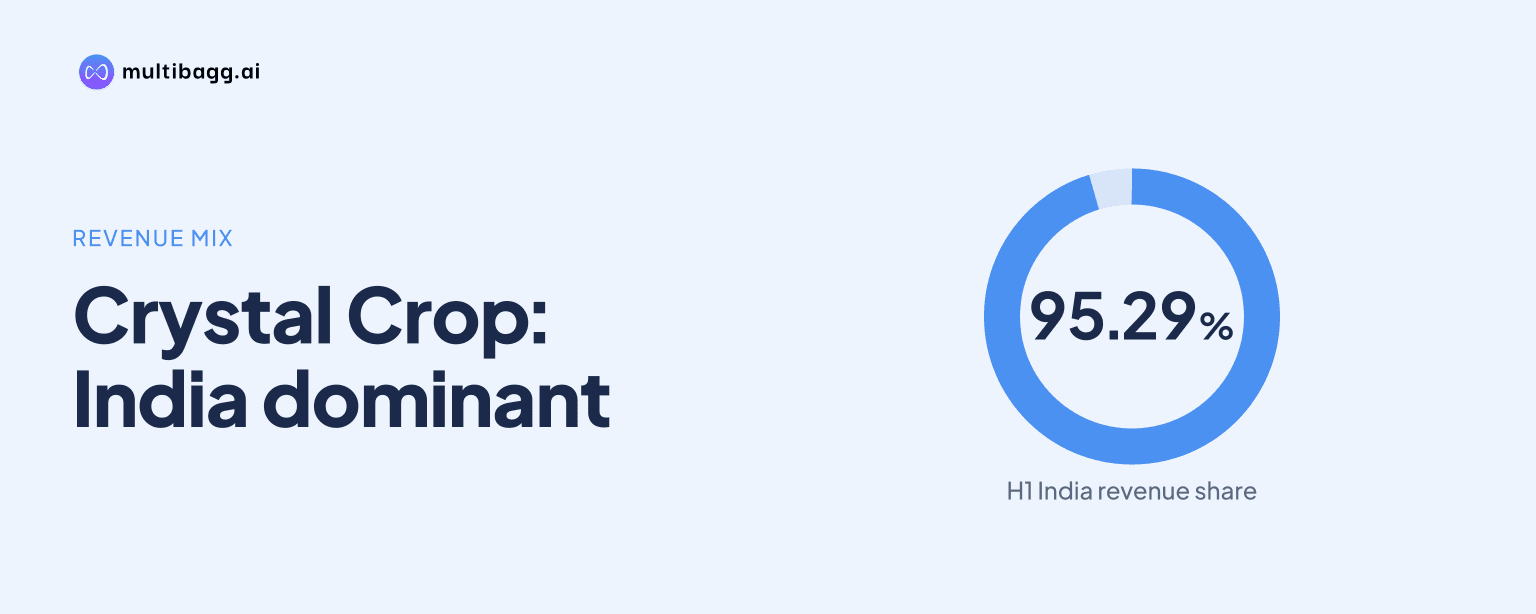
Crystal Crop Protection generated 95.29% of Revenue from Operations from domestic India sales in the six months ended September 30, 2025, demonstrating its continued reliance on the Indian market. Crystal Crop’s seeds business accounted for 21.59% of segment revenue, up from 12.66% in Fiscal 2023, following the October 2024 acquisition of I&B Seeds.
How dependent was Crystal Crop on India in the first half?
Crystal Crop was dependent on India for 95.29% of Revenue from Operations in the six months ended September 30, 2025, when domestic sales totalled Rs 1,884.91 crore. International sales were Rs 29.599 crore, or 1.50% of Revenue from Operations, while the disclosed domestic and international total of Rs 1,914.509 crore represented 96.79% because it excluded royalty income and e-commerce benefits.
Crystal Crop’s domestic share declined from 97.94% in Fiscal 2023 to 97.80% in Fiscal 2024, 97.48% in Fiscal 2025 and 95.29% in the six months ended September 30, 2025. The percentage movement indicates a modest increase in revenue outside domestic sales, but India remained the principal market in every disclosed period. The latest six-month sales figures cannot be directly compared with full-year Fiscal 2025 amounts.
Crystal Crop identifies domestic demand, economic volatility and negative trends in India’s crop protection products and natural crop solutions industry as risks to its business. The company distributes its brands within India and sells to domestic corporate clients, so a change in Indian agricultural demand would affect most of the revenue base represented by the 95.29% domestic-sales share.
What changed in Crystal Crop’s revenue mix?
Crystal Crop’s seeds business increased to 21.59% of segment revenue in the six months ended September 30, 2025, from 17.45% in Fiscal 2025 and 12.66% in Fiscal 2023. Seeds generated Rs 420.454 crore in the latest six-month period, compared with Rs 469.879 crore for Fiscal 2025, although Fiscal 2025 included only five months of I&B Seeds revenue after its October 2024 acquisition.
Crop protection products and natural crop solutions remained Crystal Crop’s largest business segment, contributing Rs 1,515.614 crore, or 77.82%, in the six months ended September 30, 2025. Its segment share fell from 86.87% in Fiscal 2023 and 81.74% in Fiscal 2025, while seeds became a larger second revenue stream. Other activities accounted for Rs 11.463 crore, or 0.59%, in the latest half-year period.
Crystal Crop’s geographic and segment tables use different revenue definitions, so their totals are not interchangeable. The segment table excludes non-operational business of 13 limited liability partnership firms, which amounted to Rs 5.14 lakh in the six months ended September 30, 2025, and gross provisions for sales returns and internet-company elimination of Rs 36.398 crore in that period. The geographic table instead states that it excludes royalty income and e-commerce benefits.
Got a follow-up? Ask IRIS
Why does Crystal Crop’s India revenue concentration matter?
Crystal Crop’s 95.29% India revenue share matters because demand for crop protection products, natural crop solutions and seeds is linked to domestic cropping cycles and weather conditions. The company identifies Kharif sowing and application windows as typically running from April to September, while Rabi activity generally runs from October to March, concentrating purchases by distributors, retailers and farmers before and during those seasons.
Delayed or uneven monsoons, floods, droughts, heat waves, cold spells and cyclones can reduce or defer product demand, according to Crystal Crop’s risk disclosures. Missed or shortened sowing and spraying windows may not be recoverable later in the year, while weather changes can alter demand between insecticides, fungicides and herbicides. Those conditions can affect the volume and product mix of sales from the domestic market that generated Rs 1,884.91 crore in the latest half year.
Crystal Crop’s seasonality also affects working capital because it builds inventory and extends credit to distributors before sowing seasons. If actual demand falls below inventory planning, higher holding costs, product obsolescence and receivables may result; if demand is underestimated, stock-outs and reduced sales may follow. These outcomes mean that half-year revenue and profitability may not indicate performance for the full financial year ending March 31.
What must hold for Crystal Crop’s revenue mix to persist?
Crystal Crop’s crop protection and natural crop solutions segment must retain customer demand for its 77.82% share of segment revenue to persist. The company identifies customer seasonality, potential loss of customer market share and economic conditions in customers’ markets as factors that can reduce purchases. Lower customer orders could also leave manufacturing capacity underutilised during particular periods.
Crystal Crop’s seeds contribution depends on the post-acquisition execution of I&B Seeds as well as seed-specific conditions. The company states that seed demand is affected by sowing and commercial sales seasons, weather, irrigation, crop yields, farmer access to credit and overall agricultural production. Unseasonal or aged seed lots may require revalidation, reprocessing or re-tagging and could be written down or disposed of if they do not meet quality or regulatory specifications.
Crystal Crop also states that agrochemical and seed innovation can take five to seven years to reach the market and is subject to stringent evaluation and registration processes. Research and development expenditure, including capital expenditure, was Rs 32.332 crore in the six months ended September 30, 2025, equal to 1.63% of Revenue from Operations. Continued portfolio expansion therefore depends on successful product development, required registrations and market acceptance.
Conclusion
Crystal Crop’s disclosures show that its revenue remains predominantly exposed to India, despite the domestic sales share easing from 97.94% in Fiscal 2023 to 95.29% in the six months ended September 30, 2025. At the same time, seeds increased from 12.66% to 21.59% of segment revenue, while crop protection products and natural crop solutions continued to account for more than three quarters of the segment total.
The next measure to watch is whether seeds retains a larger contribution through a full year after the October 2024 I&B Seeds acquisition. Crystal Crop’s stated plans and risks also make seasonal demand through Kharif and Rabi cycles, product registrations, and the ability to develop and launch products within the disclosed five-to-seven-year innovation timeframe relevant to the future revenue mix.