










Crystal Crop Protection built a 13-entry farm-input portfolio
Key highlights
- Crystal Crop Protection disclosed 13 acquisition entries from 2011 to 2024: 7 in crop protection, 5 in seeds and 1 in manufacturing assets.
- Crystal Crop Protection acquired 90% of Rohini Seeds Private Limited in 2011 and the remaining 10% in Fiscal 2014.
- Crystal Crop Protection’s 2024 Sunrice transaction covered India, Thailand, Bangladesh and Vietnam.
- Unidentified acquisitions and general corporate purposes together cannot exceed 35% of Crystal Crop Protection’s Gross Proceeds.
powered by IRIS
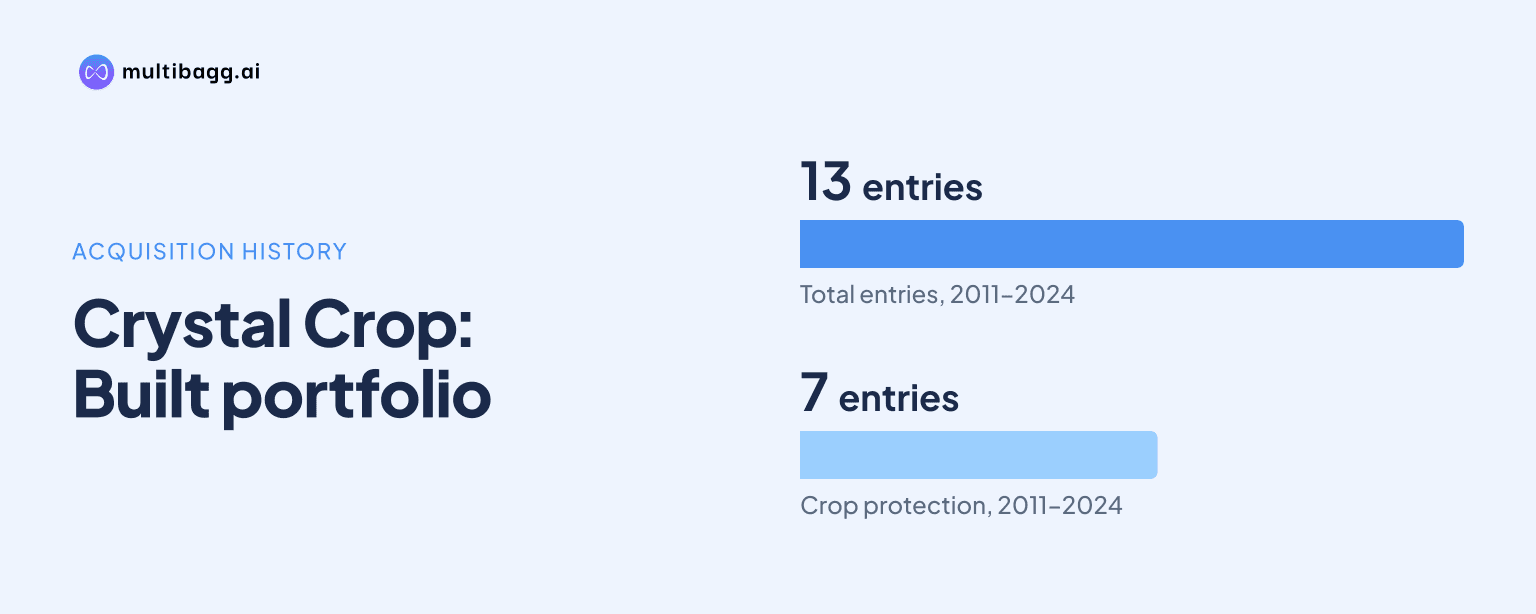
Crystal Crop Protection built a 13-entry farm-input portfolio between 2011 and 2024 through seven crop-protection transactions, five seed transactions and one manufacturing-asset purchase. Its Draft Red Herring Prospectus also allows unidentified acquisitions and general corporate purposes to use up to 35% of Gross Proceeds in combination, although no future target had a definitive agreement.
What acquisition record does Crystal Crop Protection disclose for its farm-input portfolio?
Crystal Crop Protection discloses 13 acquisition entries from 2011 to 2024: seven for crop-protection products and natural crop solutions, five for seeds and one for manufacturing facilities. The record includes acquisitions of companies, brands, seed portfolios, intellectual property, breeding assets, people and physical production assets, so the entries do not all represent purchases of entire companies.
Crystal Crop Protection entered the seeds market in 2011 by acquiring 90% of Rohini Seeds Private Limited and acquired the remaining 10% in Fiscal 2014. At the other end of the period, its 2024 transactions acquired 100% of I&B Seeds Private Limited and the Sunrice brand rights in India, Thailand, Bangladesh and Vietnam, with technology know-how and a patent for an Ethoxysulfuron mixture.
The 2018 Cytec India transaction shows the difference between an asset acquisition and a brand purchase. Crystal Crop Protection acquired lease rights over land, buildings, plant and machinery, equipment, furniture, fixtures and other assets from Cytec India to expand Technicals manufacturing, where Technicals are active chemical ingredients used in crop-protection products.
How has Crystal Crop Protection used crop-chemical brand acquisitions?
Crystal Crop Protection has used its seven disclosed crop-protection transactions to add recognised brands and, in selected cases, support product-category or geographic objectives. The additions include Luphos from Cheminova India Limited in 2012, Bavistin from BASF SE in 2016, Proclaim, Tilt and Blue Copper from Syngenta entities in 2018, and Gramoxone from Syngenta entities in 2023.
The 2018 Syngenta transaction had more specific stated objectives than the 2012 Luphos purchase. Crystal Crop Protection said Proclaim, Tilt and Blue Copper would help its expansion in Maharashtra and Karnataka, increase its insecticides-market share specifically for Emamectin, and add multi-crop products used in several geographies; the Luphos acquisition was intended to add the brand and increase visibility and reach.
Crystal Crop Protection added five named brands in its 2019 transaction with FMC India Private Limited and Cheminova India Limited: Furadan 3G, Furadan Ultra, Splendour, Affinity Force and Metcil. A separate 2019 purchase from Dow AgroSciences LLC added Dursban, Predator and Nurelle D, while the 2024 Bayer transaction was intended to broaden the agrochemicals brand portfolio across four named countries.
The disclosed mechanism for converting these purchases into a broader portfolio is integration. Crystal Crop Protection says it has integrated new companies and brands into its ecosystem while using its technology stack to pursue synergies, but the prospectus does not quantify revenue, profit or market-share effects from any of the 2012-2024 transactions.
Got a follow-up? Ask IRIS
Why do seeds and manufacturing assets feature in Crystal Crop Protection’s strategy?
Crystal Crop Protection has used five seed transactions to move from market entry into a broader collection of field-crop, cotton, vegetable and marigold offerings. The 2011 Rohini Seeds investment established its seeds presence, while the 2018 acquisition from Syngenta India added Grain Sorghum, Fodder Sorghum and Pearl Millet businesses, as well as research and development assets, personnel and related intellectual-property rights.
The later seed transactions expanded both product lines and breeding capability. Crystal Crop Protection acquired cotton, Pearl Millet and Mustard seed businesses from Bayer Bio Science Private Limited and Bayer Crop Science in 2021; in 2023, it acquired the Sadanand cotton-seed business and related breeding assets from Kohinoor Seeds Fields India Private Limited to increase cotton-seed market share.
The 2024 acquisition of 100% of I&B Seeds Private Limited differs from the 2021 portfolio purchase because it was an equity acquisition intended to expand the seed portfolio and enter vegetables and marigold seeds. Across the five seed entries, the stated rationale ranges from entering a market in 2011 to adding research, intellectual property, breeding assets and new seed categories through 2024.
Crystal Crop Protection’s sole disclosed manufacturing acquisition was completed in 2018, rather than alongside the 2023-2024 brand and seed additions. The Cytec India assets were acquired to expand domestic Technicals manufacturing and manufacture products in India, giving the strategy a production-capability element that its crop-chemical brands and seed businesses do not provide on their own.
What flexibility does Crystal Crop Protection retain for future acquisitions?
Crystal Crop Protection may allocate Fresh Issue proceeds to unidentified acquisitions and strategic initiatives, but it had not entered into definitive agreements for any potential acquisition or investment when the Draft Red Herring Prospectus was prepared. The unidentified-inorganic-growth category and general corporate purposes together cannot exceed 35% of Gross Proceeds, while each category is separately limited to 25% of Gross Proceeds.
Crystal Crop Protection says its Board-led target selection will consider domain expertise, strategic compatibility, additional products or services, market-share expansion, new geographic presence, and technology infrastructure or capabilities. A potential transaction is expected to involve detailed due diligence and negotiation before definitive agreements are finalised, meaning the 13 historical entries do not establish a committed next acquisition.
The company has not determined whether any unidentified transaction would be funded through cash, equity, debt or a combination, or whether it would be domestic, international or both. If allocated proceeds are insufficient, Crystal Crop Protection says any shortfall may be met through the general-corporate-purpose allocation, internal accruals, debt financing or a combination of those sources.
Use of the Fresh Issue will be subject to formal oversight because the Fresh Issue exceeds Rs 100 crore. Crystal Crop Protection must appoint a Monitoring Agency before filing the Red Herring Prospectus; the agency and Audit Committee will monitor Gross Proceeds, and the agency is required to submit quarterly reports until Net Proceeds are used in full.
Conclusion
Crystal Crop Protection’s 2011-2024 record shows a portfolio-building approach spanning seven crop-protection entries, five seed entries and one manufacturing-asset acquisition. The stated objectives changed by category: crop-chemical deals focused on brands, reach and selected geographies, seed deals added categories and breeding or research assets, and the 2018 Cytec India transaction added domestic Technicals manufacturing capability.
The next disclosed milestone is the identification and completion of a future target, because no definitive acquisition agreement existed when the Draft Red Herring Prospectus was prepared. Until then, investors can track the 35% combined cap for unidentified inorganic initiatives and general corporate purposes, the 25% ceiling for each category, and quarterly Monitoring Agency and Audit Committee oversight of proceeds deployment.