










Indian Seed Industry organised share remains below 60%
Key highlights
- India’s seed market is projected to reach US$560 crore in FY2030F.
- The organised segment is forecast at US$325 crore, or 58.5% of India’s seed market, in FY2030F.
- The unorganised segment is projected at US$231 crore, or 41.5% of India’s seed market, in FY2030F.
- Vegetables, maize and cotton account for 69.1% of organised-market value in FY2025.
powered by IRIS
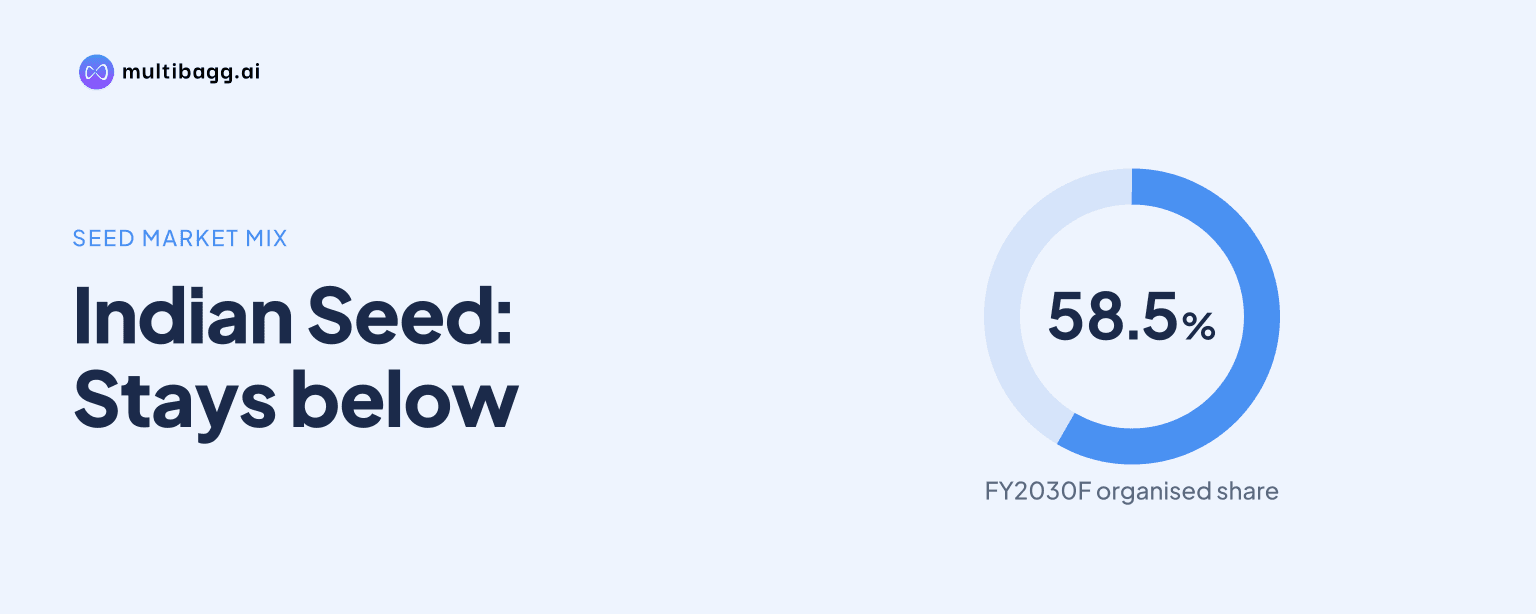
The Indian Seed Industry is forecast to have an organised market worth US$325 crore, or 58.5% of a US$560 crore market, in FY2030F, leaving formal suppliers below 60%. Frost & Sullivan projects the unorganised segment, including farm-saved and informally traded seed, at US$231 crore, or 41.5% of total market value.
Why does India’s seed market remain below 60% organised through FY2030?
India’s seed market remains below 60% organised because farmers frequently retain and trade their own seed instead of purchasing through formal seed companies. The source defines the unorganised segment as farmer-saved and exchanged seed alongside local, regional and small businesses, and forecasts that segment at 41.5% of market value in FY2030F.
India’s seed market has a formal segment comprising established seed producers, government agencies and companies such as Bayer, BASF, Corteva, Advanta Seeds, Crystal Crop, Mahyco, Seedworks, Rasi Seeds, Kaveri and VNR Seeds. These suppliers sell field-crop and vegetable seeds, while the unorganised segment remains fragmented across smaller operators and farmer-to-farmer channels. The organised share can rise only where more farmers choose formally supplied seed over retained or locally traded seed.
The projected mix shows that value growth does not mean the displacement of informal channels. Organised suppliers are expected to add US$100 crore of market value between FY2025E and FY2030F, but the unorganised segment is also expected to increase by US$66 crore over the same period. The result is a 0.8 percentage-point organised-share increase, from 57.7% to 58.5%, rather than a structural break above 60%.
How large will India’s seed market be by FY2030F?
India’s seed market is forecast to reach US$560 crore in FY2030F, growing from an estimated US$390 crore in FY2025E at a 7.4% compound annual growth rate, or CAGR, for 2025 to 2030. CAGR is the annualised rate of growth over a stated multi-year period.
The organised segment is projected to expand from US$175 crore in FY2019 to US$325 crore in FY2030F, while its value share rises only 1.5 percentage points, from 57.0% to 58.5%. The unorganised segment is projected to rise from US$135 crore in FY2019 to US$231 crore in FY2030F, even as its share declines from 43.0% to 41.5%.
The source attributes overall market demand to food, animal feed and biofuels, as well as adoption of hybrid and high-yielding varieties. Government regulation, technology adoption, research and development spending, and farmer awareness of insect resistance and yields are also identified as industry drivers. These factors support demand for commercial seed, but the forecast indicates they coexist with farm-saved seed use through FY2030F.
Got a follow-up? Ask IRIS
What supports organised growth in India’s seed market?
India’s seed market is supported by hybrid and higher-yielding seed development, but commercialisation requires a long research cycle. The source estimates that moving from germplasm collection, meaning genetic material used in breeding, to commercialisation takes about 10 to 12 years depending on whether a crop can be grown in multiple seasons or only once a year.
A hybrid candidate passes breeding-station trials, multi-location trials, product-evaluation trials and pre-commercial demonstrations before commercialisation. The process begins with more than 20,000 hybrid candidates, while the number of testing sites increases as entries advance. Grain yield, milling yield, disease tolerance, grain quality and lodging tolerance, meaning resistance to plants falling over, are the five stated assessment criteria.
The time to release a new variety can range from four to five years to eight to 10 years, according to the source. Formal seed suppliers therefore require breeding farms, research stations, germplasm libraries, skilled personnel and controlled laboratories for germination testing. Continued growth in the organised segment depends on product pipelines producing varieties that meet farmer and market requirements after these testing stages.
The distinction is particularly relevant for genetically modified, or GM, crop traits. CropLife International estimates that the time to commercialise a GM crop increased from 13.1 years in 2012 to 16.5 years in 2022, while cost to market declined from US$13,600 crore to US$11,500 crore. The source states that regulatory approvals consume most of the GM commercialisation timeline.
Which crops and regions shape India’s seed market value?
Vegetables, maize and cotton together account for 69.1% of organised-market value in FY2025, making them the largest value categories in India’s seed market. Vegetables account for 29.1%, maize 21.0% and cotton 19.0% of an organised market valued at US$230 crore in FY2025.
Vegetable seed has the largest value share because the source cites hybrid-seed research and development, specialised and labour-intensive production, seasonal weather and pest challenges, and storage needs. By contrast, wheat and rice together represent 22.7% of organised-market value, comprising wheat at 9.4% and rice at 13.3% in FY2025.
The volume mix differs materially from the value mix. Wheat represents 48.1% of organised seed volume and rice 24.1%, together accounting for 72.2% of approximately 935 thousand tonnes in FY2025. Vegetables represent only 0.3% of volume despite their 29.1% value share, while cotton represents 2.2% of volume and 19.0% of value.
Regional demand is concentrated in North and West India, which account for 37% and 35%, respectively, of the US$230 crore organised market in FY2025. Their combined 72% share exceeds South India’s 18% and East India’s 10%, requiring suppliers to maintain crop portfolios and distribution suited to differing regional conditions.
Conclusion
India’s seed market is projected to grow from US$390 crore in FY2025E to US$560 crore in FY2030F, but its organised share is expected to rise only from 57.7% to 58.5%. Commercial suppliers gain value through hybrid, vegetable, maize and cotton seed demand, while farm-saved seed, informal trade and smaller regional businesses remain a US$231 crore part of the market in FY2030F.
The key measure to watch is whether organised penetration exceeds the projected 58.5% by FY2030F as formal seed offerings gain adoption. Progress will depend on companies sustaining breeding, trials and commercialisation cycles that can take 10 to 12 years, while farmers continue to weigh formally supplied seed against retained and locally traded alternatives.