










Seed development takes up to 14 years; GM traits take 16.5
Key highlights
- Seed development takes 6-7 years for annual crops and 7-14 years for biannual crops.
- GM trait commercialization increased from 13.1 years in 2012 to 16.5 years in 2022.
- Global GM crop area rose 1.9% to 209.8 million hectares in 2024.
- More than half of global seed sales are made by five to six firms.
powered by IRIS
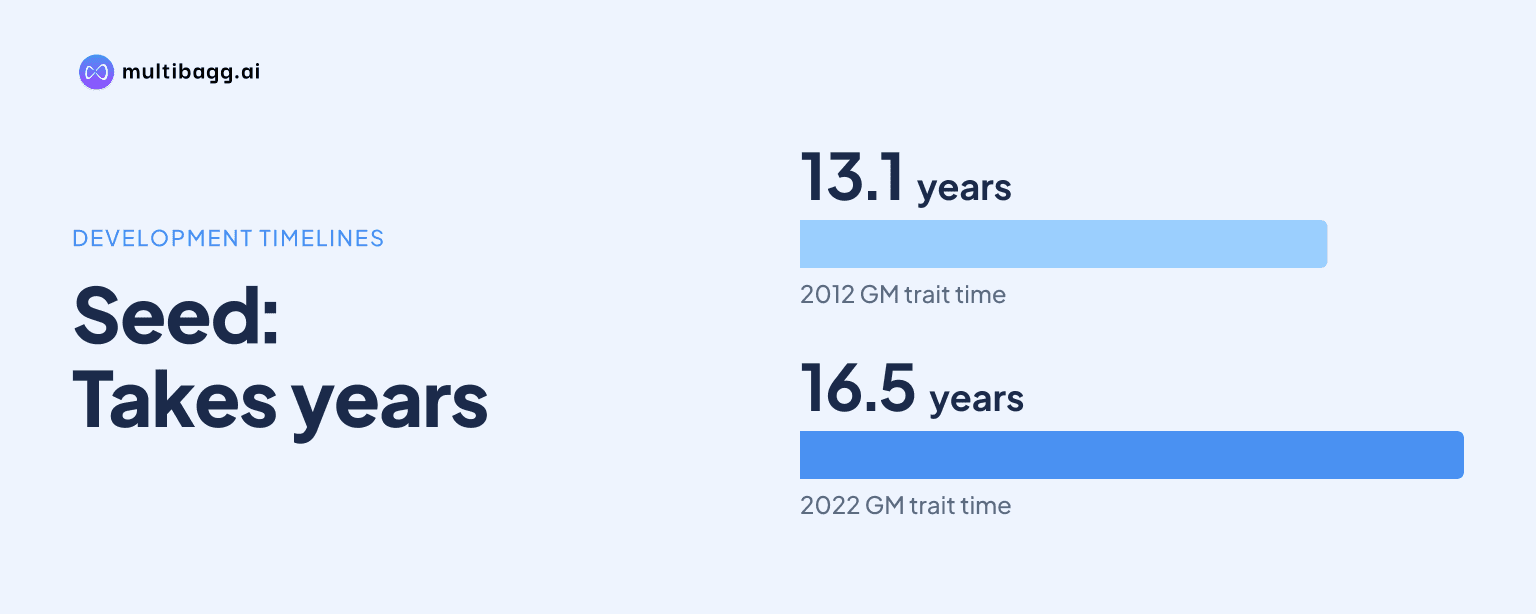
Seed development takes 6-14 years by crop category, while genetically modified (GM) traits took 16.5 years from research to commercialization in 2022, up from 13.1 years in 2012. The 3.4-year increase in GM trait timelines reflects approval requirements, while breeding depends on germplasm, trials and seed-production capacity.
How long does seed development take from breeding to sale?
Seed development takes 6-7 years for annual crops and 7-14 years for biannual crops under the International Seed Federation timeline. The process begins with germplasm collection, followed by selection of inbred lines, two screening stages, two trial stages, introduction and commercialization. The report also describes an approximate 10-12-year path from germplasm collection to commercialization, depending on whether a crop can be grown in several seasons or only once a year.
The difference between annual and biannual timelines arises from the number of breeding cycles possible in a year. A company able to use multiple growing seasons can advance breeding material faster than one restricted to a single annual season. Seed development therefore depends on scientific selection, strategically located breeding stations and multi-environment evaluation of breeding material.
Why do GM traits take 16.5 years to reach market?
GM traits took 16.5 years to commercialize in 2022 because most of the research-to-market period was spent on regulatory approvals. This was 3.4 years longer than the 13.1 years recorded in 2012. A GM trait is a genetically modified plant characteristic intended to produce a specified outcome, including insect resistance, herbicide tolerance or resilience to environmental stress.
Regulatory requirements differ by country and can cover breeding, testing, environmental effects, product performance, viability, labelling, intellectual property and food or feed rules. Imported seed must also meet phytosanitary requirements, which are plant-health measures applied to cross-border trade. Some jurisdictions require further research or annual repetition of studies even when nearby countries with similar growing conditions have already assessed the crop.
GM development operates in a broad but fragmented international regulatory market. In 2024, global GM crop area increased 1.9% to a record 209.8 million hectares, with 10 GM crops grown in 28 countries. More than 75 countries cultivate, import or field-test genetically modified organisms, yet the report identifies only 13 crops with commercially available GM versions globally, making market access specific to both crop and jurisdiction.
What stages make seed development research intensive?
Seed development uses a funnel that narrows an initial population of more than 20,000 hybrids through breeding-station trials, multi-location trials, product-evaluation trials and pre-commercial demonstrations before commercialization. The number of candidate hybrids declines at each stage, while the number of testing sites rises. This mechanism tests performance across locations and segments rather than relying on a single season or site.
The formal sequence includes pre-breeding, breeding, variety testing, variety registration, plant variety protection, basic-seed production, hybrid commercial-seed production, promotion and sale. Variety testing can include company trials, growers' trials, Distinctness, Uniformity and Stability testing, known as DUS testing, and Value for Cultivation and Use testing, known as VCU testing. DUS assesses whether a variety is distinguishable, uniform and stable, while VCU evaluates its cultivation and use value.
At the product-evaluation stage, the report identifies five criteria: grain yield, milling yield, disease tolerance, grain quality and lodging tolerance. Lodging tolerance is a crop's ability to remain standing rather than falling over. Farmers and sales teams participate in pre-commercial demonstrations, so the decision to launch depends on field data as well as feedback from intended users.
Got a follow-up? Ask IRIS
Why are germplasm and seed production capacity barriers to entry?
Seed development is constrained by germplasm, the plant genetic material used in variety discovery and breeding, because high-quality germplasm libraries take time to build. A large and diverse pool supports the search for yield, pest-resistance and climate-resilience traits. The report identifies research laboratories, research stations, advanced equipment, skilled workers, germplasm banks and knowledge of intellectual-property rules as capabilities held by established seed companies.
The commercial system also requires multiplication, processing, testing, storage and distribution. Companies can use owned farms or contract growers for multiplication, but contract networks require capacity building and buy-back guarantees for seed output. Processing facilities require equipment including cleaners, destoners, gravity separators, graders and dryers, while Indian germination laboratories require controlled temperature, humidity, lighting, hygiene, pest control and specialised equipment.
Industry concentration adds to the access challenge. More than half of global seed sales are made by five to six firms, while two to three companies sell most seed for several United States staple crops, including corn, soy, canola and cotton. Monsanto acquired 60 seed and genomics companies between 1980 and 2014, and the United States Department of Agriculture found that more than 200 commodity-seed companies were acquired or exited during the 1990s and 2000s.
Can technology or regulatory harmonization shorten seed development timelines?
Seed development timelines can be shortened by tools that improve breeding decisions, but the report does not state that these methods remove testing or approval requirements. Artificial intelligence, or AI, can analyse genetic data to predict genotype performance and assist phenotypic assessment, the measurement of observable plant traits. Double-haploid technology can shorten inbreeding relative to repeated self-pollination by producing fully homozygous lines.
Regulatory harmonization could make GM approvals more predictable by aligning data requirements, technical guidelines, safety assessments and recognition processes across jurisdictions. The International Seed Federation poll cited in the report found that more than 100 seed specialists expect some global harmonization during the next 20 years. Harmonization would not remove national autonomy, but it could reduce duplicated safety assessments and improve data transportability between regulatory systems.
Conclusion
Seed development combines a 6-14-year breeding cycle with germplasm access, repeated trials, seed multiplication and registration. GM traits add a separate approval burden, with research-to-commercialization time increasing from 13.1 years in 2012 to 16.5 years in 2022. The combined requirements explain why breeding infrastructure, genetic libraries, grower networks and regulatory capability take time to establish.
The next issue to watch is whether the regulatory harmonization anticipated by more than 100 seed specialists develops during the next 20 years. The report also identifies AI, gene editing and double-haploid methods as breeding tools, but country-specific approval rules remain the unresolved factor governing how quickly GM traits can reach market.