










Foodlink closures expose recurring casual-dining revenue risk
Key highlights
- Foodlink shut 11 Casual Dining Restaurants and 10 Cloud Kitchens from April 1, 2023 to the Red Herring Prospectus date.
- Casual Dining Restaurants & Cloud Kitchens generated Rs 66.493 crore, or 30.25% of revenue from operations, in the six months ended September 30, 2026.
- Foodlink proposes to invest Rs 50.807 crore to establish four Casual Dining Restaurants in Abu Dhabi and Dubai.
- Foodlink Global Restaurant & Catering Services LLC reported a Rs 22.703 crore loss in the six months ended September 30, 2026.
powered by IRIS
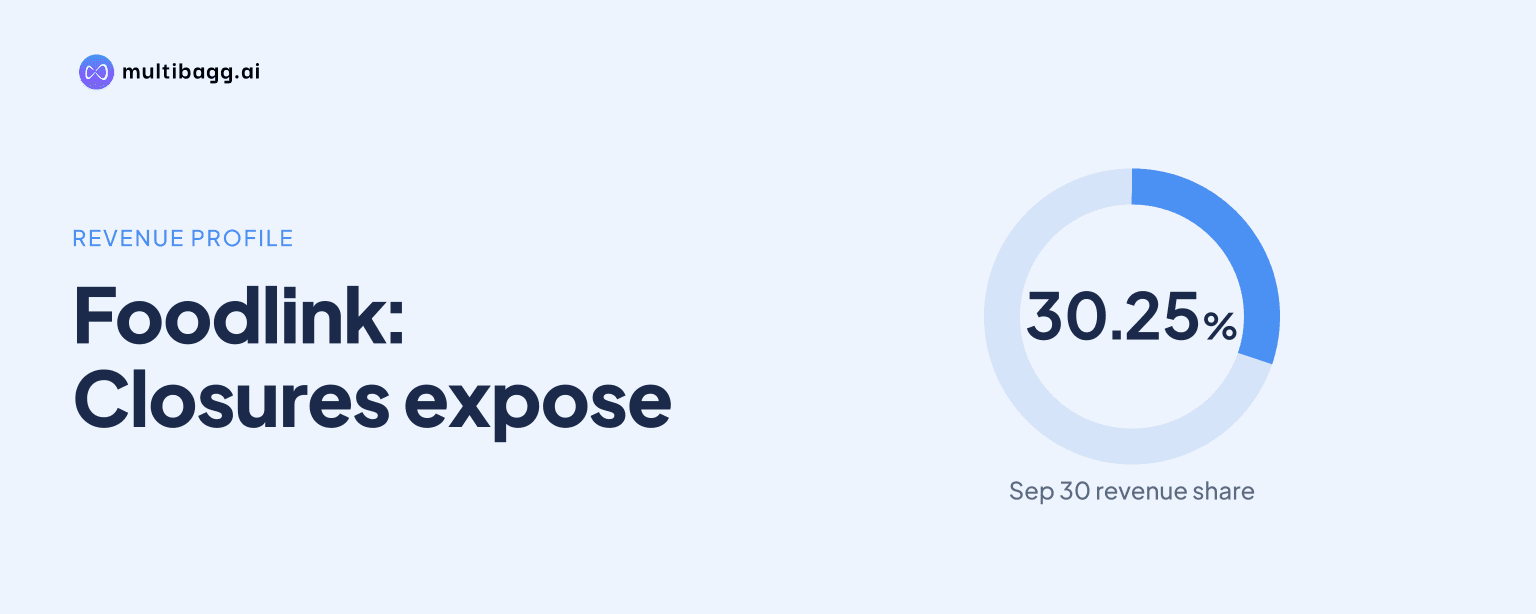
Foodlink F&B Holdings India Limited (Foodlink) shut 11 Casual Dining Restaurants and 10 Cloud Kitchens from April 1, 2023 to the Red Herring Prospectus date after low footfalls and unmet profitability expectations, while the format generated Rs 66.493 crore, or 30.25% of revenue from operations, in the six months ended September 30, 2026.
Why did Foodlink close casual-dining outlets?
Foodlink closed 21 outlets because they sustained low footfalls and did not meet its profitability expectations. A Casual Dining Restaurant is a dine-in food outlet, while a Cloud Kitchen prepares food principally for delivery rather than on-premise dining. The disclosed closures comprise four Casual Dining Restaurants and two Cloud Kitchens in the six months ended September 30, 2026, five restaurants and six Cloud Kitchens in Fiscal 2025, and two restaurants and two Cloud Kitchens in Fiscal 2024.
The closure pattern shows that 11 of the 21 units, more than half, were shut in Fiscal 2025. Foodlink disclosed that no Casual Dining Restaurants or Cloud Kitchens were shut from October 1, 2026 until the date of the Red Herring Prospectus. That statement records no subsequent closures, but it does not establish that the closed locations had become profitable before their closure.
Foodlink identifies several circumstances that can lead to another closure: an outlet failing to attain expected footfall, revenue or profitability; renovation or refurbishment that is not commercially viable; or redevelopment of the property where the unit operates. Changes in consumer preferences, tastes and food habits could also reduce demand. Foodlink said it had not experienced a demand decline from changing preferences in the six months ended September 30, 2026 or in Fiscals 2026, 2025 and 2024, apart from the outlets already closed.
How large is Foodlink's casual-dining revenue risk?
Foodlink's Casual Dining Restaurants & Cloud Kitchens business generated Rs 66.493 crore in the six months ended September 30, 2026, representing 30.25% of revenue from operations. The segment was Foodlink's second-largest disclosed operating business in that six-month period, behind Events Catering at 44.15% and ahead of Banquets and Integrated F&B Services at 25.41%.
The format's revenue share increased by 7.33 percentage points from 22.92% in Fiscal 2025 to 30.25% in the six months ended September 30, 2026. Its Rs 66.493 crore revenue for the six-month period was lower than Rs 137.152 crore for all of Fiscal 2026 because the reported periods are not like for like. The dependency is that a format contributing about three-tenths of revenue must retain commercially viable outlets despite Foodlink's past exits from units that did not meet footfall and profitability expectations.
The revenue mix shows Foodlink has other material businesses, but they do not remove the operational relevance of the restaurant format. Events Catering generated Rs 97.056 crore in the six months ended September 30, 2026, while Banquets and Integrated F&B Services generated Rs 55.855 crore. Total revenue from operations was Rs 219.825 crore, including Rs 0.422 crore of other revenue from the sale of traded goods and other operations.
What financial exposure can follow a restaurant closure?
Foodlink says closures can result in losses on money invested in a Casual Dining Restaurant or Cloud Kitchen and in the disposal or redeployment of related assets. The exposure arises because a new restaurant requires fixed lease costs, fit-outs and refurbishments to match Foodlink's preferred format, and may not become profitable immediately after opening or may take time to break even.
Long-term leases can extend costs beyond the final day of trading. Foodlink states that less profitable or unsuccessful restaurants may remain subject to lease obligations, including lease-rental payments or penalties for terminating leases. If several Casual Dining Restaurants or Cloud Kitchens close at the same time, Foodlink says these costs and asset-related losses could affect its business, financial condition, results of operations and prospects.
The disclosed risks are not limited to outlet economics. Foodlink identifies location selection, consumer preferences, competition and operating-cost management as conditions for expansion to work. Prime restaurant real estate may be unavailable on commercially acceptable terms, while location-specific approvals are required before operations can begin. Lower footfalls and lower table-turn rates, meaning the frequency with which a dining table is occupied by successive customers, could follow a poor site choice or delayed opening.
Got a follow-up? Ask IRIS
Is Foodlink still funding new casual-dining restaurants?
Foodlink proposes to invest Rs 50.807 crore of net proceeds in Foodlink Global Restaurant & Catering Services LLC, its material subsidiary, to fund capital expenditure for four new Casual Dining Restaurants. The planned sites comprise one China Bistro and three dine-in Art of Dum restaurants in Abu Dhabi and Dubai, United Arab Emirates, but exact premises had not been identified as of the Red Herring Prospectus date.
The proposed expansion therefore has both execution and outlet-performance conditions. Foodlink had obtained vendor quotations but had not placed orders or entered definitive vendor agreements for the proposed capital expenditure. Vendor bids may be revised, and delays in equipment supply, fit-out, civil, electrical or plumbing work could raise costs or extend the implementation schedule.
The proposed restaurants also need trade licences, food-safety permits and health-and-safety compliance in their relevant jurisdictions. Foodlink says it cannot assure that the new restaurants will be successful, profitable or free from low footfalls. The plan requires suitable properties and approvals, fit-outs within planned costs, and commercial viability within a reasonable period for the outlets to add revenue rather than create further closure risk.
How do overseas conditions affect Foodlink's restaurant operations?
Foodlink Global Restaurant & Catering Services LLC reported a loss of Rs 22.703 crore in the six months ended September 30, 2026, compared with a loss of Rs 1.427 crore in Fiscal 2026 and profit of Rs 12.526 crore in Fiscal 2025. Foodlink attributed the six-month loss to heightened geopolitical tensions and ongoing regional conflicts, which affected consumer sentiment, travel activity and discretionary spending while amplifying the normal seasonal slowdown.
In Fiscal 2026, the subsidiary's loss was attributed to external market disruptions and geopolitical instability in the United Arab Emirates. Foodlink said a substantial portion of previously confirmed orders was cancelled or postponed amid uncertainty, while three new Casual Dining Restaurants commenced operations in Fiscal 2026 and incurred pre-operating expenses, start-up costs and initial integration costs. These disclosures connect restaurant expansion to both local outlet economics and conditions affecting customer demand in the United Arab Emirates.
Conclusion
Foodlink's disclosure shows recurring operating risk in a business that generated Rs 66.493 crore, or 30.25% of revenue from operations, in the six months ended September 30, 2026. The closure of 11 Casual Dining Restaurants and 10 Cloud Kitchens since April 1, 2023 reflects Foodlink's stated practice of exiting locations with low footfalls or inadequate profitability, but those exits can leave lease, asset-disposal and redeployment costs.
The next disclosed development is Foodlink's proposed Rs 50.807 crore investment in four Casual Dining Restaurants in Abu Dhabi and Dubai. Foodlink had not identified exact properties or placed capital-expenditure orders as of the Red Herring Prospectus date, making site selection, regulatory approvals, vendor execution, opening costs, footfalls and commercial viability the disclosed matters to watch amid geopolitical conditions in the United Arab Emirates.