










Foodlink’s UAE conflict exposure covers 26.27% of revenue
Key highlights
- Foodlink earned Rs 57.738 crore, or 26.27%, of revenue from operations outside India in the six months ended September 30, 2026.
- Foodlink said UAE conflict disruption during the fourth quarter of Fiscal 2026 increased logistics costs and caused certain event cancellations, postponements and rescheduling.
- Foodlink had three Dubai storage facilities, one centralized kitchen, six cloud kitchens and seven casual dining restaurants outside India as of September 30, 2026.
- Outside-India revenue contribution increased from Rs 86.137 crore in Fiscal 2024 to Rs 149.073 crore in Fiscal 2026.
powered by IRIS
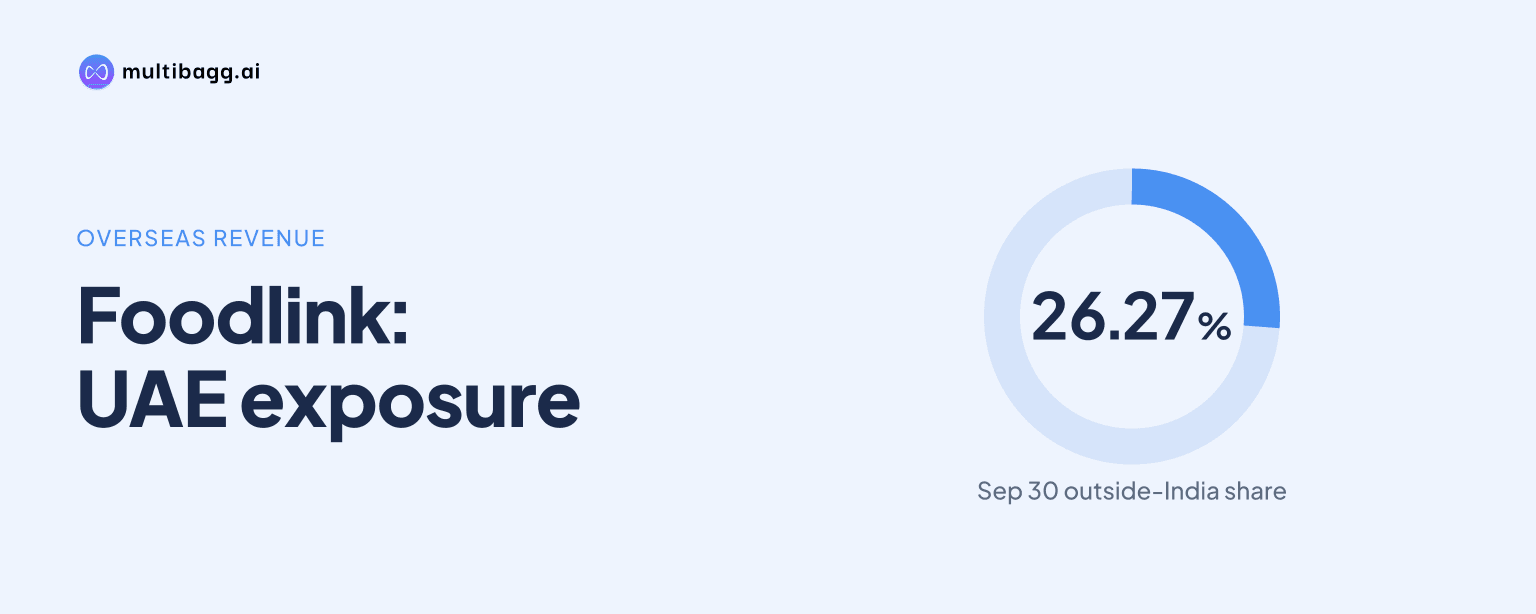
Foodlink’s UAE conflict exposure covered 26.27% of revenue from operations in the six months ended September 30, 2026, when overseas operations supplied Rs 57.738 crore. Foodlink said regional conflict in the United Arab Emirates disrupted travel, logistics, supply chains and event schedules during the fourth quarter of Fiscal 2026.
How did the UAE conflict affect Foodlink’s operations?
Foodlink said regional conflict and geopolitical instability in the United Arab Emirates adversely affected operations during the fourth quarter of Fiscal 2026. The disruption affected travel, transportation, logistics, personnel movement, procurement and supply chains, causing cancellations, postponements and rescheduling of certain events, alongside increased operating and logistics costs. Foodlink did not quantify the number of affected events, the additional costs or the resulting effect on profit.
Foodlink’s Dubai infrastructure gives the disruption direct operational relevance. As of September 30, 2026, Foodlink had three Dubai storage facilities for cooking equipment used in international catering events, one centralized kitchen, six cloud kitchens and seven casual dining restaurants outside India, all located in Dubai. Restrictions affecting staff mobility, equipment movement, ingredient procurement or local transport can therefore affect both event catering and restaurant operations.
Foodlink said continued or escalating conflict could result in further operational disruptions and lower demand in affected markets. For that risk to ease, travel, personnel movement, procurement, supply chains and event schedules would need to function without further cancellations or delays. The disclosure does not identify a quantified UAE contingency arrangement, insurance recovery or conflict-specific financial mitigation.
How dependent is Foodlink on overseas revenue?
Foodlink derived Rs 57.738 crore, or 26.27%, of revenue from operations outside India in the six months ended September 30, 2026. Revenue from operations in India was Rs 162.087 crore, or 73.73%, including other operating income. The September 2026 half-year geographic mix was identical to the reported Fiscal 2026 split of 26.27% outside India and 73.73% in India.
Foodlink’s outside-India revenue share increased by 3.43 percentage points from 22.84% in Fiscal 2024 to 26.27% in Fiscal 2026, but declined by 4.18 percentage points from 30.45% in Fiscal 2025. Outside-India revenue increased by Rs 62.936 crore between Fiscal 2024 and Fiscal 2026. International activity was therefore more than one-quarter of reported revenue in Fiscal 2026, although India remained the larger revenue market.
The outside-India category is broader than the United Arab Emirates. As of September 30, 2026, Foodlink had operations in India, the United Arab Emirates, the United Kingdom and Malaysia, and had catered events in countries including Oman, Qatar, Egypt and Jordan. Foodlink does not disclose a country-by-country revenue split, so Rs 57.738 crore of latest half-year overseas revenue cannot be treated as UAE revenue alone.
Got a follow-up? Ask IRIS
What other international risks could affect Foodlink’s overseas revenue?
Foodlink identifies risks beyond the UAE conflict because its international markets have different legal, regulatory, economic and infrastructure conditions. The disclosed risks include difficulties with local business, logistics and transport partners; higher raw-material and marketing costs; longer receivable collection periods; foreign-exchange and repatriation controls; permits; import and export rules; tax consequences; and political instability. These factors can affect revenue collection, service delivery and the cost of operating across borders.
Foodlink also depends on cross-border employee mobility for international work. It may need outbound or inbound visas, work permits and compliance with local-hiring or nationalisation rules, although it reported no difficulty securing visas or work permits, labour shortages, or related costing or execution risks in the six months ended September 30, 2026 and Fiscals 2026, 2025 and 2024. Foodlink said visa, work-permit and employee travel costs are recovered from customers, subject to the relevant customer arrangements continuing.
Foreign-currency revenue is a narrower measure than overseas operational revenue. Foodlink reported nil revenue generated in foreign currency for the six months ended September 30, 2026, compared with Rs 3.090 crore in Fiscal 2026, Rs 1.489 crore in Fiscal 2025 and Rs 1.383 crore in Fiscal 2024. Thus, the 26.27% overseas revenue contribution in the latest half year did not correspond to reported foreign-currency revenue under Foodlink’s disclosed measure.
Can Foodlink continue international expansion amid UAE disruptions?
Foodlink plans to expand its international presence by focusing on target countries under its business strategy, but had not entered into specific expansion agreements as of the Red Herring Prospectus date. The plan is therefore a stated strategic objective rather than a disclosed pipeline of committed overseas projects. Foodlink said expansion across multiple jurisdictions may require considerable management attention and financial resources.
Foodlink’s international growth also depends on building brand recognition and competing with companies that may have more local-market or international experience. Foodlink said it may be unable to compete if it cannot offer services at price points that appeal to consumers, while guest preferences, health and dietary considerations, food-safety concerns and competing menus can affect demand or costs. These commercial conditions operate alongside the logistical and geopolitical risks disclosed for the United Arab Emirates.
Foodlink’s Events Catering business has seasonal timing exposure that can compound disruptions. In Fiscal 2026, 67.20% of consolidated revenue from operations was earned in the second half, compared with 63.24% in Fiscal 2025 and 69.53% in Fiscal 2024. Foodlink said extreme weather, periods with fewer weddings or events, and cancelled events can delay or reduce revenue while some operating expenses continue.
Conclusion
Foodlink’s disclosed UAE conflict risk matters because overseas operations accounted for 26.27% of revenue from operations in both the six months ended September 30, 2026 and Fiscal 2026. Its Dubai footprint of three storage facilities, one centralized kitchen, six cloud kitchens and seven casual dining restaurants links regional disruption to event delivery, restaurant operations, procurement and logistics costs.
The next disclosed issue to watch is Foodlink’s international-expansion strategy, because it had no specific expansion agreements as of the Red Herring Prospectus date. Readers can also monitor whether regional conditions affect event scheduling, procurement, staff mobility and logistics costs, particularly because 67.20% of Fiscal 2026 revenue from operations was generated in the second half.