










Indian cloud kitchen market projected to reach Rs 17,250 crore by FY2030F
Key highlights
- The cloud kitchen market is projected to rise from Rs 7,080 crore in FY2026E to Rs 17,250 crore in FY2030F at a 24.9% CAGR.
- Multi-brand kitchens accounted for about 47.5% of FY2026E cloud kitchen value, or Rs 3,360 crore.
- Standalone kitchens represented 42.0% of FY2026E cloud kitchen value, equal to Rs 2,970 crore.
- Online food delivery is estimated to account for 10% to 15% of total foodservice spending by CY2026.
powered by IRIS
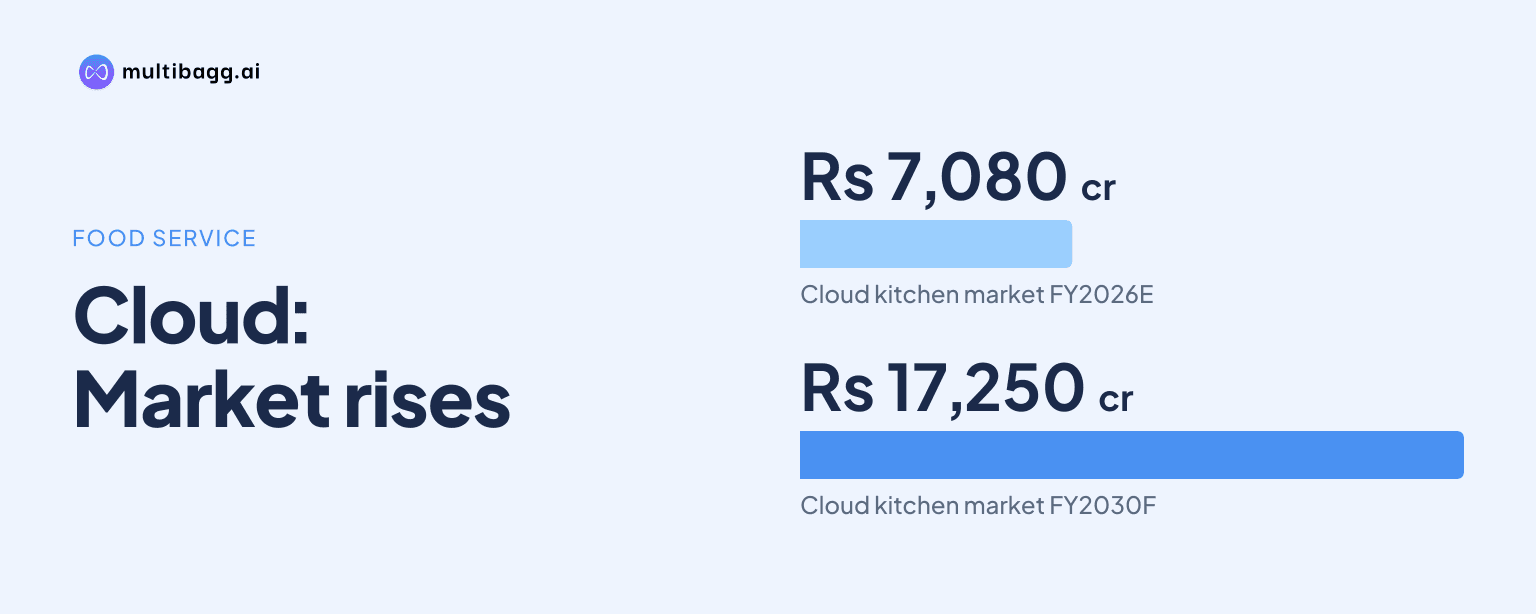
The Indian Cloud Kitchen Market is projected to reach Rs 17,250 crore in FY2030F from Rs 7,080 crore in FY2026E, a 24.9% compound annual growth rate, with multi-brand kitchens holding the largest FY2026E format share at about 47.5%.
How fast is the cloud kitchen market expected to grow?
The cloud kitchen market is forecast to add Rs 10,170 crore between FY2026E and FY2030F, growing from Rs 7,080 crore to Rs 17,250 crore at a 24.9% compound annual growth rate, or CAGR. CAGR is the annualised growth rate over a period assuming gains compound, and the FY2030F estimate follows a rise from Rs 1,300 crore in FY2019 to Rs 3,100 crore in FY2023.
The projected FY2026E-to-FY2030F CAGR of 24.9% is lower than the 27.4% CAGR reported for FY2019 to FY2023, although the forecast increase of Rs 10,170 crore is substantially larger in absolute value. The projection depends in part on online food delivery accounting for an estimated 10% to 15% of total foodservice spending by CY2026.
Why does the cloud kitchen market operate differently from restaurants?
The cloud kitchen market consists of delivery-only production facilities without customer-facing dining space, unlike traditional restaurants designed around location, ambience and walk-in traffic. The format directs kitchen assets towards food preparation, demand aggregation and supply-chain logistics, rather than maintaining a dine-in area, in a market valued at Rs 7,080 crore in FY2026E.
Cloud kitchens rely on digital orders through platforms including Swiggy and Zomato, while physical restaurants provide direct customer interaction, brand visibility and dine-in services. The source describes a hybrid model in which a food brand uses cloud kitchens for delivery reach and physical outlets for dine-in occasions, provided the formats serve different needs rather than duplicate operating costs.
The model's scale is therefore linked to order flow, production efficiency and delivery logistics instead of footfall. The estimated 10% to 15% share of foodservice spending expected from online delivery by CY2026 is the disclosed demand base supporting cloud-kitchen expansion through FY2030F.
Got a follow-up? Ask IRIS
Why are multi-brand kitchens the largest cloud kitchen format?
Multi-brand kitchens are the largest cloud kitchen format because they represented about 47.5% of FY2026E market value, or Rs 3,360 crore, by operating multiple virtual restaurant brands from a central production facility. A virtual brand is a delivery-focused restaurant identity without its own dedicated dine-in outlet.
The multi-brand model shares procurement, labour, kitchen capacity and logistics across several menus and revenue streams. It can also use common ingredients across brands instead of dedicating a facility to one menu with limited stock-keeping unit, or SKU, variation; SKU refers to an individual inventory item or product variant.
Rebel Foods is cited as operating more than 45 virtual brands from a single kitchen setup, illustrating the portfolio approach underlying the Rs 3,360 crore multi-brand segment. The source also identifies artificial intelligence, or AI, driven brand switching as a way to replace an underperforming concept with another offering without significant new infrastructure spending.
Standalone kitchens accounted for 42.0% of FY2026E value, or Rs 2,970 crore, and concentrate on a single brand or cuisine. Biryani By Kilo and FreshMenu are cited as examples, while the source notes that a standalone kitchen can adapt to local tastes but remains more dependent on customer loyalty and order frequency in its selected category.
What could affect the cloud kitchen market's FY2030F projection?
The cloud kitchen market's FY2030F projection could be affected by aggregator commissions of 20% to 25%, delivery costs and packaging expenses, which the source says can leave net margins below 5%. Market growth from Rs 7,080 crore in FY2026E to Rs 17,250 crore in FY2030F does not itself establish that individual operators will improve their margins.
A delivery-only brand may also need marketing, promotions or links with established brands because it has no dine-in site to build consumer awareness. Changes in delivery-platform ranking algorithms or commission structures can alter an operator's visibility and advertising needs, creating dependence on third-party platforms as online food delivery approaches an estimated 10% to 15% of foodservice spending by CY2026.
Municipal approvals for industrial kitchens vary by city, and the source identifies uncertainty around health, safety and environment, or HSE, clearances for larger multi-brand facilities. A failure to maintain required approvals can create shutdown risk, while standalone kitchens worth Rs 2,970 crore in FY2026E have less scope than multi-brand facilities to offset a decline in demand for one cuisine.
Conclusion
The cloud kitchen market forecast combines a delivery-led production model with a significant shift towards shared infrastructure. Multi-brand kitchens led FY2026E formats at about 47.5%, or Rs 3,360 crore, ahead of standalone kitchens at 42.0%, or Rs 2,970 crore, showing the scale of the format that pools kitchen capacity, supply chains and virtual brands.
The next disclosed target is market value of Rs 17,250 crore in FY2030F, following the Rs 7,080 crore FY2026E base. What to watch is whether online delivery reaches its estimated 10% to 15% share of foodservice spending by CY2026 and whether operators can manage commissions of 20% to 25%, delivery costs, platform visibility and local HSE approvals as capacity expands.