










Indian wedding catering market: luxury delivers 31-40%
Key highlights
- Luxury and ultra-luxury weddings generated 31-40% of FY26 catering value while representing only 3-3.5% of wedding volumes.
- The Indian wedding catering market is estimated at Rs 1,24,000-2,03,700 crore in FY26.
- Luxury and ultra-luxury catering is estimated at Rs 38,700-82,350 crore in FY26.
- The wedding catering market is projected to reach Rs 1,95,100-3,20,500 crore by FY30 at a stated 12% CAGR.
powered by IRIS
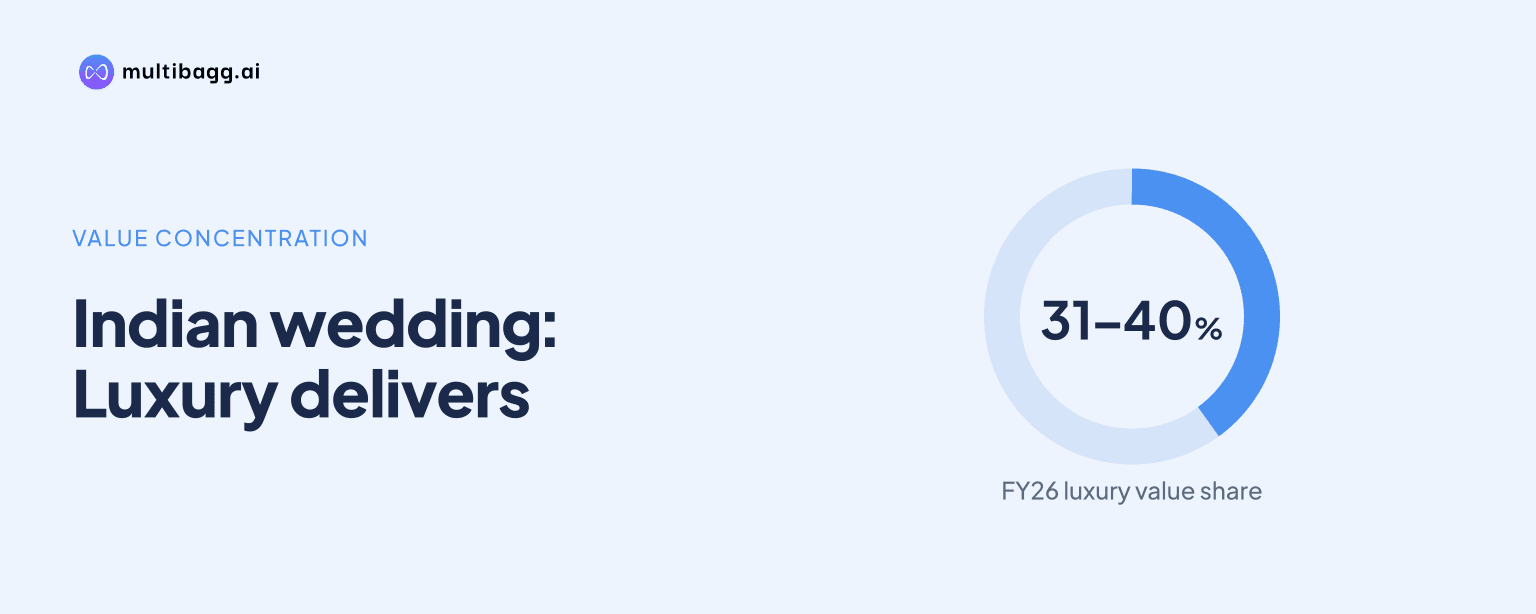
The Indian wedding catering market derived 31-40% of FY26 value from luxury and ultra-luxury weddings, equal to Rs 38,700-82,350 crore, even though those segments represented only 3-3.5% of wedding volumes. The concentration reflects multi-day functions, bespoke food formats and destination-event logistics rather than the number of weddings alone.
How concentrated is the Indian wedding catering market in luxury weddings?
The Indian wedding catering market is concentrated at the top end because luxury and ultra-luxury weddings generated 31-40% of FY26 catering value while accounting for only 3-3.5% of wedding volumes. The total FY26 market is estimated at Rs 1,24,000-2,03,700 crore, and catering represents 13-15% of total Indian wedding expenditure.
Luxury weddings, defined as events with total budgets from Rs 70 lakh to Rs 3 crore, account for 2-2.5% of all weddings and 11-16% of total wedding spending. Ultra-luxury weddings, defined as those above Rs 3 crore, represent less than 1% of weddings but contribute 13-16% of total wedding expenditure. This gap between event volume and spending explains why a small number of high-budget functions can account for a large share of the wedding catering market.
Why does luxury wedding catering command a larger spend?
Luxury wedding catering commands a larger spend because food is arranged as bespoke, multi-function hospitality rather than a single meal. Luxury catering accounts for 15-18% of a luxury wedding budget and is valued at Rs 16,200-37,800 crore annually, while ultra-luxury catering is estimated at Rs 22,500-44,500 crore in FY26 and represents 18-22% of the catering market.
The higher cost arises from menu design, service format and operational requirements. Luxury events can include gourmet regional food, international cuisines, plated dinners and interactive chef stations for guest lists often exceeding 700. Ultra-luxury events may run across several days and multiple destinations, requiring curated wine pairings, personalised dietary menus, international culinary teams and specialised ingredient sourcing.
Destination weddings add another operating layer because 70-80% of luxury and ultra-luxury weddings are estimated to be destination events. Events in Rajasthan, Kerala, Goa or overseas venues require caterers to coordinate kitchens, ingredients, storage and service teams away from their regular base. The premium-end share therefore depends on continuing demand for multi-day, customised and venue-linked hospitality.
How does luxury catering compare with other wedding segments?
Luxury and ultra-luxury catering is comparable in FY26 value with masstige catering, but the two categories reach that scale through very different event volumes and spend per function. Luxury and ultra-luxury catering is estimated at Rs 38,700-82,350 crore, compared with Rs 39,200-40,000 crore for masstige catering, although masstige weddings account for 40-48% of wedding volumes.
Premium catering is another large category at Rs 38,600-71,800 crore, with guest lists generally ranging from 300 to 700. The source identifies live counters, sushi, artisanal pizzas and molecular-gastronomy displays as examples of premium-service formats. Masstige events generally host 200-500 guests and commonly use buffet formats that combine regional dishes with pasta, Chinese stir-fries and gourmet desserts.
Economy catering is the smallest listed segment, at Rs 7,400-9,500 crore in FY26, with catering budgets of 8-10% of total wedding spending and typical guest counts of 100-200. Economy weddings account for 34-40% of all weddings, illustrating the difference between volume and catering value. The segment centres on regional dishes and traditional high-volume buffets, while upper-tier weddings add differentiated menus, food-station presentation and separate meal occasions.
Got a follow-up? Ask IRIS
What factors determine wedding catering market revenue?
Wedding catering market revenue depends on professionalisation, destination logistics and the ability to deliver regional menus consistently. Overall wedding expenditure rose 56% between FY22 and FY24, while digital platforms enabled families to compare vendors and helped unorganised caterers move towards formal operations. The source identifies service quality, menu breadth and personalisation as rising customer requirements.
India's regional cuisines create fragmentation because caterers may need hyper-local suppliers, distinct staff training and separate quality-assurance processes for different menus. The source also identifies refrigeration and transport gaps outside major metropolitan areas, which can increase spoilage and last-mile freight costs. A caterer's opportunity at a destination event therefore depends on ingredient sourcing, cold-chain capability and trained service capacity.
Cloud kitchens, defined as delivery-only production kitchens with no customer-facing dining area, are presented as one mechanism to support local sourcing and menu customisation across cities. The model does not remove venue-access constraints: five-star hotels and stadiums can require exclusive agreements, onboarding and compliance standards. Those requirements can determine whether a caterer can serve high-value luxury events.
What is the wedding catering market outlook through FY30?
The wedding catering market is projected to reach Rs 1,95,100-3,20,500 crore by FY30 from Rs 1,24,000-2,03,700 crore in FY26, implying a stated compound annual growth rate of 12%. Compound annual growth rate is the annualised rate linking a starting value with an ending value over a defined period. The forecast includes organised and unorganised catering providers.
The source links the FY30 outlook to the government's Wed in India initiative, destination-wedding demand and greater use of organised services. It identifies live cooking stations, molecular-gastronomy displays, regional-global fusion menus and hyper-personalised tastings as formats that may grow. The projection also requires premium and luxury operators to provide end-to-end services including transport, menu customisation, venue coordination and trained staff.
Conclusion
The FY26 figures show that catering value is not distributed in proportion to wedding volumes. Luxury and ultra-luxury weddings represent only 3-3.5% of events but account for 31-40% of the Indian wedding catering market because their budgets support bespoke menus, multiple functions, destination logistics and higher-touch service models.
The next point to watch is whether organised capacity can support the stated 12% growth rate through FY30. The Wed in India initiative, potential destination markets including the Andaman and Nicobar Islands and North-East India, and the movement of unorganised operators towards registration and compliance will influence how much of the projected Rs 1,95,100-3,20,500 crore market can be served consistently.