










Jio Platforms Ltd. IPO: price band, dates, issue size, business profile, financials and key risks
Key highlights
- Jio Platforms’ IPO is scheduled for 21–23 October 2026, with listing planned for 28 October 2026.
- The ₹30,213 crore IPO is entirely a fresh issue, with no offer for sale, and includes a lot size of 12 shares.
- Jio Platforms reported over 533 million customers as of 30 June 2026, spanning wireless, fixed broadband and digital services.
- Consolidated revenue increased from ₹1,10,175.4 crore in FY2024 to ₹1,49,759.1 crore in FY2026, while FY2026 PAT reached ₹30,052.7 crore.
powered by IRIS
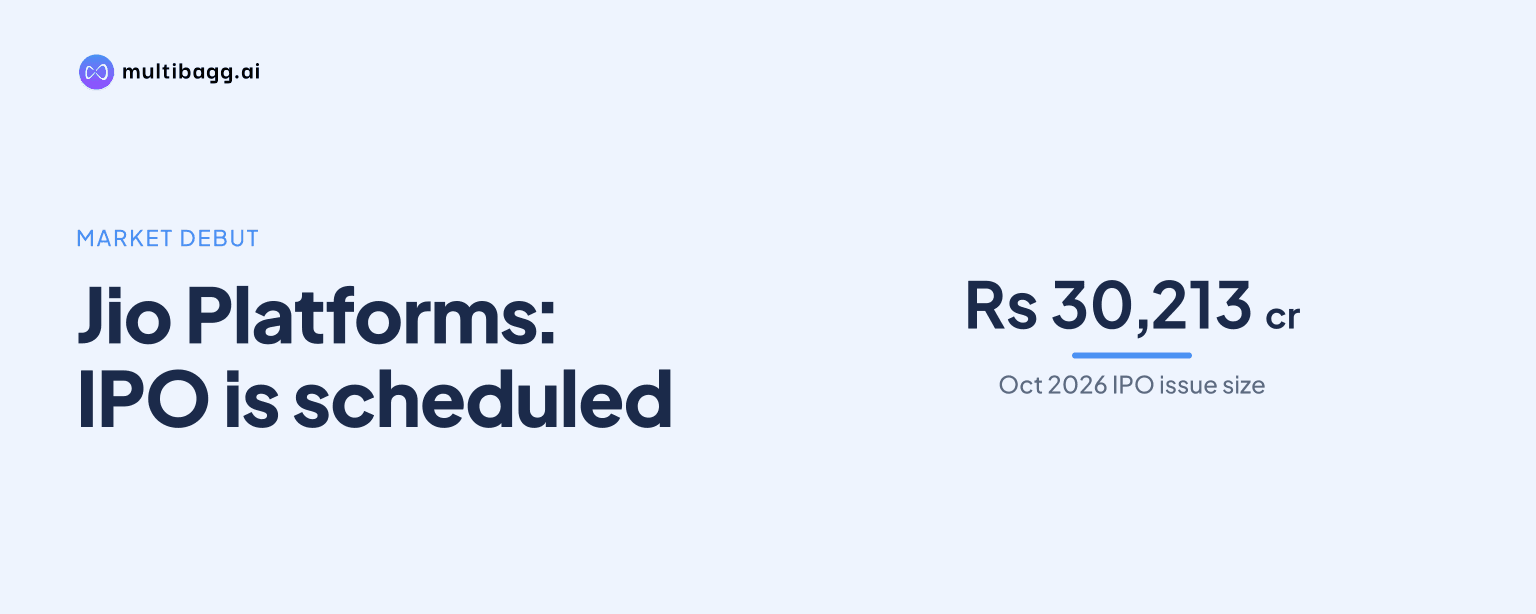
Jio Platforms Limited, backed by Reliance Industries, is set to launch a mainboard initial public offering (IPO) between 21 October 2026 and 23 October 2026, with listing scheduled for 28 October 2026. The issue size is ₹30,213 crore, structured as a 100% fresh issue with no offer for sale (OFS). The price band is ₹1,065 to ₹1,119 per share and the lot size is 12 shares.
Company overview: a digital connectivity and services platform
Jio Platforms Limited positions itself as a digital services and digital connectivity platform combining pan-India wireless access (4G/5G) and fixed broadband with a suite of consumer and enterprise offerings. Connectivity is delivered mainly through its licensed telecom subsidiary, Reliance Jio Infocomm Limited (RJIL).
Alongside connectivity, the company’s offerings in the provided red herring prospectus (RHP) slice span entertainment, cloud, Internet of Things (IoT), managed services and AI-enabled products. The company also highlights that much of its technology stack is largely in-house, framing this as part of the platform’s vertical integration.
A central operating context disclosed in this snapshot is scale: the company reports over 533 million customers as of 30 June 2026. This customer base is presented as the distribution layer for connectivity and as the addressable base for adjacent digital services.
Milestones and operating evolution
The milestones disclosed are closely linked to RJIL’s network rollouts and device-led adoption, followed by broader digital product launches.
The group traces its scale-up to RJIL’s launch of India’s first greenfield all-IP network and 4G services with Voice over LTE (VoLTE) technology in 2016. In 2017, it reported reaching 100 million 4G customers in less than 180 days from commercial launch and introduced the JioPhone 4G feature phone.
Fixed broadband entered the portfolio with the launch of JioFiber in 2018. Jio Platforms Limited was incorporated in 2019, with RJIL becoming its wholly owned subsidiary.
A major funding milestone was disclosed for 2020, when the company raised ₹1,520,553 million from 13 investors including Meta and Google, along with multiple global financial investors.
From 2021 onward, the milestones list reflects a wider product mix and 5G expansion: the launch of JioPhone Next (developed jointly with Google), spectrum acquisition across multiple bands and the launch of India’s first standalone 5G network, and later the launch of JioAirFiber fixed wireless broadband. The company also lists the launch of JioAICloud and JioPC, partnerships for distribution of enterprise AI products, and offering Google AI Pro plan benefits to eligible users. For 2025, it states it had over 280 million 5G customers.
Financial trajectory and profitability indicators
The restated consolidated financials in the provided RHP slice show an upward trajectory across FY2024 to FY2026 in total revenue, profit after tax (PAT), and total assets. Over the same period, the reported PAT margin stays around the 20% level based on the snapshot.
The KPI set in this snapshot includes earnings per share (EPS) of ₹33.62. Return metrics reported include return on equity (ROE) of 9.42%, return on capital employed (ROCE) of 10.76%, and return on net worth (RoNW) of 9.42%. The disclosed EBITDA margin is 51.91% and the reported PAT margin is 20.46%. The debt-to-equity ratio is stated as 0.21.
The same KPI panel shows pre-IPO price-to-earnings (P/E) and price-to-book as 0 in this snapshot, which does not provide usable valuation multiples from the data available here.
Offer structure: fresh issue only, and where proceeds are proposed to go
The IPO is structured entirely as a fresh issue, with no OFS component disclosed in this snapshot. In a fresh issue, proceeds (net of issue expenses) are intended to flow to the company, while OFS proceeds, when present, flow to selling shareholders.
In its stated objectives, Jio Platforms proposes to utilise the net proceeds for (1) prepayment, in full or in part, of certain outstanding borrowings availed by its material subsidiary RJIL, and (2) general corporate purposes.
Within the disclosed breakdown, ₹27,500 crore is proposed to be used toward prepayment of certain outstanding borrowings of RJIL. The amount earmarked for general corporate purposes is not specified in this snapshot. These are proposed uses of funds as stated in the offer document context, not completed actions.
Got a follow-up? Ask IRIS
Grey market premium (GMP): what the latest observations show
Grey market premium (GMP) is an unofficial, off-market indicator that can change quickly and is not part of the formal IPO process.
In the latest 10 GMP observations available in this snapshot (14 October 2026 to 16 October 2026), the reported GMP ranges from ₹203 to ₹225. Some observations reference ₹1,119 (the upper end of the price band), while earlier entries show a referenced price of 0 in the dataset.
Key risks from the disclosed context, and monitoring points
The risk context provided highlights operating dependencies and concentration points relevant to a telecom-led platform.
One disclosed risk is dependence on telecom licences and spectrum; changes in renewals, auctions, or rollout rules could affect costs and service quality, with implications for cash flows.
Another highlighted risk is reliance on Reliance Group arrangements for many core activities; if key agreements change or end, switching could be slow and expensive, with implications for margins.
The snapshot also flags a concentration risk around distribution: Reliance Retail is disclosed as the only distributor for prepaid, described as driving most revenue. A disruption in this channel is stated as potentially affecting customer additions, collections and marketing execution, and could impact earnings.
Monitoring points to track as disclosures update during and after the IPO process:
Track the timing and extent of the proposed prepayment of RJIL borrowings using net proceeds.
Track any disclosed changes in prepaid distribution arrangements, including reliance on a single distributor.
Track regulatory and cost developments linked to spectrum and licence obligations, including renewals and rollout conditions.
Track the reported mix and contribution of digital offerings (cloud, IoT, managed services and AI-enabled products) alongside connectivity within subsequent disclosures.
Complete numeric snapshot
IPO terms and schedule
Key performance indicators and valuation
Category reservations and anchor allocation
Proposed use of fresh issue proceeds
Subscription status (16 Oct 2026)
Grey market premium (GMP) trend
GMP is an unofficial market indicator and can change; these are dated snapshot observations, not a listing forecast.