










IRIS CARBON ARR rises 52% to Rs 57 crore in six months
Key highlights
- IRIS CARBON ARR reached Rs 57 crore on 30 September 2026, up 52% from Rs 37.65 crore at 31 March 2026.
- IRIS CARBON H1 FY27 revenue was Rs 21.84 crore, up 58% from Rs 13.8 crore in H1 FY26.
- IRIS CARBON reported more than 50 disclosure-management customers, a 4.8 out of 5 G2 rating and 92% NPS.
- A disclosed Fortune 500 customer expanded from one to three products and increased ARR 22 times between 2020 and 2026.
powered by IRIS
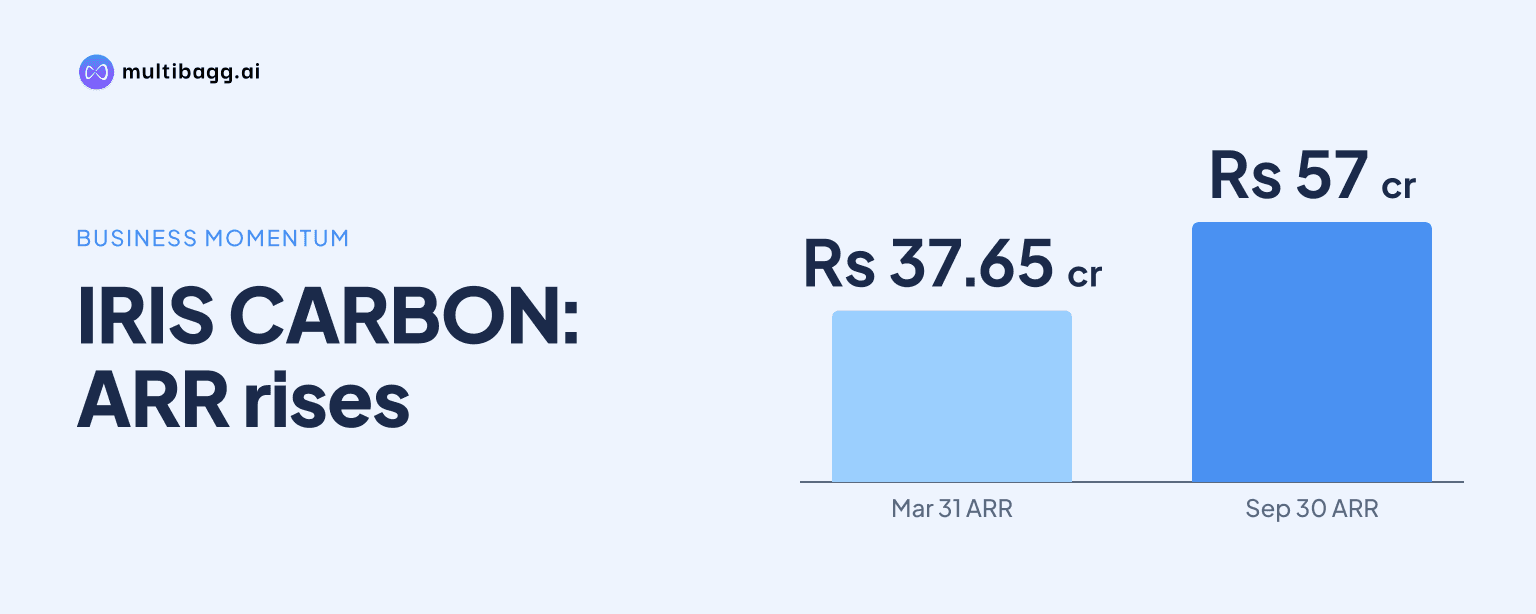
IRIS CARBON, the enterprise reporting product of IRIS RegTech Solutions Limited, increased annual recurring revenue, or ARR, by 52% to Rs 57 crore at 30 September 2026 from Rs 37.65 crore at 31 March 2026. Management attributes the expansion to wider adoption of disclosure management across report types, markets and group entities.
Know IRIS Regtech Solutions inside out
Results, valuation, peers and who's buying, in one view.
How fast did IRIS CARBON grow in H1 FY27?
IRIS CARBON reported H1 FY27 revenue of Rs 21.84 crore, up 58% year on year from Rs 13.8 crore in H1 FY26, while ARR rose 52% between 31 March 2026 and 30 September 2026. Revenue therefore increased by Rs 8.04 crore over the comparable six-month period, whereas ARR increased by Rs 19.35 crore over six months.
The two measures use different comparison periods: revenue compares H1 FY27 with H1 FY26, while ARR compares the 30 September 2026 balance with the 31 March 2026 balance. IRIS CARBON also reported more than 50 disclosure-management customers, a 4.8 out of 5 G2 rating and a 92% Net Promoter Score, or NPS.
Management identifies three growth drivers behind the Rs 57 crore ARR figure: uptake of the Disclosure Management module, growing enterprise accounts and partnerships and alliances. It says moving customers into disclosure management can raise ticket size, deepen engagement and create stickier customer relationships, but the presentation does not quantify the contribution of each driver.
What does IRIS CARBON do beyond structured filing?
IRIS CARBON is a connected reporting platform for finance, legal, environmental, social and governance, or ESG, and audit teams, linking source data with collaborative report production and final output. It takes inputs from enterprise resource planning, or ERP, systems, general ledgers, consolidation systems, spreadsheets and feeds, and supports regulatory filings, board packs, management reports, annual reports and sustainability reports.
IRIS CARBON began with structured reporting across more than 10 global XBRL and iXBRL mandates. XBRL means eXtensible Business Reporting Language, while iXBRL is inline XBRL; listed mandates include the US Securities and Exchange Commission, European Single Electronic Format, Federal Energy Regulatory Commission, HM Revenue & Customs and the Companies and Intellectual Property Commission. The initial functions were tagging, validation and filing-ready output.
The platform’s next stage is described as “shifting left” into collaborative authoring and source-system integration for financial and sustainability reporting. Rather than being used solely for a final filing task, IRIS CARBON is designed to support report preparation from source data through the final document, including audit-ready and regulator-compliant output.
Its expanded coverage includes annual and half-year reports, sustainability reports across frameworks, board packs and management reports. This broadens the product from statutory and structured-data filings towards internal management reporting and stakeholder-facing documents, while using the same data integration and collaborative workspace.
Got a follow-up? Ask IRIS
How does IRIS CARBON expand within a customer?
IRIS CARBON says its land-and-expand model begins with one reporting use case and adds products, markets and group entities over time. Its disclosed example, an unnamed Fortune 500 global oil and gas company, increased ARR from 1 times to 22 times between 2020 and 2026, while moving from one product to three, one market to two, and one group entity to two.
The customer started with European ESEF iXBRL reporting in 2020 and added US SEC iXBRL in 2022. It then added a Form 20-F use case on Disclosure Management in 2024, ESEF and ESG report authoring in 2025, and subsidiary reporting in 2026. The case study therefore links the 22-times ARR increase to six years of additional reporting requirements, product adoption and organisational coverage.
The example supports management’s view that an initial structured-filing mandate can expand into broader enterprise reporting work. It does not show that all of IRIS CARBON’s more than 50 customers follow the same pattern, because the presentation provides no average customer ARR, retention rate, expansion rate or count of customers using three products.
The progression also follows IRIS CARBON’s stated product path: structured reporting, collaborative authoring, multi-jurisdiction reporting for wider user groups, and market expansion through new mandates and geographies. Management names the Corporate Sustainability Reporting Directive, or CSRD, as an example of a new mandate that can add demand, alongside initial public offering documentation and prospectus creation.
What could support wider IRIS CARBON adoption?
IRIS CARBON’s opportunity is based on connecting regulatory reporting with enterprise disclosure processes. Finance, legal, ESG and audit teams may work with ERP systems, general ledgers and consolidation tools, while the platform is designed to bring those inputs into one reporting workflow for financial, management and sustainability outputs.
Multi-jurisdiction reporting is another disclosed route to expansion. In the oil and gas case study, the customer moved from a European ESEF requirement in 2020 to a US SEC requirement in 2022, helping take the account from one to two markets and eventually from 1 times to 22 times ARR by 2026.
Channel partnerships are the third stated driver. Management says a cadence is becoming established with channel partners and that early wins are building confidence, but it does not disclose partner revenue, partner numbers or a target for partner-led sales. The reported evidence is therefore the Rs 57 crore ARR balance and 52% six-month ARR growth, rather than a forecast for channel activity.
Conclusion
IRIS CARBON’s H1 FY27 figures show expansion from structured filing into a broader disclosure-management workflow. Revenue rose 58% year on year to Rs 21.84 crore, while ARR rose 52% in six months to Rs 57 crore. The disclosed customer case illustrates the model, with one ESEF use case in 2020 developing into three products, two markets and two group entities by 2026.
The next points to watch are uptake of the Disclosure Management module, growth in enterprise accounts and the development of channel partnerships. Management also identifies CSRD and other new mandates, geographies, initial public offering documentation and prospectus creation as routes to broaden the market, although the presentation gives no numerical targets or timetable for those opportunities.