










IRIS SupTech revenue rose 25% in H1 FY27 as reach broadened
Key highlights
- IRIS SupTech revenue was Rs 41.30 crore in H1 FY27, up 25% from Rs 32.80 crore in H1 FY26.
- IRIS SupTech ARR reached Rs 23.10 crore at 30 September 2026, up 10% from Rs 21.10 crore at 31 March 2026.
- IRIS reported more than 30 SupTech regulators and 26 countries live in H1 FY27.
- IRIS entered tax within the last year, while deposit insurance and pension were entered within the last two years.
powered by IRIS
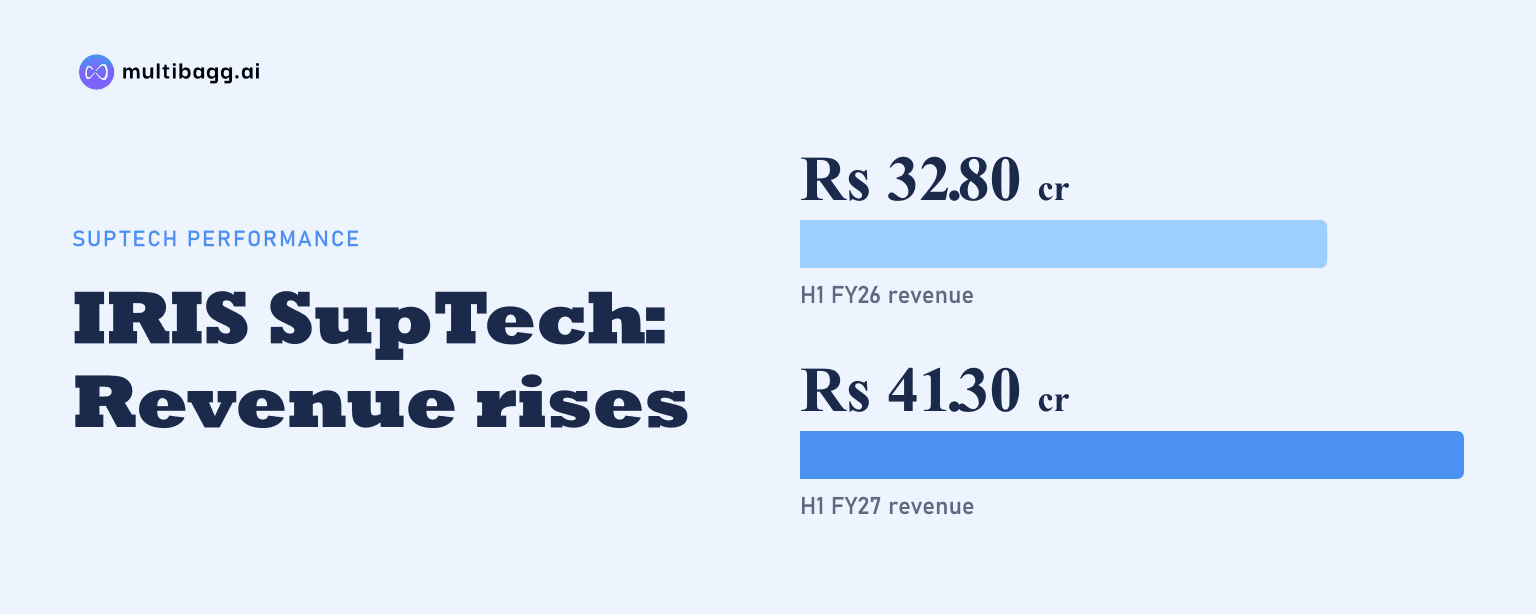
IRIS RegTech Solutions Limited reported SupTech revenue of Rs 41.30 crore in H1 FY27, up 25% from Rs 32.80 crore in H1 FY26, while expanding from established regulator categories into tax, deposit insurance and pension. IRIS also reported SupTech annual recurring revenue, or ARR, of Rs 23.10 crore at 30 September 2026.
Know IRIS Regtech Solutions inside out
Results, valuation, peers and who's buying, in one view.
How much did IRIS SupTech revenue grow in H1 FY27?
IRIS SupTech revenue grew 25% year on year to Rs 41.30 crore in H1 FY27, compared with Rs 32.80 crore in H1 FY26. The Rs 8.50 crore increase was reported in the business that provides reporting infrastructure for regulators, covering the process from setting reporting requirements through collecting submissions and supervising the data received.
IRIS also reported ARR of Rs 23.10 crore at 30 September 2026, up 10% from Rs 21.10 crore at 31 March 2026. Revenue records sales during the first half, while ARR measures the recurring-revenue base at a specified date. The presentation links that recurring component to multi-year contracts and the cost of switching after a regulator's reporting and supervisory process is embedded on the platform.
What does the IRIS SupTech platform do for regulators?
IRIS SupTech supports three stages of a regulator's reporting process: designing reporting requirements, collecting data and supervising the information received. At the design stage, the regulator specifies what must be reported and in what structured form. Filers then submit structured and unstructured data sets through the platform, enabling the regulator to validate, analyse and act on the information.
IRIS describes the platform as integrated from source data to the final filing or publication, rather than limited to a single reporting task. The company supplies products for regulators and enterprises, covering financial and non-financial reporting. Its presentation states that IRIS has more than 20 years in RegTech, serves more than 30 regulators across more than 55 countries, and has thousands of filers on its platform.
For the SupTech deployment base specifically, IRIS reported more than 30 regulators and 26 countries live in H1 FY27. The wider footprint of more than 55 countries refers to the company overall, while 26 countries refers to live SupTech deployments. The Rs 41.30 crore H1 FY27 revenue figure is also presented specifically for SupTech rather than for every IRIS product.
Which regulator categories has IRIS entered recently?
IRIS entered tax authorities within the last year, while deposit insurance and pension were first entered within the last two years. These categories sit alongside three established regulator types: central banks, capital-market regulators and business registries. IRIS says a deployment with one regulator of a type can provide a reference point for other regulators in that category.
The established categories cover monetary and prudential supervision at central banks, securities and market oversight at capital-market regulators, and company and statutory filings at business registries. The new categories extend the platform to revenue and compliance reporting for tax authorities, depositor-fund protection for deposit insurance, and retirement and provident oversight for pension regulators.
The presentation does not allocate the Rs 41.30 crore H1 FY27 SupTech revenue among tax, deposit insurance and pension, or disclose customer numbers for each category. It does disclose the timing of the entries: tax was added within the last year, while deposit insurance and pension were added within the last two years. Those additions broaden the regulator categories served beyond the three established segments.
Got a follow-up? Ask IRIS
How can IRIS expand sales with existing regulators?
IRIS says it can expand within an existing regulator through licensing, case management, registration, risk-based supervision, and business intelligence and analytics modules. The company says it was historically a collection platform and now has the capability to add these modules. This provides a route to broaden a deployment's scope when regulation changes.
The distinction is between the original collection role and added supervisory workflows. A regulator can use the platform to receive structured and unstructured submissions, then add tools for licensing, cases, registration, risk assessment or analytics. IRIS does not disclose module-level revenue, adoption rates or contract values, so the available evidence is product capability rather than a quantified contribution to H1 FY27 revenue.
IRIS identifies partners as a second route to extend the SupTech footprint. Global system integrators and the Big 4 provide consulting reach, while local IIT firms provide delivery and support, with IRIS supplying the platform. The presentation does not disclose the number of partner-led contracts, partner revenue or a deployment timetable.
Why does IRIS describe SupTech as a recurring business?
IRIS describes SupTech as a recurring business because the platform is embedded in how a regulator conducts supervision and is supplied under multi-year contracts. The system covers the design of filings, collection of submissions and supervision of data. IRIS associates this position with high switching costs and a recurring-revenue component that is growing year on year.
The reported ARR movement shows that recurring base rising to Rs 23.10 crore at 30 September 2026 from Rs 21.10 crore at 31 March 2026, a 10% increase. By comparison, H1 FY27 revenue rose 25% year on year from Rs 32.80 crore to Rs 41.30 crore. These are different measures and periods, but both show growth in the reported half-year revenue and the recurring-revenue base.
The presentation attributes IRIS's operating position to regulator relationships, product delivery and coverage across the reporting process. It also states that domain-trained artificial-intelligence models are used across all products. However, IRIS does not quantify SupTech revenue attributable to artificial intelligence or identify a separate AI contract category.
Conclusion
IRIS reported a 25% increase in H1 FY27 SupTech revenue to Rs 41.30 crore and a 10% increase in ARR to Rs 23.10 crore at 30 September 2026. The business is broadening through entries into tax, deposit insurance and pension, while seeking greater scope within existing regulator relationships through additional supervisory modules.
The next disclosed areas to watch are whether the category entries made over the last one or two years lead to further deployments and whether licensing, case management, registration, risk-based supervision, and business intelligence and analytics broaden existing contracts. IRIS has not disclosed category-level revenue, module adoption data or partner-led revenue, leaving those measures unresolved beyond the reported H1 FY27 revenue and September 2026 ARR.