










IRIS iDeal revenue rises 24% as overseas rollout begins
Key highlights
- iDeal reported H1 FY27 revenue of Rs 5.60 crore, up 24% from Rs 4.50 crore in H1 FY26.
- iDeal ARR was Rs 9.80 crore at 30 September 2026, up 6% from Rs 9.30 crore at 31 March 2026.
- iDeal says it has more than 90% market share among banks in India.
- An Indian small finance bank case study reported 3x ARR for end-to-end reporting versus last-mile reporting.
powered by IRIS
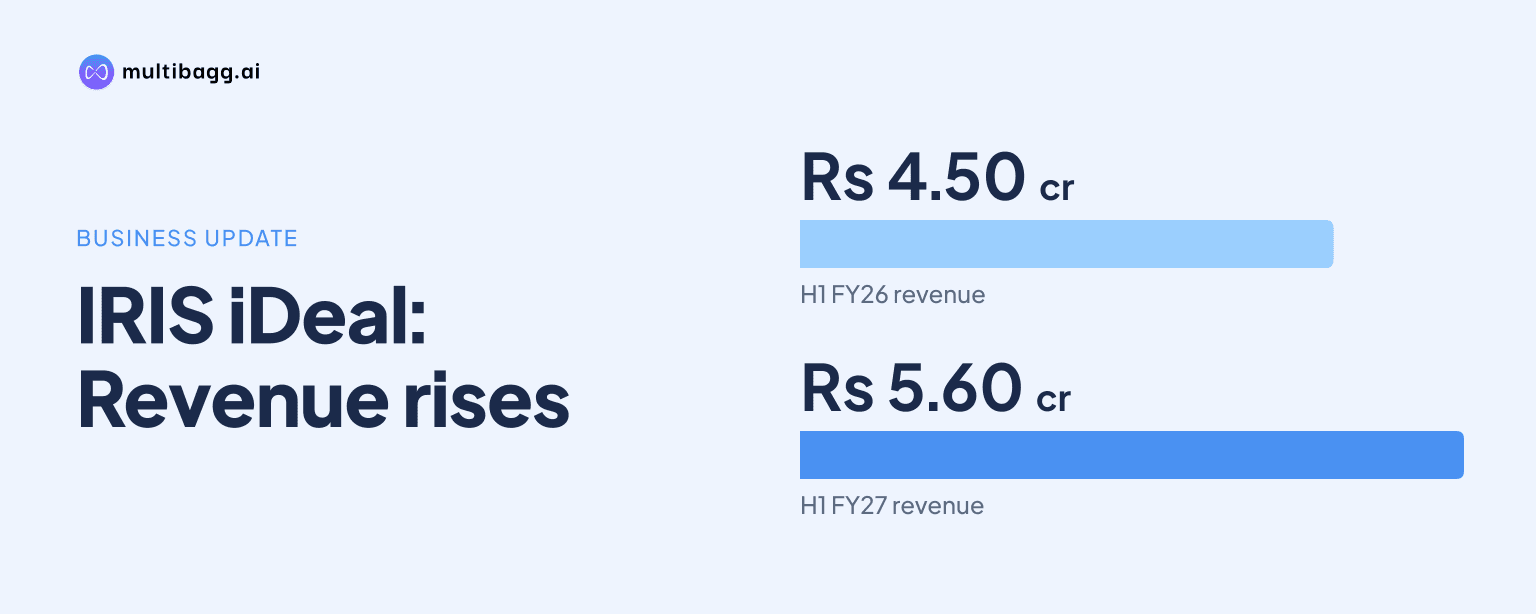
IRIS RegTech Solutions Limited's IRIS iDeal reported Rs 5.60 crore of H1 FY27 revenue, 24% above H1 FY26, while saying it has more than 90% of India’s bank market and is introducing the platform in Mauritius and Qatar. The company identifies source-data integration and international entry as its disclosed paths to larger regulatory-reporting deployments.
Know IRIS Regtech Solutions inside out
Results, valuation, peers and who's buying, in one view.
How does iDeal automate regulatory reporting for banks?
iDeal automates the collection, transformation, validation and submission of high-frequency regulatory filings for financial institutions. The platform is designed around the disclosure that banks report more than 100,000 data points to regulators annually, a scale that requires data to move from operating systems into a controlled reporting process.
iDeal draws data from warehouses, ledgers, treasury systems, core-banking systems, spreadsheets and feeds. It uses a standard data model and central data repository to automate flows across those systems. The resulting submissions can support XBRL, XML, JSON, CSV and SDMX formats, while cross-validation is intended to provide consistency across reports sent to different regulatory departments.
The platform also includes an analytics layer described as allowing users to see what the regulator sees. That feature sits alongside the ability to file hundreds of regulatory reports, according to the presentation. The product proposition is therefore broader than producing an output file: it links source systems, a central repository, validation processes and the final regulator-facing submission.
What were iDeal's H1 FY27 revenue and recurring revenue figures?
iDeal reported H1 FY27 revenue of Rs 5.60 crore, compared with Rs 4.50 crore in H1 FY26, an increase of 24% year on year. Its ARR, or annual recurring revenue, was Rs 9.80 crore at 30 September 2026, compared with Rs 9.30 crore at 31 March 2026, an increase of 6%.
Revenue increased by Rs 1.10 crore between the two first-half periods, whereas ARR increased by Rs 0.50 crore between 31 March and 30 September 2026. These are different comparison bases: revenue covers H1 FY27 against H1 FY26, while ARR is a point-in-time measure compared with the preceding 31 March date. The presentation does not disclose the number of iDeal customers or a revenue split by bank type.
The disclosed figures sit alongside iDeal's claim of more than 90% market share among banks in India. That claim describes the product's domestic footprint, while the Rs 5.60 crore H1 FY27 revenue figure measures its reported sales in the half-year. The presentation does not provide a methodology for the market-share calculation or identify the total bank population used in it.
Got a follow-up? Ask IRIS
Why is iDeal moving upstream into banks' source data?
iDeal is moving upstream into data collection from transaction systems because management says this can raise deal size. Rather than being limited to the last stage of regulatory reporting, the stated upsell route connects the platform to data originating in core banking, treasury, ledgers, data warehouses, spreadsheets and other feeds.
The presentation's case study says an end-to-end reporting deployment at an Indian small finance bank generated three times the ARR of last-mile reporting. It does not disclose the bank's name, contract value, implementation date or the ARR base used for that three-times comparison. Still, the example provides the source's direct evidence for management's proposition that wider data-system coverage can increase the value of a deployment.
This upstream approach relies on iDeal's standard data model and central data repository. Data is collected from various systems, transformed and validated before filing, rather than being handled only at the output stage. The mechanism matters because a bank's regulator-facing filings can require more than 100,000 data points annually, according to the presentation.
The company also identifies the Indian EBR, or element based reporting, opportunity as a growth driver. Its disclosure does not quantify the addressable EBR market, specify a timetable for adoption, or give expected revenue from it. What is disclosed is a product direction: iDeal seeks to extend from last-mile reporting toward data collection and end-to-end reporting workflows.
Where is iDeal expanding beyond India?
iDeal is being introduced in Mauritius and Qatar as part of management's effort to follow SupTech, or supervisory technology, opportunities in global markets. The presentation describes these as markets being entered, not as jurisdictions that have already contributed disclosed revenue, ARR or customer numbers.
The international move follows a domestic position the company describes as more than 90% market share among banks in India. The presentation pairs that claim with a statement of growing presence in international markets, but it does not provide separate financial results for Mauritius, Qatar or any other overseas geography. As a result, the reported Rs 9.80 crore ARR at 30 September 2026 cannot be assigned between India and international operations from the supplied disclosure.
iDeal's multi-format capability is relevant to the overseas plan. It supports XBRL, XML, JSON, CSV and SDMX, and is built to report to different regulator departments with cross-validation. Those functions may allow the product to address varying supervisory-reporting requirements, but the presentation does not identify regulators, mandates, partners or implementation milestones in Mauritius or Qatar.
Management's expansion rationale is therefore disclosed at two levels. In India, it is seeking higher-value deployments by integrating source data and pursuing element based reporting. Outside India, it is introducing iDeal in Mauritius and Qatar under the SupTech opportunity. Neither route includes revenue guidance, an ARR target, or a stated date for commercial scale-up.
Conclusion
iDeal's H1 FY27 results show revenue of Rs 5.60 crore, up 24% from Rs 4.50 crore a year earlier, and ARR of Rs 9.80 crore at 30 September 2026, up 6% from 31 March 2026. Against a claimed more-than-90% share of Indian banks, the company is trying to increase deployment value through source-system integration, supported by a case study reporting three times the ARR of last-mile reporting.
The next disclosed items to watch are the introduction of iDeal in Mauritius and Qatar and the execution of its upstream data-collection plan. Management has not provided targets for those markets, a timetable for the Indian EBR opportunity, or financial contributions by geography. Future disclosures on customer additions, end-to-end deployments and ARR beyond the Rs 9.80 crore reported at 30 September 2026 would clarify progress.