










IRM Energy CNG Network Reaches 156 Stations as of H1FY27
Key highlights
- IRM Energy had 156 CNG stations as of September 30, 2026, up from 25 in FY19 at a reported six-year CAGR of 28%.
- Franchisees and oil marketing companies operated 149 of IRM Energy’s 156 CNG stations, while 7 were listed as owned.
- Daughter booster stations accounted for 130 of IRM Energy’s 156 stations as of September 30, 2026.
- IRM Energy’s CNG volume share rose to 66% in H1FY27 from 60% in FY26 and 43% in FY23.
powered by IRIS
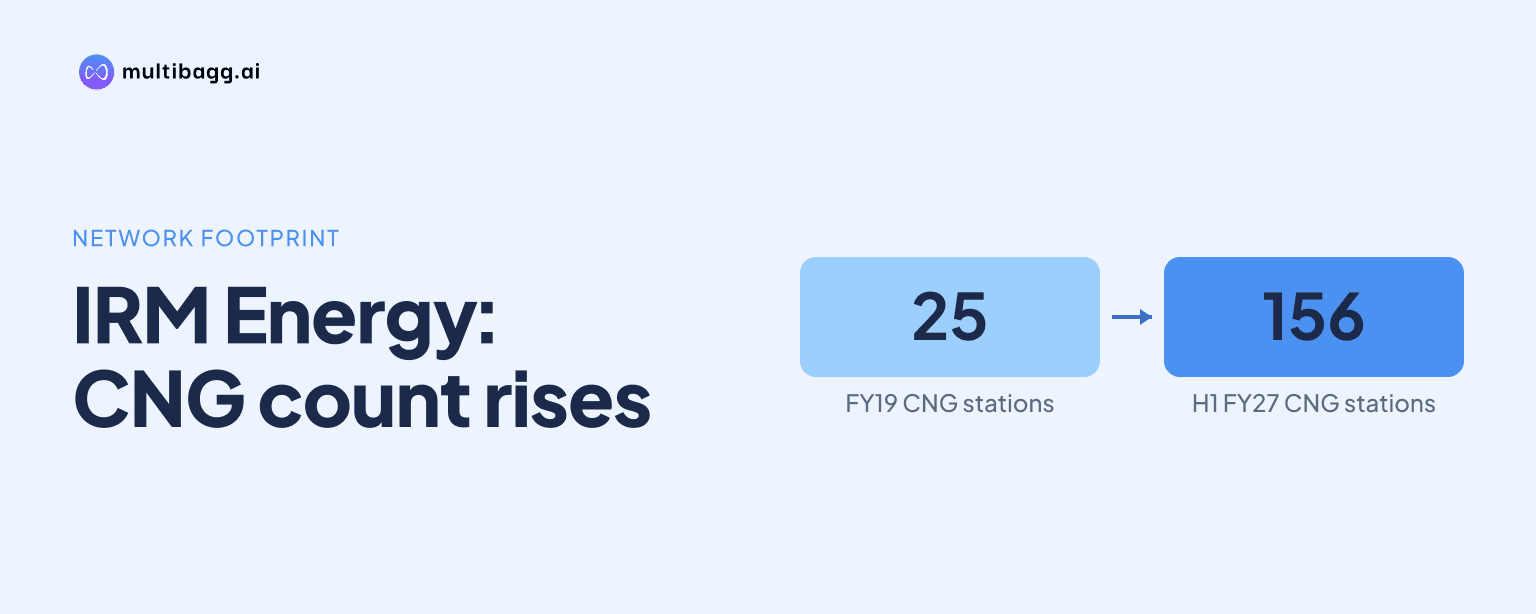
IRM Energy Limited (IRM Energy) expanded its compressed natural gas (CNG) station network from 25 in FY19 to 156 as of September 30, 2026, the end of H1FY27. The presentation reports a 28% six-year compound annual growth rate, while franchisees and oil marketing companies operated 149 sites and IRM Energy listed seven as owned.
Know IRM Energy inside out
Results, valuation, peers and who's buying, in one view.
How fast has IRM Energy expanded its CNG network?
IRM Energy increased its CNG station count by 131 stations from FY19 to H1FY27, taking the network from 25 to 156. Its presentation reports a 28% compound annual growth rate (CAGR) over six years, with the cumulative network rising from 34 stations in FY20 to 46 in FY21, 53 in FY22 and 62 in FY23.
The build-out accelerated after FY23, when the network added 20 stations in FY24, 29 in FY25 and 39 in FY26. IRM Energy then added six stations in H1FY27, taking the count from 150 at FY26 end to 156 as of September 30, 2026. The six-year track-record table reports 34 stations for FY20, while the wider historical table reports 35 for that year.
The increase from 62 stations in FY23 to 156 in H1FY27 added 94 locations over roughly three and a half financial years. The sequence also shows that FY26 produced the largest annual increment disclosed in the presentation, at 39 stations, compared with 29 in FY25 and 20 in FY24.
Who operates IRM Energy's 156 CNG stations?
IRM Energy's 156-station network was operated mainly by franchisees and oil marketing companies, while seven stations were listed as owned as of September 30, 2026. Franchisees operated 70 stations, Bharat Petroleum Corporation Limited (BPCL) operated 35, Indian Oil Corporation Limited (IOCL) operated 32 and Hindustan Petroleum Corporation Limited (HPCL) operated 12.
Together, franchisees and the three oil marketing companies operated 149 of the 156 stations. Calculated against the reported total, franchise-operated sites represented 44.9%, followed by BPCL-operated sites at 22.4%, IOCL-operated sites at 20.5% and HPCL-operated sites at 7.7%; the seven owned sites represented 4.5%.
IRM Energy's separate modality table classifies 70 sites as dealer-owned dealer-operated, or DODO, and six as company-owned company-operated, or COCO. It also lists 35 BPCL, 32 IOCL, 12 HPCL and one pure-play mother-station site, showing that the modality classification is presented separately from the operator table.
What types of CNG stations does IRM Energy use?
IRM Energy's network was concentrated in daughter booster stations, which accounted for 130 of its 156 CNG stations as of September 30, 2026. The remaining sites comprised 13 online stations, 12 mother-cum-online stations and one pure-play mother station.
Daughter boosters represented 83.3% of the reported station base, compared with 8.3% for online stations and 7.7% for mother-cum-online stations. The presentation also states that the cumulative 156-station total includes two stations designated LCNG, without separately allocating those sites within the four disclosed station types.
Station type and operating modality measure different features of the network. The mother, mother-cum-online, online and daughter-booster classifications describe station formats, while DODO and COCO describe ownership and operating arrangements. This means the 130 daughter boosters span the overall network rather than representing a separate operator category.
Got a follow-up? Ask IRIS
How does CNG expansion relate to IRM Energy's infrastructure growth?
IRM Energy's CNG expansion coincided with higher gross assets and net revenue between FY19 and FY26. Gross assets increased from Rs 144 crore in FY19 to Rs 951 crore in FY26, while net revenue rose from Rs 74 crore to Rs 1,067 crore and the CNG network grew from 25 to 150 stations.
FY26 net revenue was Rs 92 crore above FY25 net revenue of Rs 975 crore, while gross assets increased by Rs 182 crore from Rs 769 crore. The presentation defines gross assets as property, plant and equipment gross block, intangible assets and right-of-use assets; it does not allocate revenue or assets to individual CNG stations.
As of September 30, 2026, IRM Energy reported 576 dispensing points and 7,313 inch-kilometres of steel and medium-density polyethylene pipeline, alongside 3,441 kilometres of pipeline. Its infrastructure served 89,308 domestic customers, 657 commercial customers and 235 industrial customers across four geographical areas encompassing six districts.
What will determine IRM Energy's next CNG additions?
IRM Energy says future CNG expansion will be based on demand assessment and does not disclose a numerical station target beyond the 156 reported for H1FY27. The stated approach follows 45 additions across FY25 and FY26, then six additional stations in the first half of FY27.
Gas sourcing is a disclosed operating mechanism for the transport network. For CNG and domestic piped natural gas, IRM Energy lists administered price mechanism gas, natural well gas and high-pressure high-temperature gas, with GAIL and spot or Indian Gas Exchange sources among its suppliers. The presentation says CNG and domestic piped natural gas receive priority allocation under Ministry of Petroleum and Natural Gas guidelines issued in August 2022.
CNG accounted for 66% of IRM Energy's volume composition in H1FY27, compared with 60% in FY26 and 43% in FY23. Piped natural gas accounted for the remaining 34% in H1FY27, down from 40% in FY26 and 57% in FY23. The presentation does not quantify volume per station or isolate the volume effect of individual additions.
Conclusion
IRM Energy's central network result is the increase from 25 CNG stations in FY19 to 156 at September 30, 2026. The operating structure is primarily franchise- and oil-marketing-company-led, with 149 stations run by those parties, while daughter boosters account for 130 locations and the broader network includes 576 dispensing points.
The next point to watch is whether demand assessments result in additions beyond the six stations opened in H1FY27. IRM Energy has not disclosed a numerical station target, while CNG's share of volume composition increased to 66% in H1FY27 from 60% in FY26.