










IRM Energy H1 EBITDA More Than Doubles, Margin Reaches 16.5%
Key highlights
- IRM Energy’s standalone H1FY27 EBITDA excluding other income rose 107.78% year on year to Rs 109.10 crore.
- H1FY27 EBITDA margin increased 648 basis points to 16.54%, while profit after tax rose 111.21% to Rs 60.15 crore.
- IRM Energy’s Q2FY27 total gas volume reached a record 61.23 mmscm, up 12% year on year, led by 25% CNG growth and 50% PNG commercial growth.
- IRM Energy spent Rs 108 crore on capital expenditure in H1FY27 and expanded its network to 156 CNG stations and 576 dispensing points as of September 30, 2026.
powered by IRIS
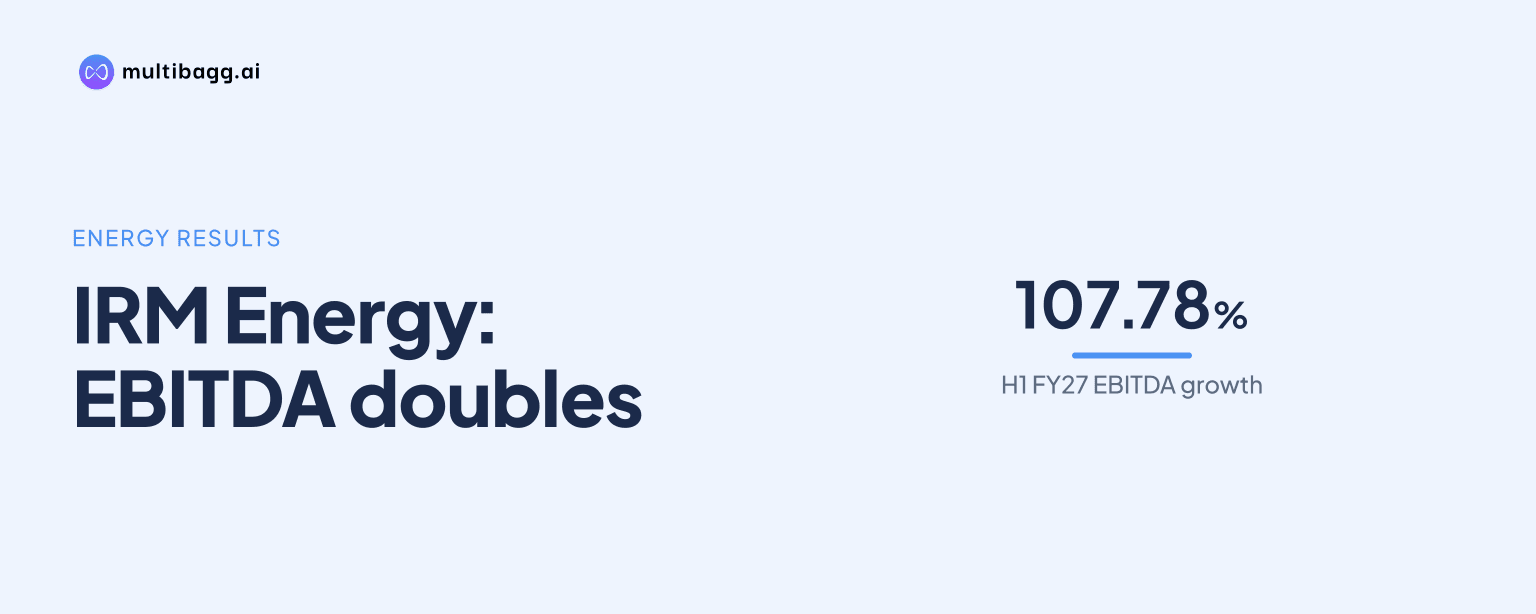
IRM Energy Limited reported standalone H1FY27 EBITDA, excluding other income, of Rs 109.10 crore, up 107.78% from Rs 52.51 crore a year earlier. EBITDA margin rose 648 basis points to 16.54%, while profit after tax increased 111.21% to Rs 60.15 crore, even as Q2FY27 EBITDA fell from Q1FY27.
Know IRM Energy inside out
Results, valuation, peers and who's buying, in one view.
What drove IRM Energy’s H1FY27 EBITDA increase?
IRM Energy’s H1FY27 EBITDA increase accompanied a 26.41% year-on-year rise in revenue from operations to Rs 659.76 crore, compared with Rs 521.94 crore in H1FY26. EBITDA, or earnings before interest, tax, depreciation and amortisation, excludes other income in the presentation. EBITDA was Rs 109.10 crore for the first half, more than twice the Rs 52.51 crore reported a year earlier, while total income rose 25.36% to Rs 728.35 crore.
IRM Energy’s EBITDA margin was 16.54% in H1FY27, compared with 10.06% in H1FY26. A basis point is one-hundredth of a percentage point, making the reported change 648 basis points. The presentation provides the revenue and profit outcomes but does not give a cost bridge identifying the components behind the H1FY27 margin change.
IRM Energy’s profit after tax, or PAT, rose faster than revenue in H1FY27, reaching Rs 60.15 crore from Rs 28.48 crore in H1FY26. PAT margin increased to 9.12% from 5.46%, a 366-basis-point change. Revenue from operations is stated after excise duty in the presentation, which applies to the reported revenue and margin comparison across the two half-year periods.
How did IRM Energy’s second-quarter profitability change?
IRM Energy’s Q2FY27 profitability remained above Q2FY26 but declined from Q1FY27. Standalone EBITDA was Rs 47.32 crore in Q2FY27, up 77.23% from Rs 26.70 crore in Q2FY26, but down 23.39% from Rs 61.77 crore in Q1FY27. Revenue from operations rose 28.70% year on year to Rs 333.91 crore and increased 2.47% sequentially from Rs 325.85 crore.
IRM Energy’s Q2FY27 EBITDA margin was 14.17%, 388 basis points above Q2FY26’s 10.29%, but 479 basis points below Q1FY27’s 18.96%. Q2FY27 PAT was Rs 25.83 crore, up 81.83% year on year from Rs 14.20 crore, while PAT margin of 7.73% was below Q1FY27’s 10.53%.
IRM Energy’s EBITDA per standard cubic metre, or SCM, was Rs 7.73 in Q2FY27, compared with Rs 10.48 in Q1FY27 and Rs 4.89 in Q2FY26. The H1FY27 figure was Rs 9.08 per SCM, compared with Rs 5.02 per SCM for FY26. This measure showed that the second-quarter moderation occurred despite the year-on-year increase in Q2 EBITDA.
Got a follow-up? Ask IRIS
Which volume segments supported IRM Energy’s results?
IRM Energy’s total volume reached an all-time quarterly high of 61.23 million metric standard cubic metres, or mmscm, in Q2FY27, 12% above Q2FY26’s 54.66 mmscm. Compressed natural gas, or CNG, volume grew 25% year on year to 39.73 mmscm, while piped natural gas, or PNG, commercial volume grew 50% to 0.90 mmscm. The presentation identified CNG and PNG commercial volumes as drivers of the quarterly record.
IRM Energy’s Q2FY27 mix was not uniformly higher across PNG customer types. PNG domestic volume was 2.41 mmscm, down 1% year on year from 2.43 mmscm, and PNG industrial volume was 18.19 mmscm, down 8% from 19.74 mmscm. Industrial volume nevertheless increased from 16.50 mmscm in Q1FY27, while commercial PNG rose from 0.77 mmscm and CNG increased from 39.33 mmscm.
IRM Energy’s H1FY27 total volume was 120.16 mmscm, compared with 223.67 mmscm for the full FY26 period. CNG accounted for 79.06 mmscm in H1FY27, against 133.53 mmscm in FY26, while PNG commercial volume was 1.67 mmscm against 2.27 mmscm. PNG industrial volume was 34.69 mmscm in H1FY27, compared with 78.13 mmscm in FY26.
How is IRM Energy expanding its network and customer base?
IRM Energy expanded its CNG station network to 156 stations as of September 30, 2026, 34% above the prior-year level, while dispensing points rose 36% to 576. Its customer base included 89,308 PNG domestic customers, 657 commercial customers and 235 industrial customers. Domestic customers increased 14% year on year, commercial customers 48%, and industrial customers 8%.
IRM Energy incurred Rs 108 crore of capital expenditure in H1FY27, taking total capital expenditure to date to Rs 1,158 crore. It reported 7,313 inch kilometres of steel and medium-density polyethylene, or MDPE, pipeline, equivalent to 3,441 kilometres, across four geographical areas. These areas are Banaskantha, Fatehgarh Sahib, Diu and Gir Somnath, and Namakkal and Tiruchirappalli.
IRM Energy entered memoranda of understanding with Tamil Nadu State Transport Corporation, or TNSTC, for captive CNG dispensing facilities in Namakkal and Trichy. It facilitated conversion of 83 TNSTC buses to CNG in Q2FY27, taking the CNG fleet to about 183 buses in Namakkal and 55 buses in Trichy. Its targeted customer incentives included support for 193 PNG customers buying CNG vehicles or retrofitting existing vehicles.
Conclusion
IRM Energy’s H1FY27 revenue of Rs 659.76 crore was accompanied by a faster increase in standalone EBITDA to Rs 109.10 crore and PAT to Rs 60.15 crore. The 648-basis-point EBITDA-margin expansion to 16.54% was the central half-year change, although Q2FY27 EBITDA of Rs 47.32 crore and its 14.17% margin were lower than Q1FY27’s Rs 61.77 crore and 18.96%.
The next results will show whether CNG growth, which reached 39.73 mmscm in Q2FY27, and PNG commercial growth, which reached 0.90 mmscm, continue to offset lower industrial PNG volumes. Execution of the TNSTC captive-dispensing arrangements, the converted bus fleet and the H1FY27 capital-expenditure programme of Rs 108 crore are the disclosed developments to watch as Namakkal and Tiruchirappalli ramp up.