










IRM Energy Limited CNG volumes rise 25% as Q2 sales grow
Key highlights
- CNG volume rose 24.58% year on year to 39.73 mmscm in Q2 FY27.
- Total gas sales volume increased 12.02% year on year to 61.23 mmscm.
- Revenue from operations grew 28.70% year on year to Rs 333.907 crore.
- IRM Energy commissioned 3 CNG stations and facilitated the conversion of 83 TNSTC buses during Q2 FY27.
powered by IRIS
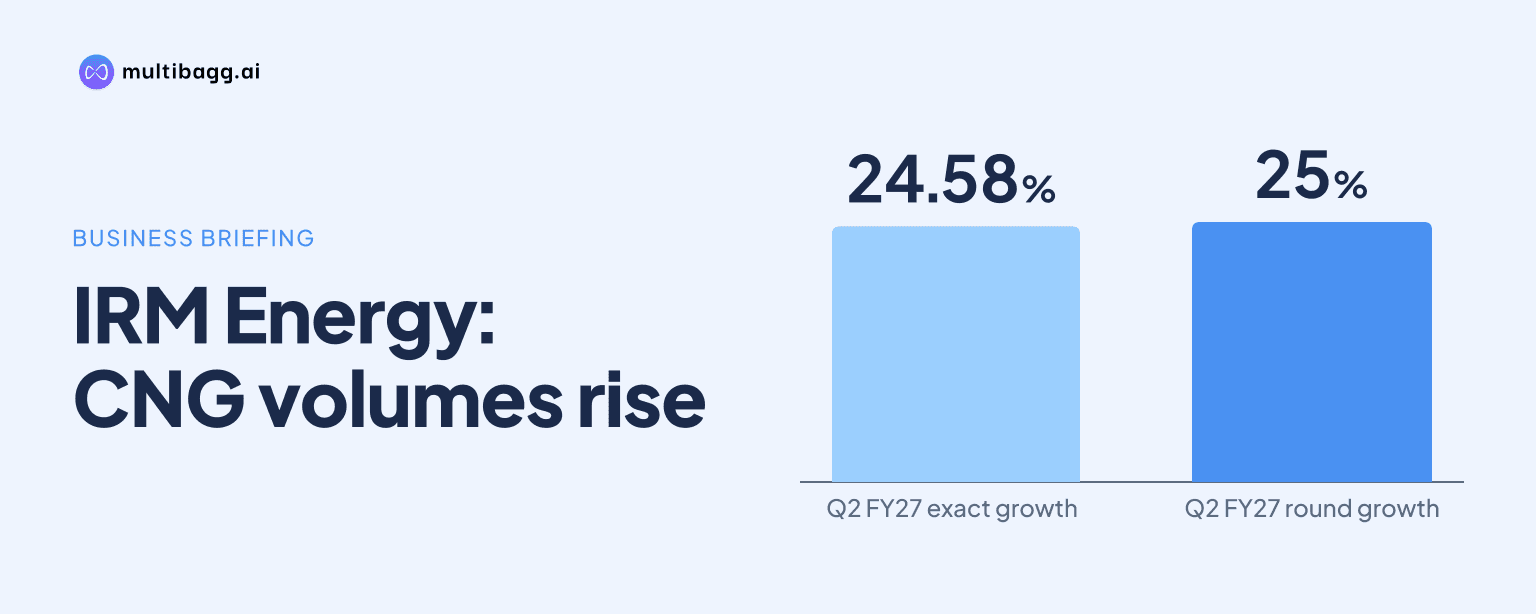
IRM Energy reported compressed natural gas (CNG) volume of 39.73 million metric standard cubic metres (mmscm) in Q2 FY27, up 24.58% year on year from 31.89 mmscm. Total gas sales volume rose 12.02% to 61.23 mmscm as the company added three CNG stations, customers and 83 converted Tamil Nadu state-transport buses during July-September 2026.
Know IRM Energy inside out
Results, valuation, peers and who's buying, in one view.
How fast did IRM Energy's CNG volumes grow in Q2 FY27?
IRM Energy's CNG volume grew 24.58% year on year to 39.73 mmscm in Q2 FY27, compared with 31.89 mmscm in Q2 FY26. CNG also increased 1.02% from 39.33 mmscm in Q1 FY27, making it the largest of the company's reported gas-volume categories in the September 2026 quarter.
Total volume rose 12.02% from 54.66 mmscm a year earlier and 3.90% from 58.93 mmscm in Q1 FY27. The increase in CNG offset year-on-year declines in both piped natural gas (PNG) categories. IRM Energy reports one operating segment, the selling and distribution of natural gas, rather than separate financial segments.
What changed in IRM Energy's PNG volumes?
IRM Energy's industrial and commercial PNG volume fell 6.15% year on year to 19.09 mmscm in Q2 FY27, while domestic PNG declined 0.82% to 2.41 mmscm. Combined PNG volume was 21.50 mmscm, below 22.77 mmscm in Q2 FY26, while CNG added 7.84 mmscm over the same comparison.
The sequential comparison was different. Industrial and commercial PNG rose 10.54% from 17.27 mmscm in Q1 FY27, and domestic PNG rose 3.43% from 2.33 mmscm. Combined PNG volume reached 21.50 mmscm from 19.60 mmscm in the preceding quarter, contributing to the 3.90% sequential increase in total volume.
How did IRM Energy expand its CNG network and customer base?
IRM Energy commissioned three CNG stations in Q2 FY27 and added 2,718 domestic PNG customers, 68 commercial customers and seven industrial customers. These additions occurred during the July-September 2026 quarter in which total volume reached 61.23 mmscm.
As of September 30, 2026, IRM Energy operated 156 CNG stations and a network of 7,313 inch-kilometres. It served more than 89,308 domestic customers, 235 industrial customers and 657 commercial customers across authorised geographies in Gujarat, Punjab, Tamil Nadu and the Union Territory of Diu.
Revenue from operations, net of excise duty, grew 28.70% year on year to Rs 333.907 crore in Q2 FY27 from Rs 259.439 crore. IRM Energy attributed the increase to the 12.02% rise in sales volume and, for the balance, higher sale prices, meaning revenue increased faster than reported volume during the quarter.
Got a follow-up? Ask IRIS
How many Tamil Nadu buses did IRM Energy convert to CNG?
IRM Energy facilitated the conversion of 83 Tamil Nadu State Transport Corporation (TNSTC) buses to CNG in Q2 FY27, comprising 43 buses in Namakkal and 40 buses in Trichy. The conversions took the CNG bus fleet to about 183 buses in Namakkal and 55 buses in Trichy.
IRM Energy has memoranda of understanding with TNSTC's Kumbakonam Divisional Office for Trichy district and Salem Divisional Office for Namakkal district. The arrangements cover captive CNG dispensing facilities for the TNSTC fleet in the Namakkal and Tiruchirappalli geographical areas, which the company said provide an established demand base for CNG sales.
Further fleet conversion is the disclosed mechanism for additional demand rather than a numerical target. IRM Energy said further volume growth is expected as conversion progresses, but its October 30, 2026 filing does not provide a completion date, a remaining bus count or a forecast volume from the captive facilities.
What did IRM Energy's volume growth mean for Q2 earnings?
IRM Energy reported gross margin of 28.93% in Q2 FY27, up from 25.43% in Q2 FY26. Gross margin increased to Rs 96.616 crore from Rs 65.981 crore, while earnings before interest, tax, depreciation and amortisation (EBITDA), excluding other income, rose to Rs 47.320 crore from Rs 26.702 crore.
EBITDA margin increased to 14.17% from 10.29% a year earlier, although it was below 18.96% in Q1 FY27. EBITDA per standard cubic metre (SCM) was Rs 7.73, compared with Rs 4.88 in Q2 FY26 and Rs 10.48 in Q1 FY27. IRM Energy attributed the year-on-year margin expansion to improved unit economics and operating leverage.
Standalone profit after tax (PAT) rose 81.90% year on year to Rs 25.834 crore from Rs 14.204 crore. Consolidated PAT increased 102.50% to Rs 25.426 crore from Rs 12.556 crore, but was below Rs 33.809 crore in Q1 FY27, showing a different sequential direction for profit than the annual comparison.
How is IRM Energy sourcing compressed biogas?
IRM Energy sourced 12,687 SCM per day of compressed biogas (CBG) during Q2 FY27 under tripartite agreements with GAIL (India) Limited and CBG producers. The agreements operate across its geographical areas under the CBG-CGD Synchronization Scheme, where CGD means city gas distribution.
Fatehgarh Sahib supplied 9,449 SCM per day, Namakkal and Tiruchirappalli supplied 3,146 SCM per day, and Banaskantha supplied 93 SCM per day. The filing presents the arrangements as part of its cleaner mobility and energy-transition activity, separate from the 39.73 mmscm of CNG sales volume reported for the quarter.
Conclusion
IRM Energy's Q2 FY27 results show that CNG was the principal source of volume expansion, rising 24.58% year on year while combined PNG volume remained below its Q2 FY26 level. Three new stations, 2,793 customer additions and 83 TNSTC bus conversions coincided with total volume growth of 12.02% and revenue growth of 28.70%.
The next operating developments to watch are further TNSTC fleet conversions in Namakkal and Trichy and progress on captive CNG dispensing facilities under the two memoranda of understanding. IRM Energy said conversion progress could support further volume growth, but disclosed no conversion target or timetable in its October 30, 2026 filing.