










iValue Sees AI Threats Extend Long-Term Security Demand
Key highlights
- iValue said AI can reduce a potential breach timeline from about one year to one month or two days.
- iValue said customers due for a technology refresh after five or six years may defer purchases to a subsequent year.
- iValue defines large deals as transactions above Rs 100 crore and was working on more than six to seven such opportunities.
- Management said India typically accounts for about 1% to 2% of an OEM's global revenue.
powered by IRIS
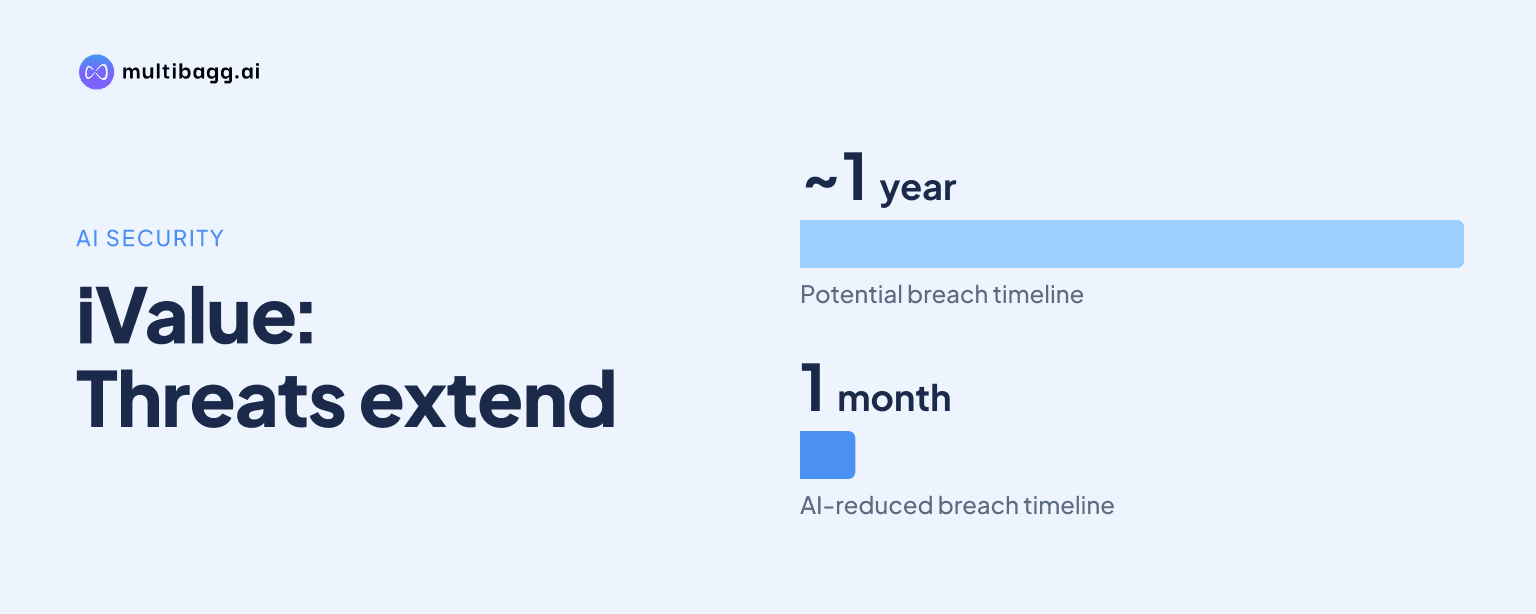
iValue Infosolutions Limited says AI-driven threats can support longer-term cybersecurity demand because a potential breach timeline may shrink from about one year to one month or even two days. Management said on November 05, 2026 that recent breaches are deepening customer engagement, although they do not necessarily trigger immediate budget increases or software purchases.
Know Ivalue Infosolutions inside out
Results, valuation, peers and who's buying, in one view.
Why does iValue see a longer-term cybersecurity demand tailwind?
iValue sees a longer-term opportunity because the threat landscape and the security tools used to address it are both changing. On the November 05, 2026 earnings call, managing director Sunil Pillai described cybersecurity as a continuing catch-up process in which breaches may occur despite customer protections and require new controls, configurations or implementation work.
Management did not identify a single cybersecurity product category that would benefit first. Pillai said cybersecurity covers multiple products and solutions, and iValue could not yet pinpoint the segment where the opportunity would emerge. The stated mechanism is broader: customers must locate gaps, activate technology features and update protections as threat methods evolve.
The outlook extends beyond spending delayed by hardware inflation. In discussing fiscal 2028, Pillai said new technology and market changes could create a larger tailwind than deferred purchases alone. An analyst had suggested that both breach-related demand and technology-refresh spending postponed by higher hardware prices could support that later period.
How are cyber breaches affecting iValue's customer engagement?
iValue said recent breaches are increasing engagement with customers, but they can also interrupt procurement. Pillai referred to four or five recent incidents affecting Europe and India and said customers were talking to iValue while the company was also approaching them after reports of an incident became public.
That engagement does not automatically result in a faster sale. Pillai said one expected deal was postponed after an incident at the customer organisation. Customers may undertake forensic work and consult multiple agencies to determine what happened before they close vulnerabilities, which can shift attention away from an existing purchasing decision.
For iValue's enterprise customer base, management said the issue is often implementation rather than the simple absence of security software. Pillai said customers generally have technologies, checks and balances, and IT teams that can handle incidents; a breach can occur if a feature has not been activated or an implementation was not completed properly.
This makes systems integrators, or SIs, part of the demand mechanism. Management said strong implementation through SIs can prevent breaches, while remediation may include enabling technology features already available to a customer. The commercial effect can therefore include services, configuration and deployment activity rather than only a new software purchase.
How is AI changing iValue's security opportunity?
iValue said AI has amplified cyber risk by reducing the time needed for a malicious actor to attempt a network breach. Pillai said an attack scenario that may once have taken about a year could now take one month or even two days, bringing prospective threats closer to customers more quickly.
Management expects this acceleration to provide an uplift to iValue's business, but did not quantify an AI-security revenue target or a near-term sales forecast. Customers are conducting proofs of concept, or POCs, in their own environments and assessing guardrails that could mitigate the use of AI to breach a network.
The relevant opportunity includes both security for AI and AI for security, according to management. Pillai compared the current stage of AI adoption with the early phase of cloud adoption, when customers were still working out practical use cases. That uncertainty supports preparation activity but does not establish that each customer will make an immediate incremental purchase.
Management also said the Indian market is not directly comparable with the United States or Europe. India typically accounts for about 1% to 2% of an original equipment manufacturer's, or OEM's, global revenue, while pricing in India and Asia can be about 25%, 30% or 40% lower than in the United States and Europe.
Got a follow-up? Ask IRIS
What role can cloud and hybrid deployments play for iValue?
iValue said cloud adoption is occurring in a hybrid model, creating a further route for cybersecurity demand. Management said the company is signed with one hyperscaler, rather than all three, and described that business as growing while still at an early stage of development.
The company is running a specific commercial motion around workloads moving from on-premise systems to the cloud in a hybrid model. Management said it had put resources behind this motion and expected some results in coming quarters, although it did not provide a billing target or revenue contribution for the hyperscaler relationship.
Most of iValue's OEMs have cloud-ready solutions, management said. Cloud-native security solutions are expected to sit within cybersecurity, while the separate hyperscaler motion addresses the broader transition of workloads. This means the cloud opportunity spans both security products and the implementation of a hybrid operating model.
What could delay iValue's security demand conversion?
iValue said hardware-cost inflation and customer budgets can defer technology-refresh spending. Customers that have completed five or six years on existing systems may be due for a refresh, but management said some had postponed purchases after making heavy hardware buys at elevated prices.
Management expects deferred refreshes to move to a subsequent year because renewal is part of what it called technology hygiene. The comparison is between a current-year delay and continuing underlying need: the refresh requirement remains, but the billing date may shift. iValue did not say breach-related demand would fully offset present budget constraints.
Large-deal conversion is another timing variable. iValue defines a large deal as above Rs 100 crore and said it generally completes at least two to three such transactions a year. Management said it was working on more than six to seven large opportunities, with around five to six in the pipeline and some progressing through documentation after the partner was named L1.
Management said it was positive about fiscal 2027's third and fourth quarters and expected the large-deal pipeline to help achieve second-half numbers. However, it also said pressure in banking, financial services and insurance, or BFSI, could delay or defer deals, leaving customer budgets, procurement and purchase orders central to timing.
Conclusion
iValue's message is that AI is accelerating the cyber threat environment and that breaches are prompting deeper customer discussions. The opportunity is presented as a sustained demand tailwind involving AI guardrails, security tools, hybrid-cloud workloads, feature activation and implementation quality, rather than a uniform rush for additional software after every incident.
The next indicators are the results from iValue's hyperscaler motion in coming quarters and the conversion of its five to six large deals during the second half of fiscal 2027. Management also identified postponed five- to six-year technology refreshes as a potential subsequent-year driver, while saying it cannot yet identify the cybersecurity solutions that will benefit first.