










iValue reports 23% gross-sales CAGR and 28% PAT CAGR over decade
Key highlights
- iValue reported FY26 gross sales of Rs 2,914 crore, up from Rs 457 crore in FY17.
- iValue stated a 10-year gross-sales CAGR of 23% and PAT CAGR of 28% through FY26.
- iValue’s FY26 PAT was Rs 102 crore, compared with Rs 10 crore in FY17.
- Cybersecurity represented 48% of iValue’s H1 FY27 gross sales billed to customers.
powered by IRIS
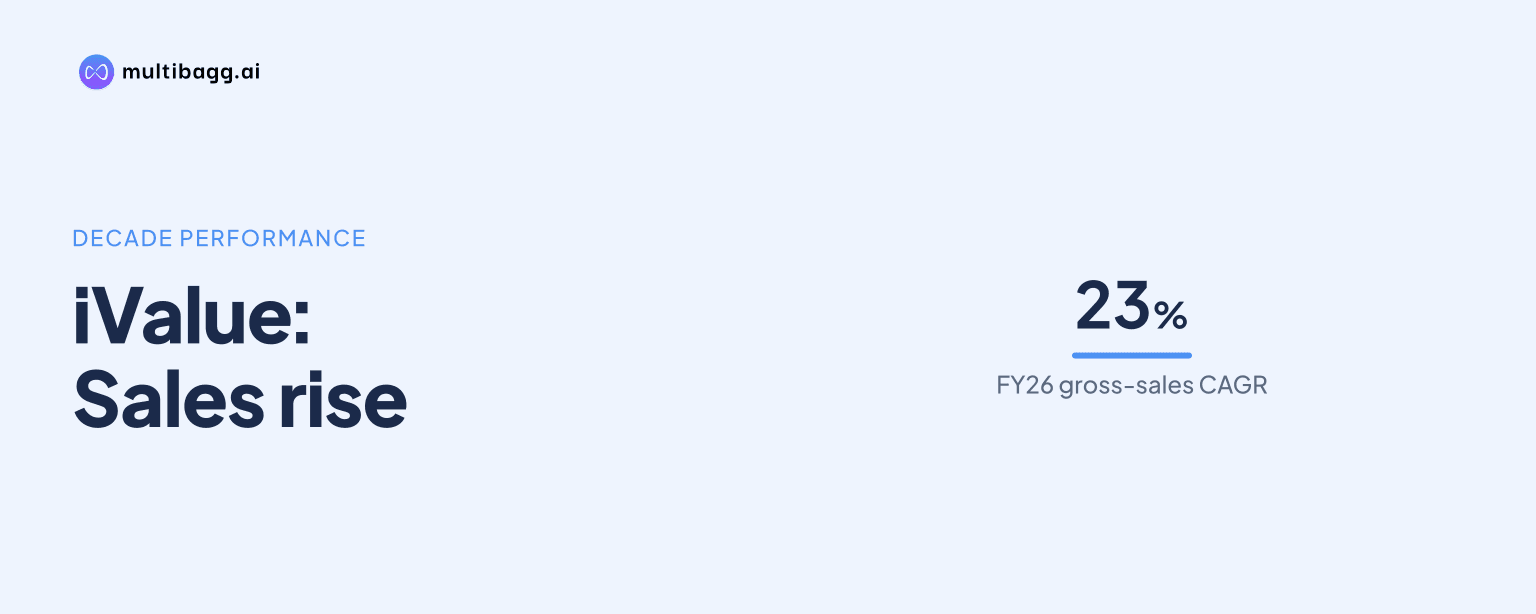
iValue Infosolutions Ltd. reported that gross sales rose at a 23% 10-year compound annual growth rate, or CAGR, and profit after tax, or PAT, at a 28% CAGR through FY26, as gross sales increased from Rs 457 crore in FY17 to Rs 2,914 crore and PAT from Rs 10 crore to Rs 102 crore.
Know Ivalue Infosolutions inside out
Results, valuation, peers and who's buying, in one view.
What was iValue’s long-term sales and profit growth?
iValue’s reported 10-year growth record shows PAT expanding faster than gross sales, with the company stating a 28% PAT CAGR against a 23% gross-sales CAGR. Over the FY17 to FY26 series, gross sales increased by Rs 2,457 crore, while PAT increased by Rs 92 crore. The presentation identifies these as its 10-year CAGR measures, based on the annual financial figures shown through FY26.
The annual series also shows growth in both measures in every financial year listed. Gross sales moved from Rs 457 crore in FY17 to Rs 526 crore in FY18 and Rs 712 crore in FY19, before reaching Rs 939 crore in FY21. PAT rose from Rs 10 crore in FY17 to Rs 18 crore in FY18, Rs 26 crore in FY19 and Rs 36 crore in FY21, providing the base for the subsequent scale-up.
How did iValue’s growth change across the decade?
iValue’s growth accelerated in absolute rupee terms in the later years of the series, particularly after FY21. Gross sales added Rs 357 crore between FY21 and FY22, Rs 515 crore between FY22 and FY23, and Rs 299 crore between FY25 and FY26. PAT increased by Rs 1 crore in FY22, then by Rs 23 crore in FY23 and by Rs 17 crore in FY26, compared with Rs 5 crore added in FY20.
The contrast between FY21 and FY26 illustrates the change in scale. Gross sales were Rs 939 crore in FY21 and Rs 2,914 crore in FY26, while PAT was Rs 36 crore and Rs 102 crore, respectively. FY23 was another notable step in the disclosed record, with gross sales reaching Rs 1,811 crore and PAT reaching Rs 60 crore, versus Rs 1,296 crore and Rs 37 crore in FY22.
How has iValue broadened its technology-solutions business?
iValue describes its development as a move from specialised security and data-centre offerings to an end-to-end technology solutions and services aggregator. The company started in 2008 and says it has made 18 years of continuous gross-sales and PAT growth. It operates as a link between original equipment manufacturers, or OEMs, system integrators, or SIs, and enterprise customers.
The disclosed milestones show how the offering widened over time. iValue launched a banking, financial services and insurance, or BFSI, practice in FY15; expanded to more than 30 OEM partners in FY18; entered Southeast Asia and established iAcademy in FY21; and acquired ASPL in FY21 to build hybrid multi-cloud capabilities spanning managed security, information-technology and infrastructure services. In FY24 it launched a Centre of Excellence, or CoE, and onboarded Google Cloud as an OEM.
The more recent steps focus on newer deployment and solution categories. iValue launched AIM solutions and a services partnership with ASPL in FY23, introduced specific solutions for digital-native-focused channel partners in FY25, and added artificial-intelligence security and AI infrastructure offerings through an AI-enabled CoE in FY26. In H1 FY27, it listed public cloud, software-as-a-service, or SaaS, offerings and hyperconverged infrastructure solutions among its additions.
Got a follow-up? Ask IRIS
Which technology segments made up iValue’s H1 FY27 sales?
iValue’s H1 FY27 gross sales were led by cybersecurity at 48%, with data centre infrastructure and application lifecycle management, or ALM, cloud and others each accounting for 19%, and information lifecycle management, or ILM, contributing 14%. The segment shares are percentages of total gross sales billed to customers during H1 FY27, rather than a measure of profitability by segment.
Cybersecurity includes cloud, application and network security, plus data security, endpoint security, authentication and security information and event management, or SIEM. The 19% data-centre-infrastructure category includes private, public and hybrid clouds, edge data centres, hyperconverged infrastructure, software-defined data centres and storage and recovery capabilities. ILM covers storage, data protection, monitoring, classification, backup, recovery and archival solutions.
The remaining 19% ALM, cloud and others category includes hybrid-cloud management, database services, DevOps, DevSecOps, application programming interface security and data and security lakes. iValue also states that it provides associated professional services. This four-segment mix places nearly half of H1 FY27 billed gross sales in cybersecurity, while the other 52% was distributed among ILM, infrastructure and cloud-related offerings.
What did iValue report for H1 FY27?
iValue reported H1 FY27 gross sales of Rs 1,372.8 crore, operating earnings before interest, tax, depreciation and amortisation, or EBITDA, of Rs 51.5 crore, and PAT of Rs 39.1 crore. Compared with the prior-year period, the presentation reported gross sales down 8.1%, operating EBITDA down 14.7% and PAT down 2.4%, making the half-year comparison different from the expansion shown across FY17 to FY26.
The H1 FY27 snapshot also reported 53.5% annuity business, 48 working-capital days, 119 OEM partners and a cash position adjusted for debt of Rs 124 crore. Adjusted return on capital employed, or ROCE, was 22.9%; iValue defines adjusted capital employed as tangible net worth plus total net debt, reduced by deferred-tax assets. These disclosures give operating context but do not provide segment-level profits or a full explanation for the year-on-year changes.
Conclusion
iValue’s disclosed history shows a business that expanded gross sales from Rs 457 crore in FY17 to Rs 2,914 crore in FY26 while increasing PAT from Rs 10 crore to Rs 102 crore. Management’s stated 23% gross-sales CAGR and 28% PAT CAGR align with a progression from focused security and data-centre solutions toward a broader portfolio including services, hybrid cloud, public cloud and AI-related offerings.
The next disclosed areas to watch are iValue’s plan to expand its CoE into an AI validation and interoperability hub, and its work on AI infrastructure, AI data platforms, AI operations and AI security. H1 FY27 also introduced public-cloud, SaaS and hyperconverged-infrastructure offerings, while reported gross sales were down 8.1% year on year, providing the context for future updates on those offerings and the existing segment mix.